
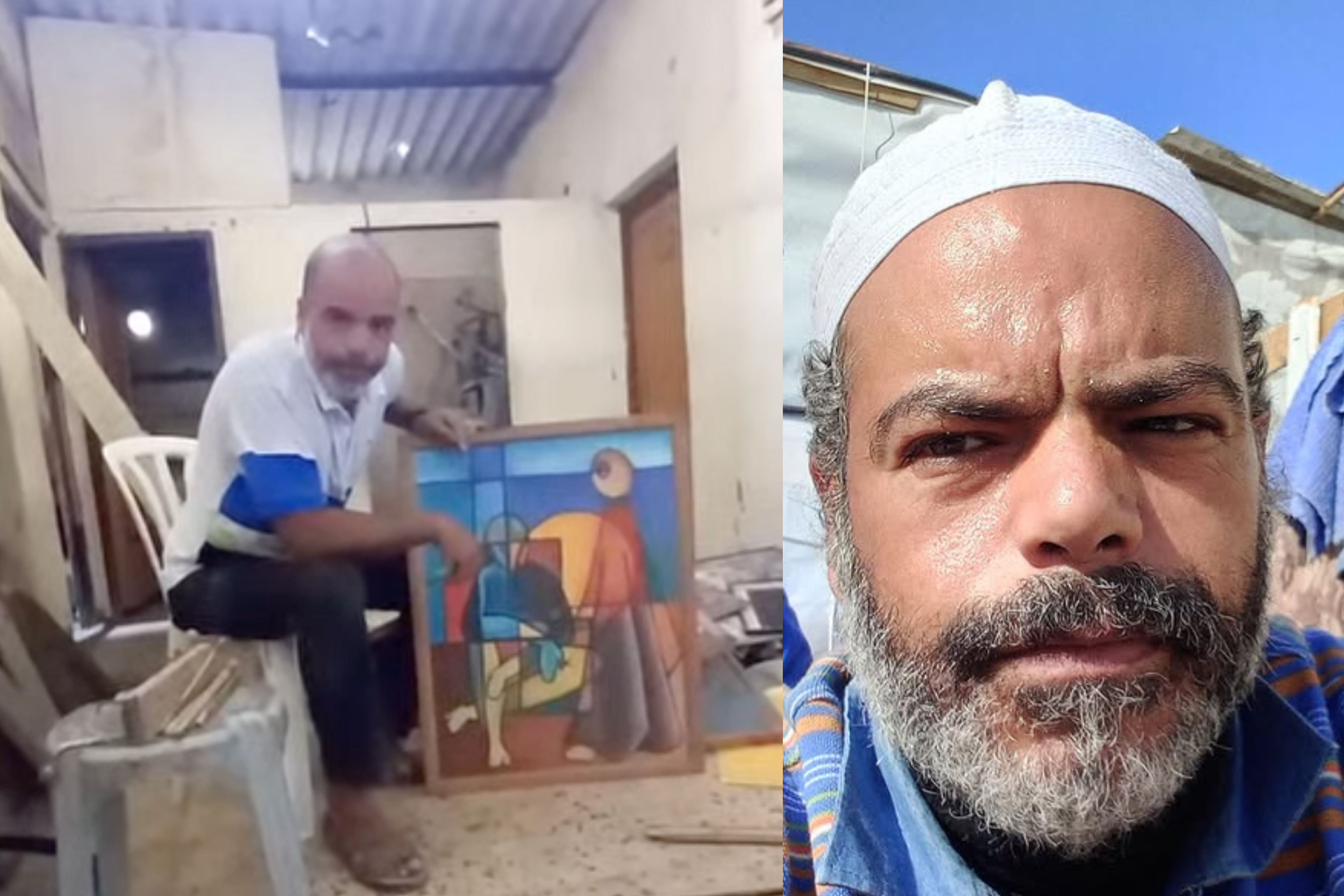
War often dominates headlines with numbers such as casualties, destruction, and aid shortages, but the personal toll is just as devastating. In Gaza, daily life has been reduced to survival, with families facing choices no one should ever have to make. One local artist recently burned his own paintings for firewood. This heartbreaking act shows how conflict strips away not only safety and comfort but also the simple joys and expressions of life.
A Gaza Artist’s Painful Choice
In a small, dimly lit room in Gaza, Palestinian artist Taha Hussein Abu Ghali takes apart his own paintings, breaking the wooden frames to use as firewood. A video of the moment shows him dismantling the vibrant pieces he once poured his energy into. Portraits of children, abstract scenes, and colorful stories now feed a small cooking fire.
“We cannot find flour or anything to cook with. These are some of my favorite paintings, portraits of children, colors, and stories. All gone, burned to survive,” Abu Ghali says in the clip as his wife tends a small pot over the fire.
For Abu Ghali, every piece represented hours of labor and moments of inspiration. Now, in a city under blockade where 2.2 million residents face extreme shortages, his artwork has become fuel for survival. His experience reflects the reality of many families in Gaza, where life has been stripped to its essentials.
International aid organizations, including Doctors Without Borders, Save the Children, and Oxfam, have issued warnings of widespread hunger in the area. The director general of the World Health Organization, Tedros Adhanom Ghebreyesus, described the situation plainly. He stated that he did not know what else to call it except “mass starvation,” emphasizing that it is entirely man-made.
Abu Ghali’s decision to burn his art is a quiet statement on survival. When basic needs are no longer met, even the most personal expressions of beauty and creativity can become a last resource.
The Artist Who Burned His Paintings
Taha Hussein Abu Ghali’s life as an artist began long before the current crisis forced him to make unthinkable choices. A graduate of Al Aqsa University in Gaza, he developed a passion for figurative surrealism, combining abstract and cubist elements to explore themes of identity, childhood, and memory. His workshop often reflected the emotional reality of life under siege, turning both personal and collective experiences into vivid visual stories.
In addition to painting, Abu Ghali works as an art teacher and explores the use of art therapy to support mental health. He has used creative expression as a way to help others cope with trauma. His commitment to education and community projects made him more than just an artist. He became a preserver of cultural memory, offering a sense of normalcy and hope through art in a place where both are fragile.
His studio was once a refuge, a space where color and imagination thrived despite the constant backdrop of conflict. Each piece he created took hours of careful work, often completed under extremely challenging conditions with limited materials. His journey shows the determination of artists who continue to create in environments where making art itself is an act of resistance against despair.
The Humanitarian Crisis in Gaza
Taha Abu Ghali’s act of burning his own paintings reflects a crisis far larger than any single family’s struggle. Across Gaza, hunger, displacement, and the breakdown of basic infrastructure have reached life-threatening levels, and survival often comes at the cost of dignity and culture.

According to the British Red Cross and the Palestine Red Crescent Society (PRCS), 470,000 people, or 22 percent of Gaza’s population, are on the brink of starvation. Cases of severe child malnutrition are increasing rapidly. Field hospitals in Rafah report treating infants so weak they collapse in their sleep. Medics are performing up to 40 emergency procedures a day despite extreme shortages of medicine, fuel, and food. With 70 percent of Gaza’s water infrastructure destroyed, families often rely on contaminated water, which has led to outbreaks of hepatitis, diarrhea, and other preventable illnesses.
In northern Gaza, the conditions are even worse. BBC reporting has documented families grinding animal feed into flour to survive, while others subsist on rice alone. Mahmoud Shalabi, a medical aid worker in Beit Lahia, explained, “What we had was actually from the six or seven days of truce [in November], and whatever aid was allowed into the north of Gaza has actually been consumed by now. What people are eating right now is basically rice, and only rice.”
Residents have been filmed digging through rubble to access broken water pipes. One mother walked six miles searching for food after her children went three days without eating. The World Food Programme warns that without regular and secure aid deliveries, famine is almost inevitable. WFP regional chief Matt Hollingworth stated, “We know there is a very serious risk of famine in Gaza if we don’t provide very significant volumes of food assistance on a regular basis.”
Missions to northern Gaza are frequently denied, leaving 300,000 residents largely isolated from lifesaving support. Convoys face weeks-long delays or nearby shelling, and medical supplies continue to run out. Currently, 47 percent of hospital medications are unavailable, and treatments for chronic diseases are completely depleted. The human toll continues to rise, with more than 52,000 people killed and 118,000 injured since the escalation began. Ninety percent of the population has been displaced, many multiple times, while mass-casualty incidents surge and field hospitals operate far beyond capacity.
While Israeli authorities deny the presence of famine, stating there is “no starvation in Gaza” and attributing shortages to Hamas, the World Health Organization and multiple humanitarian organizations describe the crisis as “man-made mass starvation.” They stress that unrestricted and consistent aid is the only way to prevent a full-scale famine.
Supporting With Care: How You Can Make a Difference
Stories like Taha Abu Ghali’s remind us that conflict affects more than survival. It takes a toll on emotional well-being and cultural identity. While we cannot change the situation overnight, we can take steps to support responsibly and compassionately.

- Support Trusted Humanitarian Organizations
Contributing to organizations that are already on the ground is one of the most effective ways to help. Groups like the Palestine Red Crescent Society, the International Committee of the Red Cross, the World Food Programme, and Doctors Without Borders (MSF) deliver food, medical care, and shelter directly to those in crisis. Verify the organization before donating to ensure your help reaches those who truly need it. - Share Stories Responsibly
If you feel moved to share Abu Ghali’s story or others like it, add context. Include credible details from verified sources, such as UN reports or humanitarian updates. This helps your audience understand the full humanitarian picture rather than reacting to isolated emotional clips. - Help Preserve Cultural Memory
Artists like Abu Ghali carry the stories of their people. When art is lost, part of that history disappears. Supporting campaigns that document, digitize, or protect displaced artwork ensures that these narratives live on even during times of crisis. You can amplify these efforts by following and promoting cultural preservation initiatives from museums, nonprofits, and heritage organizations. - Raise Awareness and Encourage Action
Contacting your local representatives, supporting awareness campaigns, or participating in online advocacy can amplify the voices of those in crisis. Public awareness and pressure can often help improve aid access and policy decisions. - Stay Informed and Share Accurate Information
Educate yourself using credible news sources and avoid sharing unverified social media content. Spreading accurate information supports humanitarian efforts, while misinformation can unintentionally harm aid delivery and the people who need help most.
By taking even small steps with care, you can contribute to both immediate relief and the preservation of human stories that might otherwise be lost in the headlines.
When Beauty Burns
Taha Abu Ghali’s story is not only about an artist burning his paintings. It reflects a community where memory, art, and beauty have become luxuries in the struggle to survive. Each frame that disappeared into the fire carried years of effort and a piece of Gaza’s cultural identity, sacrificed so his family could eat for one more day.
Gaza’s crisis is often reduced to statistics: tens of thousands of lives lost, hundreds of thousands displaced, and nearly half a million on the brink of starvation. Yet numbers cannot capture the quiet devastation of a father taking apart his own heritage, or the way conflict strips life of its color one piece at a time.
Abu Ghali’s story urges us not just to watch, but to respond. It is a call to support verified humanitarian work, to protect culture where it still survives, and to ensure that survival does not erase a people’s memory. In Gaza, even art can burn, but the responsibility to remember and the choice to act belong to all of us.
Featured Image from @art_taha_husien on Instagram
