
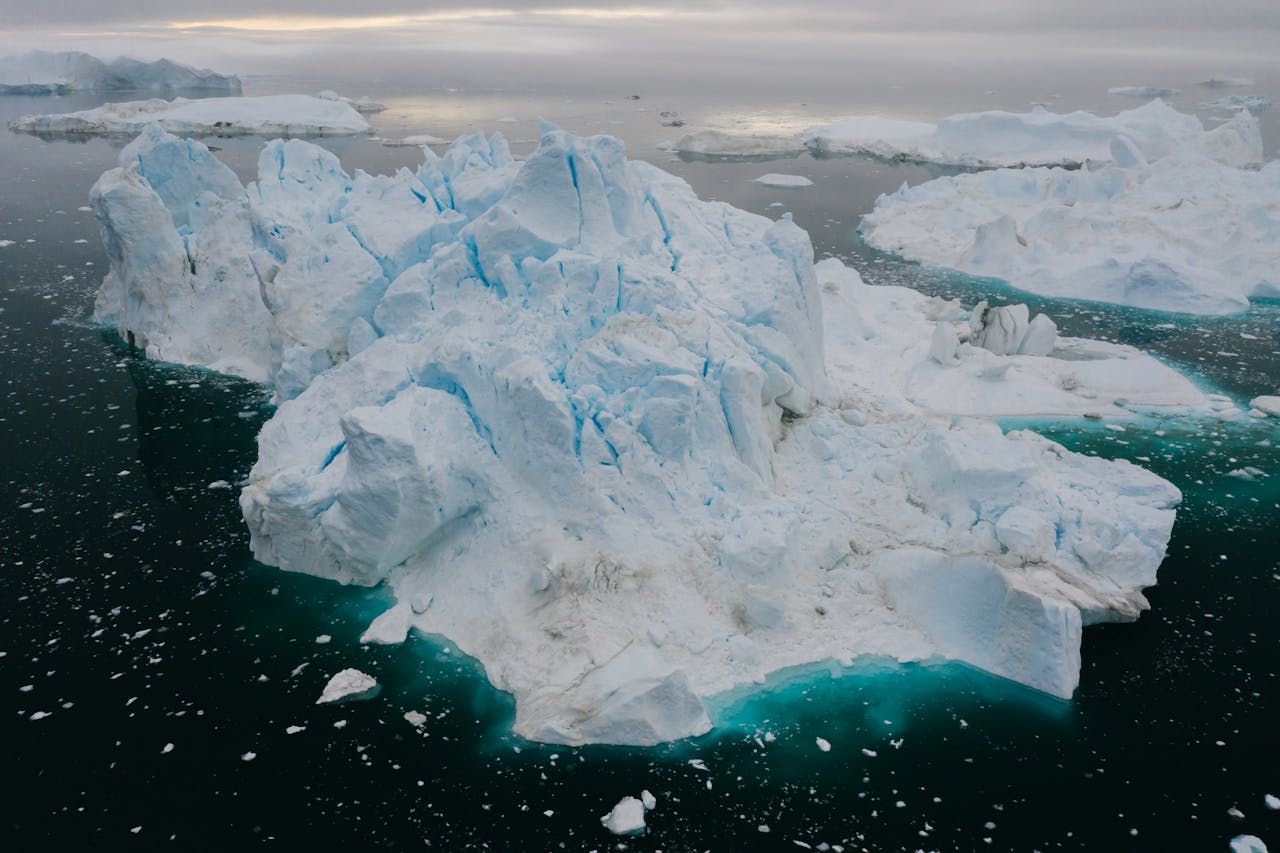
What does it mean when a block of ice the size of a city begins to drift after nearly forty years of stillness? The iceberg known as A23a has broken free in the Southern Ocean, so massive it can be tracked from space. Beyond its size, scientists see it as a signal—an early warning of how quickly Antarctica is changing, and how those shifts may reach far beyond the frozen continent.

From Stillness to Drift
When A23a broke away from Antarctica in 1986, it didn’t immediately set off on a long voyage. Instead, its sheer size anchored it to the seafloor for decades. Only recently did it begin to move northward, entering warmer waters and stronger currents that are slowly wearing it down. Covering about 1,400 square miles and taller than London’s Shard, it is now large enough to be tracked easily by satellite. Pools of meltwater visible on its surface show that the iceberg is gradually weakening.
Researchers are watching its next steps closely. Dr. Andrew Meijers, a physical oceanographer at the British Antarctic Survey, explained: “The iceberg A23a is now moving with the prevailing current towards the island of South Georgia, after having been ‘trapped’ spinning around a submarine mountain for several months further south. The iceberg, at least in satellite images, appears to be maintaining its structure and has not yet broken up into smaller chunks, as previous ‘megabergs’ have done. It is presently in a meander of the current and not moving directly towards the island, but our understanding of the currents suggest that it is likely to again move towards the island soon. The current follows the shallow continental shelf around the island to the south east. But the question is whether the berg will follow this out into the open South Atlantic, or run up onto the shelf and become stuck for some time.”
The risks extend beyond its massive size. South Georgia, a remote island in its path, is home to vast colonies of penguins and seals that depend on nearby feeding grounds. Professor Geraint Tarling of the British Antarctic Survey warned: “An iceberg grounding close to South Georgia could result in them having to make large diversions to their feeding grounds and not getting back to their young in time.”
After nearly forty years of stillness, A23a’s release into open waters highlights a sobering truth: Antarctic ice, once considered stable, is now increasingly vulnerable to change.
The Fragility of Antarctica’s Balance
Antarctica was once thought to be a slow responder to climate change. That assumption no longer holds. Recent research shows that the continent is undergoing rapid and compounding changes—shifts that are harder to predict than what scientists have observed in the Arctic. The drifting of A23a is just one visible sign of a larger pattern of instability across ice, oceans, and ecosystems.

A study published in Nature by the Australian National University and the University of New South Wales described these shifts as “rapid, interacting and sometimes self-perpetuating changes.” Lead author Dr. Nerilie Abram warned that “other changes to the continent could soon become unstoppable, including the loss of Antarctic ice shelves and vulnerable parts of the Antarctic ice sheet that they hold behind them.” When shelves collapse, the glaciers behind them no longer have support, accelerating their flow into the ocean and raising sea levels worldwide.
The study also pointed to the far-reaching consequences of Antarctic change. Co-author Professor Matthew England explained: “These include rising sea levels that will impact our coastal communities, a warmer and deoxygenated Southern Ocean that’s less able to remove carbon dioxide from the atmosphere… and increased regional warming from Antarctic sea ice loss.” These processes feed into one another, creating feedback loops that accelerate warming and make the climate crisis harder to manage.
What makes this situation more urgent is that even small rises in temperature—fractions of a degree—can trigger these tipping points. Unlike the Arctic, Antarctica has fewer long-term observations, leaving many of its feedbacks less understood. But one fact is clear: the changes are not distant or gradual. They are abrupt, escalating, and tied to decisions humanity makes today about energy, emissions, and environmental protection.
When an Iceberg Disturbs the Food Chain
The journey of A23a is reshaping more than the Antarctic seascape. Its movement northward threatens ecosystems that depend on consistency and access to open waters. South Georgia Island, directly in its path, is a breeding ground for penguins, seals, seabirds, and whales. These animals must reach the ocean regularly to feed, and a blocked route can mean adults fail to return in time to care for their young. In a single season, an entire generation of wildlife can be placed at risk.
The disruption is not limited to wildlife. Human activity in the area is also affected. Ecologist Mark Belchier told the BBC that “if it breaks up, the resulting icebergs are likely to present a hazard to vessels as they move in the local currents and could restrict vessels’ access to local fishing grounds.” This means fishing industries, and the communities they support, may also experience direct consequences.

The impact extends much further than the island. As giant icebergs melt, they release large volumes of freshwater, altering the temperature and salinity of the ocean. These shifts can weaken thermohaline circulation—a global system that helps regulate climate by moving heat and nutrients through the seas. The Southern Ocean is particularly important because it absorbs carbon dioxide from the atmosphere. As warming continues and ice loss accelerates, that absorption weakens, leaving more heat-trapping gases in the air.
Even the smallest organisms feel the effects. Antarctic krill, which form the foundation of the marine food web, depend on sea ice for breeding. When ice melts earlier each year, krill populations decline, setting off a chain reaction that affects fish, seals, whales, and penguins.
The story of A23a shows how one iceberg can reveal the fragility of global systems. A single shift in Antarctica reverberates through the ocean, the food chain, and human life thousands of miles away.
How Polar Change Reaches Every Shore
At first glance, the drift of A23a seems like a distant event. But Antarctica is not an isolated world—it is a critical part of the Earth’s climate system, and its instability is already influencing human life. Coastlines, food systems, and weather patterns all feel the effects of what happens at the poles.
A study in Nature by the Australian National University and the University of New South Wales warns that the collapse of Antarctic ice shelves could raise global sea levels by more than five meters. This would redraw coastlines worldwide, placing millions of people in cities from Manila to Miami at risk of displacement.
The risks go well beyond flooding. Professor Matthew England, a co-author of the study, explained: “A warmer and deoxygenated Southern Ocean that’s less able to remove carbon dioxide from the atmosphere.” Because this ocean currently absorbs a large share of global carbon emissions, a weakening in its capacity means more carbon dioxide remains in the air, driving further warming.
Australia provides a glimpse of what this future looks like. Rising seas are already threatening infrastructure, while heatwaves, droughts, and wildfires have become more common and more severe. Dr. Nerilie Abram, lead author of the study, observed: “As sea ice is lost from the ocean surface, it is also changing the amount of solar heat being retained in the climate system.” This process intensifies warming locally and feeds into global instability.
The consequences extend across systems: lower oxygen in oceans reduces fish stocks, shifting rainfall patterns affect agriculture, and rapid ice loss increases stress on geological structures, raising the risk of natural hazards. What begins in Antarctica does not stay in Antarctica—it spreads outward in waves that touch every community.
Climate Change and the Body
The collapse of Antarctic ice may feel like a problem for distant ecosystems, but its effects reach into the most personal dimension of life: health. Rising seas, shifting weather, and altered oceans create conditions that change how our bodies live, breathe, and function.
Flooding from sea-level rise increases the risk of contaminated drinking water, creating outbreaks of waterborne illness. Storm surges and saltwater intrusion also damage sanitation systems and farmland, making it harder for communities to secure clean water and healthy food.
Shifts in temperature and rainfall influence the spread of infectious diseases. Warmer conditions allow mosquitoes and ticks to expand into new regions, exposing populations to illnesses like dengue and malaria in areas where they were once rare. These changes place added strain on public health systems that are already under pressure.

Air quality is also shaped by climate instability. Hotter and drier conditions, combined with wildfire smoke, worsen respiratory diseases such as asthma. For vulnerable groups—including children, older adults, and people with existing conditions—these changes can be life-threatening.
Mental health is equally important. Living with climate instability contributes to stress and anxiety, sometimes referred to as “eco-anxiety.” For many, the knowledge that change is accelerating can lead to sleep disturbances, heightened worry, or feelings of helplessness. Recognizing these responses is the first step toward managing them, and connecting with community or supportive practices can help reduce their weight.
What happens in Antarctica is not abstract. It is a reminder that the health of the planet is inseparable from the health of the body. Protecting one is part of protecting the other.
Protecting Earth, Protecting Ourselves
The journey of A23a is more than a story about ice. It shows how quickly the systems we once thought were stable can shift, and how those shifts ripple into human life. From rising seas to food security, from the spread of disease to the air we breathe, Antarctica’s changes remind us that planetary health and human health are inseparable.
Addressing climate change is not only about protecting distant ecosystems. It is about safeguarding clean water, nutritious food, stable homes, and peace of mind. It is about ensuring that future generations inherit a planet capable of sustaining life.
Each action—whether scientific, political, or personal—becomes part of this shared effort. The iceberg’s drift is a signal. The real question is how we choose to respond.

.jpg)
.gif)