
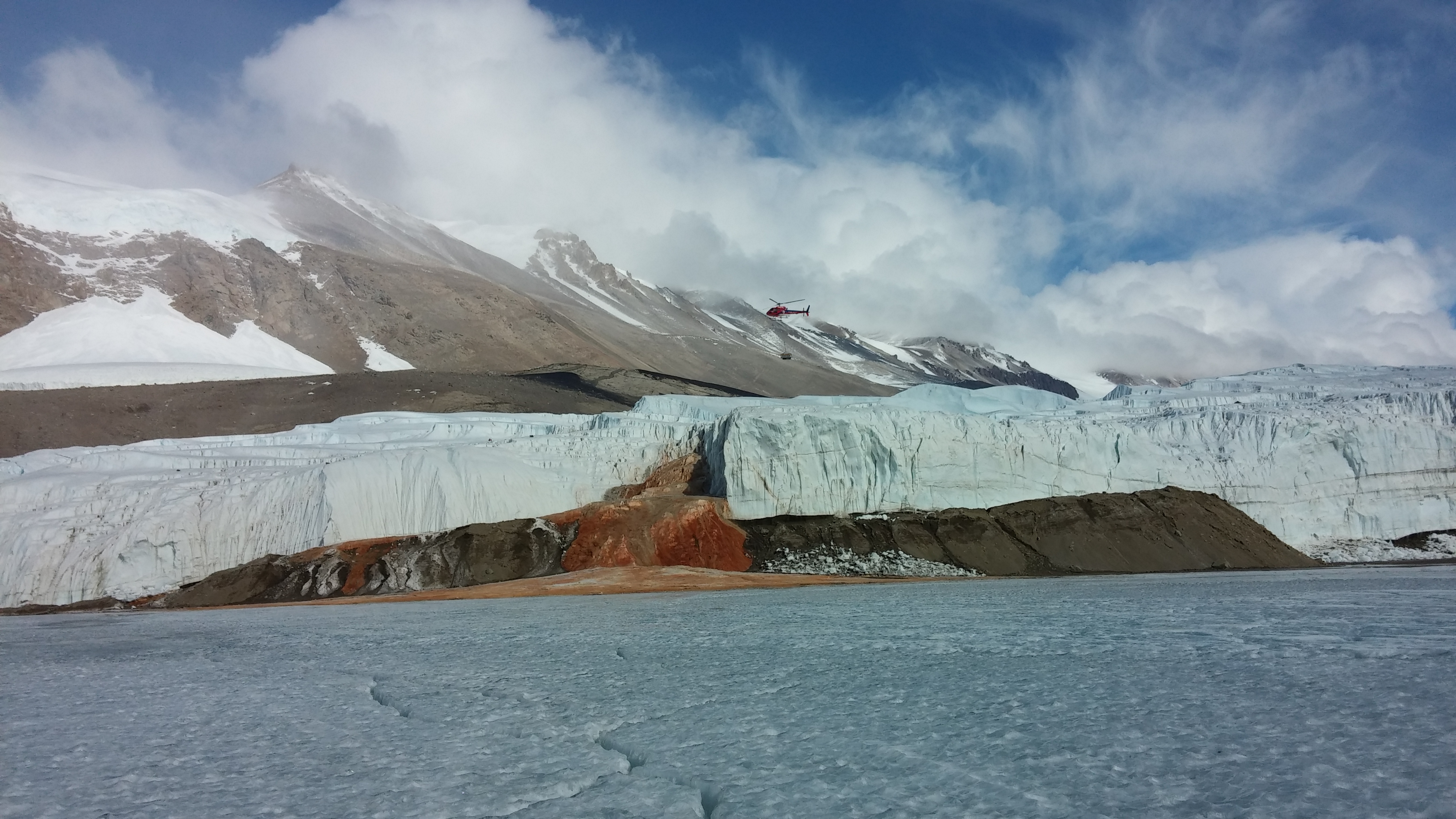
Hidden in East Antarctica, a startling sight breaks through pristine white ice. Vivid red water pours from Taylor Glacier, creating a scene so unusual it earned its name: Blood Falls. First spotted in 1911, this crimson cascade has puzzled scientists for over a century. Most liquids freeze solid in Antarctica’s harsh environment, yet this strange waterfall flows unpredictably, defying expectations.
More surprisingly, research shows microscopic life forms exist in this extreme setting, adapting in ways that challenge our understanding of survival limits. Scientists have made progress unraveling some aspects of this phenomenon, but key mysteries remain unsolved about its sudden bursts and liquid persistence in freezing conditions. Modern technologies bring new insights, but Blood Falls carefully guards its secrets, offering a rare glimpse into Earth’s most unusual natural features and possibly clues about life beyond our planet.
Nature’s Crimson Surprise in Antarctica
In 1911, Antarctic explorer Griffith Taylor first documented a strange, red-stained outflow from the pristine white ice of Taylor Glacier. The sight was so striking that it became known as Blood Falls. Initially, scientists speculated that red algae or other biological factors caused the coloration, but further research revealed a different explanation: the water is rich in iron, which oxidizes upon exposure to air, producing a rust-like effect.
Modern studies, led by glaciologists like Chris Carr from Los Alamos National Laboratory, have uncovered more details about this unusual flow. Unlike typical glacier melt, Blood Falls does not follow a predictable schedule. It emerges in sudden bursts, sometimes flowing for hours before stopping again. Researchers suspect that internal pressure fluctuations in the glacier’s subglacial brine reservoir play a role, but the precise mechanism remains elusive.
Despite the harsh Antarctic conditions, scientists continue to study this phenomenon, setting up specialized monitoring equipment to track flow patterns and chemical changes. Blood Falls challenges long-standing assumptions about ice-bound water systems and provides valuable insights into how liquid water can persist in extreme environments.
Liquid Water Defying Antarctic Freeze
Blood Falls stands out as one of Antarctica’s most unusual features because its water remains liquid despite subzero temperatures. Scientists have discovered that a hidden saltwater reservoir beneath Taylor Glacier feeds this intermittent flow. The brine’s extremely high salinity—five times saltier than ocean water—lowers its freezing point, allowing it to remain liquid even in Antarctica’s frigid climate.
This underground reservoir is thought to be a remnant of an ancient seawater body trapped millions of years ago when shifting ice sheets isolated it from the ocean. Over time, the water became increasingly concentrated in salt and iron, forming a unique subglacial environment.
The brine moves through tiny fractures and channels within the glacier, pushed upward by pressure changes in the ice. While scientists have made progress in mapping these hidden pathways using radar and remote sensing tools, directly observing the flow remains a challenge due to the delicate and isolated nature of the system.
Iron Chemistry Creating Blood-Red Illusion

Despite its eerie appearance, Blood Falls contains no actual blood. Its distinctive red color comes from iron-rich brine that has been trapped beneath Taylor Glacier for millions of years. As the brine reaches the surface and comes into contact with oxygen, a chemical reaction occurs: iron in the water oxidizes, creating iron oxide—commonly known as rust. This process is similar to how metal exposed to moisture develops a reddish hue over time.
Early theories suggested that red algae might be responsible for the coloration, but laboratory analysis of water samples disproved this idea. Instead, researchers found that each new outflow carries fresh iron-rich brine, ensuring that Blood Falls maintains its vivid appearance rather than fading over time. Scientists have even replicated this process in controlled environments, confirming that oxidation is the key factor behind the striking coloration.
Winter Flows Baffling Scientific Expectations
One of the most perplexing aspects of Blood Falls is its occasional winter outflows, despite extreme Antarctic temperatures that plunge far below freezing. Unlike most surface water, which remains frozen for months during the polar night, Blood Falls sometimes releases liquid brine even in the harshest conditions.
To better understand this phenomenon, scientists installed seismic monitoring equipment to detect small earthquakes or ice movements that might trigger the flow. While some shifts in the glacier’s position were recorded, none directly aligned with the timing of outflows.
According to Erin Pettit, a glaciologist at Oregon State University, one leading theory suggests that pressure changes deep within the subglacial brine reservoirs periodically force water upward through cracks in the ice. Another possibility is that even subtle seasonal temperature variations—despite their minimal impact—could influence water movement within the glacier.
To track these unpredictable flows, research teams now use year-round monitoring systems, including time-lapse cameras and pressure sensors. These instruments help scientists respond more quickly when new outflows begin, providing crucial data on the forces driving Blood Falls’ mysterious behavior.
Microbe Communities Surviving Without Sunlight

Blood Falls is not just a geological anomaly—it also harbors a hidden ecosystem of resilient microorganisms. Unlike most life on Earth, which relies on sunlight for energy, these microbes survive in complete darkness by using chemosynthesis. Instead of photosynthesis, they extract energy from iron and sulfur compounds found in the briny water beneath Taylor Glacier.
DNA analysis of water samples has revealed that these microbes have evolved unique adaptations to withstand high salinity, near-freezing temperatures, and oxygen-poor conditions. Some species can even switch between metabolic pathways depending on available resources, showcasing remarkable flexibility in one of the planet’s harshest environments.
Because Blood Falls mimics conditions that may exist beneath Martian ice caps or Jupiter’s moon Europa, astrobiologists see it as a valuable model for studying how life might persist beyond Earth. NASA researchers collaborate with Antarctic scientists to refine techniques for detecting biomarkers and microbial life in extreme environments, providing insights for future planetary exploration.
How Blood Falls Rewrites Glaciology Textbooks
Blood Falls has challenged long-standing assumptions about glacial hydrology—the movement of water within ice sheets. Previously, scientists believed that cold-based glaciers, like Taylor Glacier, were entirely frozen with no significant liquid water movement. However, research at Blood Falls has revealed a complex subglacial brine system that persists despite frigid conditions.
Taylor Glacier is now classified as the coldest glacier known to sustain a steady liquid water flow. This discovery has helped refine climate models and reshape how scientists study glacial systems in Antarctica, Greenland, and other polar regions. By examining the movement of briny water through Taylor Glacier, researchers can better predict how subglacial water influences ice sheet stability and global sea levels.
Beyond Earth, the findings at Blood Falls also contribute to planetary science. The iron-rich deposits resemble features seen on Mars, and understanding subglacial water movement here can help scientists develop better techniques for detecting water on other icy worlds.
Questions Still Puzzle Scientists Today

Despite significant progress in understanding Blood Falls, several key questions remain. One of the biggest mysteries is what triggers its irregular flow patterns. Scientists believe that pressure buildup in the subglacial brine reservoir forces water upward through narrow cracks in the ice, but the exact mechanism remains unclear.
According to Chris Carr, a glaciologist at Los Alamos National Laboratory, there are three possible explanations:
- The brine pressure increases until it becomes strong enough to break through the ice.
- The glacier shifts in a way that temporarily opens a pathway for the brine to escape.
- New fractures form within the ice, allowing the brine to reach the surface.
The slow movement of Taylor Glacier—just millimeters per day—complicates predictions. Some cracks seal over time, while others widen, altering the flow paths in unpredictable ways. Scientists rely on ground-penetrating radar and fiber optic sensors to map these changes, but real-time monitoring remains a challenge.
Understanding Blood Falls’ flow mechanisms could provide insights into how liquid water behaves in other cold, icy environments, including those on Earth and potentially on other planets. Continued advancements in technology may help unlock the final pieces of this puzzle.
Challenges Researchers Face

Studying Blood Falls is no easy task. The extreme conditions of Antarctica’s remote landscape make research logistically complex and physically demanding. Field teams must endure freezing temperatures, powerful winds, and months of isolation, all while operating in one of the world’s most protected environments under strict Antarctic Treaty regulations.
One major challenge is funding. Research in Antarctica requires significant financial investment, often with limited immediate returns. Scientists must justify their work by linking it to broader climate studies, astrobiology, and glacial science to secure continued support.
Logistics present another hurdle. Research teams must transport specialized equipment, fuel, food, and shelter from McMurdo Station to the isolated Taylor Valley, using military aircraft and helicopters. Once on-site, scientists must operate with minimal impact on the environment, ensuring strict waste management and contamination prevention protocols.
Despite these challenges, the scientific value of Blood Falls keeps researchers returning. Ongoing technological advancements—including autonomous drones, fiber optic sensors, and AI-powered data analysis—are helping scientists collect more precise data, even in the harshest conditions.
Antarctica’s Red Wonder
Blood Falls remains one of the most fascinating natural phenomena on Earth, offering insights into extreme environments and the persistence of life in harsh conditions. Each new study brings researchers closer to understanding its unique flow patterns, chemical composition, and microbial ecosystem.
Future research will likely rely on artificial intelligence to analyze large datasets from monitoring stations, helping to identify patterns that human observers might miss. International collaborations across multiple scientific disciplines could provide fresh perspectives on the mysteries still surrounding Blood Falls.
Beyond its scientific importance, Blood Falls continues to inspire public curiosity. Educational programs use this phenomenon to teach students about extreme environments, adaptation, and planetary science. As interest in Antarctic tourism grows, conservation efforts will be crucial in preserving this site for future generations of researchers and explorers.
As Erin Pettit noted, scientists are gradually piecing together the puzzle. For now, the red water continues its rare and unpredictable journey from the depths of Taylor Glacier to the frozen surface, carrying with it valuable clues about Earth’s past—and possibly, insights into life beyond our planet.
Featured Image Source: Flickr, DLR German Aerospace Center
