
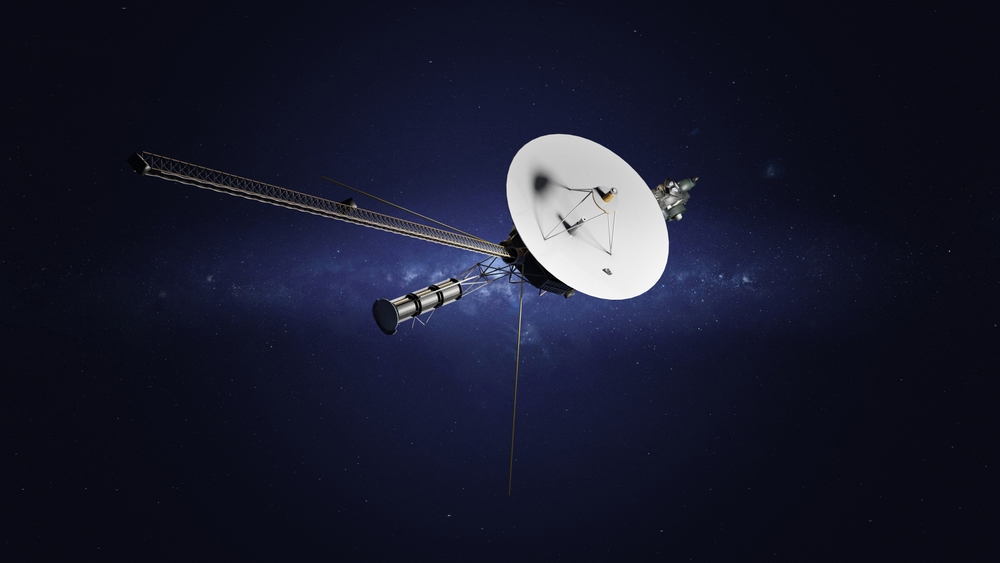
Something remarkable will happen on November 13, 2026. A small spacecraft, no bigger than a compact car, will cross an invisible boundary that no human creation has ever reached before. After traveling for nearly five decades through the cold vacuum of space, Voyager 1 will finally arrive at a destination that light reaches in just 24 hours.
Space has a way of making even our greatest achievements seem small. Yet what Voyager 1 will accomplish in November 2026 stands as a testament to human ambition and engineering brilliance. While we measure our daily commutes in minutes and our vacations in hours, Voyager has been on a continuous journey since September 5, 1977. Every second of every day for almost 50 years, it has pushed farther from home.
Mark Your Calendar for November 13, 2026
On that date, Voyager 1 will become the first human-made object to reach one full light-day from Earth. Picture a distance so vast that even traveling at 299,792 kilometers per second, the speed of light, you would need an entire day to cover it. We’re talking about 25.9 billion kilometers, or 16 billion miles, stretching between our pale blue dot and this tiny emissary of humanity.
Dr. Alfredo Carpineti calculated this precise date using data from NASA’s Eyes on the Solar System. His calculations reveal something fascinating about orbital mechanics and cosmic distances. After November 13, 2026, Voyager will never fall within 24 light-hours from Earth again. Even as our planet orbits the Sun and technically gets closer to Voyager at certain points in our yearly cycle, the probe will be too far away to ever return to this threshold.
Right now, signals from Earth take 23 hours, 29 minutes, and 27 seconds to reach Voyager. Commands sent by NASA engineers today won’t arrive at the spacecraft until tomorrow. By late 2026, that delay will stretch to a full day. Ask Voyager a question on Monday, and it won’t hear you until Tuesday.
Nearly Five Decades to Travel What Light Does in 24 Hours

Numbers can numb the mind, but consider what Voyager has accomplished. Since its launch, it has traveled at roughly 61,198 kilometers per hour. For comparison, Apollo 10 astronauts set the record for fastest human spaceflight back in 1969 at 39,937.7 kilometers per hour. No human has moved faster since. Yet even at that breakneck speed, you would need 155 days to travel just 1 astronomical unit, the distance between Earth and our Sun.
Voyager moves faster than any Apollo crew ever did. Yet it still took nearly 50 years to reach a distance light covers during a single rotation of our planet. Space doesn’t just humble us with its size. It reminds us that despite all our technological prowess, we remain bound by physical laws that make even our fastest machines look like they’re crawling.
Light has no such restrictions. Massless and swift, it covers in eight minutes and 20 seconds what would take a spacecraft more than five months to reach. Photons don’t experience the weight of fuel, the drag of atmospheres, or the limitations of chemical propulsion. They just go.
Breaking Records Since Day One
Voyager’s current position sits at roughly 169.5 astronomical units from Earth. To put that in perspective, Neptune orbits at about 30 AU from the Sun. Voyager has traveled more than five times farther than the most distant planet in our solar system. Along the way, it achieved several firsts that will likely never be repeated by the same spacecraft.
In August 2012, Voyager 1 crossed the heliopause and became the first human-made object to enter interstellar space. Before that moment, it had spent its entire journey within the heliosphere, a bubble of charged particles created by our Sun’s solar wind. Beyond the heliopause lies something different. Not space, exactly, but space that belongs more to the galaxy than to our solar system.
NASA continues to receive data from Voyager’s instruments, though the signals grow weaker each year. Four science instruments still function, sending back information about cosmic rays, magnetic fields, and plasma waves in this region of space that no probe has ever sampled before. Engineers guide the spacecraft remotely, making tiny adjustments to keep its antenna pointed at Earth and its systems running smoothly.
After November 2026, No Turning Back

Power will eventually fail. NASA scientists expect Voyager’s radioisotope thermoelectric generators to produce insufficient electricity to run any instruments by the early 2030s. When that happens, Voyager will go silent. No more data transmissions. No more commands from Earth. Just a quiet drift through the stars with only momentum to guide it.
But silence doesn’t mean the end. Voyager’s journey will continue long after its radio dies. Gravity will pull it. Inertia will carry it. Space, being mostly empty, will offer little resistance. Where Apollo missions lasted days and Mars rovers lasted years, Voyager’s voyage will span eons.
Next Stop: Oort Cloud in 300 Years
Between Voyager and true interstellar space lies a region so vast and mysterious that we’ve never directly observed it. Jan Oort, a Dutch astronomer, hypothesized its existence in 1950 based on the orbits of long-period comets. Scientists now believe the Oort Cloud forms a spherical shell around our solar system, marking the gravitational edge of the Sun’s influence.
NASA describes it well when stating that “the distant Oort cloud marks the gravitational edge of the Solar System, in a vast region of undiscovered objects.” Short-period comets, the ones that swing by Earth every few years or decades, likely originate from the scattered disk at the inner edge of this cloud. Long-period comets, visitors that might appear once in a human lifetime or once in recorded history, probably come from the outer portions of the Oort Cloud.
Estimates place the inner edge of the Oort Cloud at around 1,000 AU from the Sun at minimum. Voyager will need roughly 300 years to reach that boundary. Once there, it won’t quickly leave. Scientists estimate it will take 30,000 years for Voyager to traverse the cloud completely. During that time, the spacecraft will drift through a region populated by icy bodies, primordial remnants from the formation of our solar system, objects that have remained largely unchanged for billions of years.
Some researchers speculate that large planets might lurk in the Oort Cloud, undiscovered worlds that disturb comets in their vicinity and occasionally send them tumbling toward the inner solar system. So far, we’ve found no evidence of these hypothetical planets. Voyager might pass near undiscovered objects as it transits the cloud, but given how space truly is, a collision remains unlikely.
Science fiction has taught us to imagine space as an obstacle course of asteroids and debris. Reality differs. Space lives up to its name. Most of it contains nothing at all.
A Date With Gliese 445 in 40,000 Years

Stars move. Our Sun orbits the galactic center, and every other star does the same, each following its own path through the Milky Way. Right now, Alpha Centauri holds the title of closest star to our solar system at about 4.37 light-years away. But in 40,000 years, a different star will claim that distinction, at least from Voyager’s perspective.
Gliese 445, also cataloged as AC +79 3888, is an M-type main-sequence star with about one-third the mass of our Sun. Currently, it sits roughly 17,000 light-years from Earth. By the time Voyager 1 makes its closest approach to this star, Gliese 445 will have moved to within 3.5 light-years of our solar system. Voyager will pass within 1.7 light-years of the star, closer to it than Earth is to Alpha Centauri today.
NASA notes that “it took 35 years to reach interstellar space, but it will take 40,000 years for Voyager 1 to be closer to the star AC +79 3888 than our sun.” Four hundred centuries from now, when Voyager makes this flyby, humanity might have evolved into something unrecognizable. Our civilization might have spread across the galaxy or vanished entirely. Either way, Voyager will be there, drifting past a distant star.
But Gliese 445 won’t be Voyager’s last stellar encounter. Researchers who study the trajectories of spacecraft on escape velocity from our solar system have calculated future flybys. Around 303,000 years from now, Voyager will approach TYC 3135-52-1, another main-sequence star, passing within about 0.965 light-years of it.
Spacecraft With a Billion-Year Future
How long can Voyager last? Barring a collision with another object, potentially forever. Space contains no oxygen to rust its aluminum frame, no water to corrode its electronics, no weather to erode its surfaces. Radiation will slowly degrade some materials, but protected within its shell, Voyager’s core components could remain intact for millions or even billions of years.
Researchers examining the long-term fate of interstellar probes have calculated encounter rates with stars. On average, a spacecraft will meet stars at roughly the same rate as our Sun does, about one star within 1 parsec every 50,000 years. Closer encounters happen less frequently. One star within 0.1 parsec every 5 million years.
As for collisions, the timescale stretches beyond comprehension. Scientists estimate that “the timescale for the collision of a spacecraft with a star is of order 10²⁰ years.” That’s 100 quintillion years, or roughly 10 billion times the current age of the universe. Voyager has a long future ahead.
Carrying Earth’s Message to the Stars

Attached to Voyager sits a 12-inch gold-plated copper disc known as the Golden Record. Carl Sagan led the committee that designed it as a message to any extraterrestrial intelligence that might one day encounter the spacecraft. Sounds of Earth, music from various cultures, greetings in 55 languages, and images depicting life on our planet fill the record.
Will anyone ever find it? Probably not. Space offers too much room for one small probe to cross paths with intelligent life. But that wasn’t really the point. As much as the Golden Record serves as a message to potential aliens, it functions as a message to ourselves. We are a species capable of reaching beyond our world. We can send our voice across the stars, even if no one ever hears it.
Long after our planet has aged and changed, after our civilization has risen or fallen, Voyager will continue its voyage. It will be a time capsule from a moment when humanity first learned to touch the cosmos.
What November 2026 Really Means for Us
One light-day. It sounds simple when you say it that way. But consider what it took to get there. Thousands of engineers and scientists are designing every system. Launch vehicles are powerful enough to escape Earth’s gravity. Instruments sensitive enough to detect cosmic phenomena billions of kilometers away. Communication networks are precise enough to track a small object moving through space at tremendous speed.
And patience. Decades of patience as Voyager slowly, relentlessly pushed farther from home. No quick trip to the stars awaits us. No warp drives or hyperspace jumps. Just the slow work of crossing distances that challenge our ability to even comprehend them.
When November 13, 2026, arrives, take a moment to think about Voyager. Think about where it is and how far it has come. Think about the fact that a machine built by human hands in the 1970s still travels through space, still sends data back to Earth, still represents our species among the stars. Space may be vast and our technology may be slow, but we’re out there. We made it one light-day away. And Voyager keeps going.
