
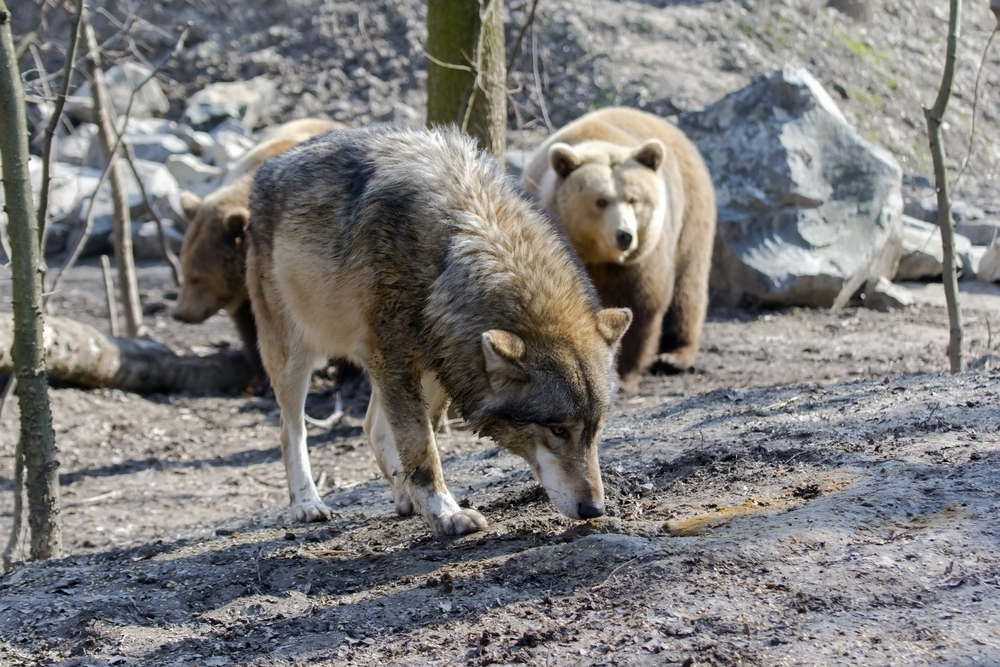
In the remote wilderness of Finland, an unexpected story has emerged—one that challenges long-held assumptions about the natural order. A wolf and a bear, both apex predators known more for rivalry than cooperation, were recorded spending night after night together. Captured by Finnish wildlife photographer Lassi Rautiainen, this rare pairing defies what we typically understand about predator behavior. For ten consecutive evenings, a female grey wolf and a male brown bear met up at dusk, traveled side by side, and appeared to enjoy each other’s company until dawn.
These weren’t brief encounters or chance meetings. The wolf and bear were seen sharing time, space, and even food—an act of cooperation virtually unheard of between such species. Rautiainen, who has spent years observing large carnivores, described the interaction as “very unusual.” And it was. Their behavior has opened the door to new questions about survival, companionship, and the capacity for unexpected bonds in the wild.
Ten Days of Togetherness Under the Nordic Sky
When we think of wolves and bears, we typically picture them as solitary hunters or even rivals, each occupying different niches in the wild. Wolves, with their pack mentality, are known for working together to bring down prey, while bears, largely solitary by nature, roam the forest in search of food. These animals don’t usually coexist peacefully, and in many cases, they might even compete for resources. So, it was nothing short of astonishing when Finnish photographer Lassi Rautiainen captured these two apex predators spending hours together, night after night, in a rare display of companionship.
For ten consecutive evenings, the female grey wolf and the male brown bear met as if they were old friends, wandering side by side in the wilderness. This wasn’t a fleeting encounter but a prolonged interaction. Rautiainen, a seasoned observer of Finland’s wildlife, was amazed by this sight. He remarked that it was “very unusual” to see such a relationship form between two creatures that typically wouldn’t even tolerate each other’s presence. Their time together wasn’t just about proximity—it was about peaceful coexistence. This rare behavior caught everyone off guard, turning the traditional predator-prey narrative on its head.
As they spent hours each night together, it became clear that this wasn’t just a random event but something far more meaningful. Instead of fighting for food or territory, the wolf and bear demonstrated a level of mutual respect and peace that most would never expect to see in nature. It was a remarkable moment in the wild, reminding us of the surprises nature holds and how little we truly know about the complex relationships that form between animals.
Sharing is Caring, Even for Apex Predators
What made this bond even more fascinating was the way the wolf and bear interacted. For most of their time together, they weren’t just in each other’s presence—they shared moments of genuine companionship. They were often seen wandering side by side in the Finnish wilderness, seemingly enjoying the quiet company of one another. This wasn’t just an occasional meeting; for ten consecutive nights, they reunited at the same time, from 8 PM until the early hours of the morning. During these hours, they simply coexisted, exploring the vast forests together, moving in sync without any sign of aggression or territorial behavior.
But the most extraordinary detail was that they were also seen sharing food. In the wild, predators typically compete for resources, yet here, two apex predators—who could easily fight over prey—were seen enjoying a peaceful meal together. This act of sharing was not just about survival; it symbolized a trust between the two animals that was hard to ignore. It was a rare example of interspecies cooperation, something rarely seen in nature, especially between two such formidable creatures. It raised the question: Could it be that these animals, in their shared solitude, had found comfort in each other’s company?
This kind of behavior challenges what we’ve traditionally understood about predator-prey relationships. The act of sharing food, typically a point of contention between competing animals, spoke volumes about the trust that had developed between the wolf and bear. Whether it was a deep understanding of each other’s needs or simply a unique bond formed under the pressures of their environment, the connection between the two was undeniable. It offered a glimpse into the complexities of animal behavior and the profound ways in which creatures navigate their world together.
The Big “Why?” – Peering into the Mystery of Their Connection
As we marvel at this extraordinary friendship, the question arises: What exactly sparked this unexpected connection between the wolf and the bear? Finnish photographer Lassi Rautiainen, who documented the events, shared his thoughts on the matter. He suggested that both animals might have been navigating a shared sense of loneliness. The young wolf and the bear were both solitary figures, each possibly struggling with the challenges of survival in the wild without the support of their respective packs or families. In their vulnerability, they may have found an unexpected ally in one another.
Rautiainen’s theory is grounded in the idea that animals, like humans, can seek companionship in times of uncertainty. In the vast wilderness of Finland, where resources can be scarce and survival is a constant challenge, two young animals might have instinctively come together for mutual support. This connection, born out of shared vulnerability, may have provided them with a sense of safety and security in an otherwise unpredictable environment. It’s a theory that resonates with the idea that, in times of need, even the most unlikely friendships can form.
The question of “why” remains a mystery, but it speaks to the deeper layers of animal behavior that we’re still learning to understand. These animals may not have consciously decided to form a friendship, but their actions suggest that, in nature, bonds can be formed in the most unexpected ways. Whether driven by necessity or a deep, unspoken understanding, the wolf and bear’s relationship is a powerful reminder of the complexities of survival and connection in the animal kingdom.
Understanding Mutualism in Nature

The unexpected friendship between the wolf and bear brings to mind the scientific concept known as mutualism—a natural relationship where two different species benefit by working together. One specific type of mutualism, called facultative mutualism, might help explain the connection seen between these two unlikely friends. In facultative mutualism, two species choose to cooperate when conditions are favorable, but they can still survive independently. Simply put, it’s nature’s version of “I’ll help you when it’s good for both of us.”
In this wolf-bear scenario, each animal likely found an advantage in sharing companionship and resources, improving their chances of survival in the Finnish wilderness. The presence of a companion might have offered protection from other predators or increased their efficiency in finding food. Though wolves and bears don’t typically rely on each other, their flexible partnership demonstrates that animals can adapt their behavior in surprising ways, forming temporary alliances that benefit both parties involved.
This relationship offers a valuable lesson about cooperation in nature. Even among apex predators, flexibility and adaptability can lead to unexpected bonds. By understanding examples of facultative mutualism like this one, we gain deeper insights into the complexity of ecosystems and the fascinating ways animals navigate survival together.
The Man Behind the Lens
Behind this extraordinary discovery is Lassi Rautiainen, a seasoned wildlife photographer with decades of experience observing Finland’s most elusive animals. Known for his deep respect for nature and his ability to capture raw, unscripted moments, Rautiainen was in the right place at the right time. But even with years spent tracking wolves and bears, he admitted he had never witnessed anything like this. “It’s very unusual to see a bear and a wolf getting on like this,” he told the Daily Mail, emphasizing just how rare and surprising this event truly was.
Rautiainen spent ten nights documenting the pair’s interactions, watching as the wolf and bear met consistently from dusk until dawn. His patience paid off, resulting in a series of images that have since gone viral—images that do more than show animals in the wild; they challenge our assumptions about predator behavior. These weren’t fleeting encounters or staged moments. What he captured was a genuine, ongoing relationship between two creatures usually thought to be competitors.
More than just a photographer, Rautiainen became a witness to a moment in nature that few others have seen. His work continues to inspire conversations about wildlife behavior and conservation, offering a reminder that there’s still so much we don’t fully understand about the animal world. Through his lens, we’re able to glimpse a story that might have otherwise gone unnoticed—one that reminds us of the depth and unpredictability of life in the wild.
Nature’s Endless Capacity for Surprise

The remarkable friendship between this wolf and bear in Finland provides more than just a captivating wildlife story—it challenges our perceptions of animal behavior. Nature, it seems, still has plenty of surprises for us, showcasing bonds that defy traditional predator-prey dynamics. Through Lassi Rautiainen’s keen observation and photography, we’ve witnessed an extraordinary example of companionship, trust, and adaptability, even among creatures we typically view as rivals.
Stories like this remind us that cooperation and mutual support can arise in unexpected places, revealing the complexities and wonders of animal interactions. This wolf-bear friendship serves as a powerful symbol of how even in the harshest environments, unlikely connections can thrive, enriching our understanding of the natural world.
Ultimately, the tale of the Finnish wolf and bear inspires us to reconsider how we view wildlife and the intricate relationships animals can form. It’s a compelling reminder that nature always holds the capacity to astonish us, teaching valuable lessons about coexistence, adaptation, and the profound bonds that can flourish in the wild.
