
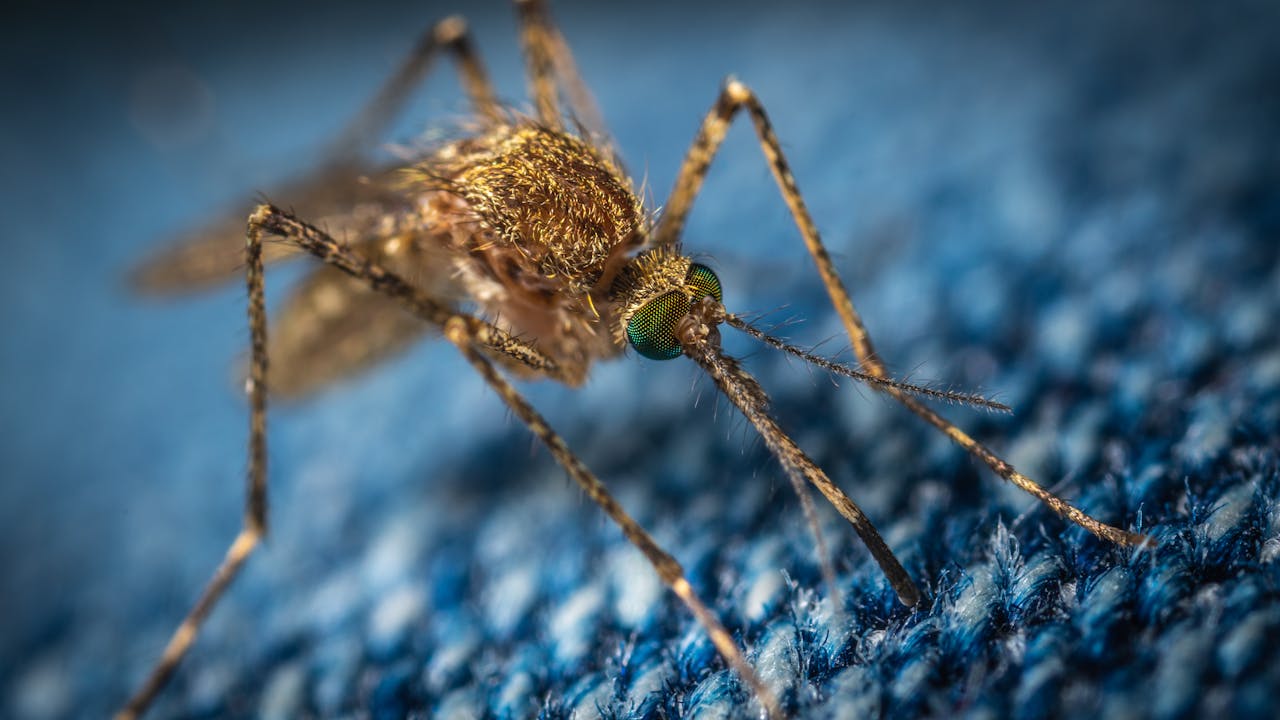
What if a long-forgotten mosquito could change the way we think about biological decay? Scientists have confirmed that a 46-million-year-old insect still contains traces of blood inside its abdomen. Not symbolic traces or theoretical assumptions, but actual molecular remnants that survived in stone long after the body should have broken down. The discovery was made from a fossil that had been boxed away for years before anyone realized what it held.

This isn’t a Jurassic Park fantasy. No dinosaurs will be cloned from this find. But the fact that blood-related compounds can persist for tens of millions of years is something scientists did not expect to see in a real-world specimen. Now they are rethinking how long biological material can endure, and what that means for how we study ancient life.
From Basement Box to Scientific Breakthrough
In the early 1980s, Kurt Constenius, a geology graduate student, collected dozens of insect fossils during weekend trips near the Kishenehn Formation in Montana. The area is known for its fine-grained sediment, which helps preserve delicate organisms. After the trips, the fossils were stored in boxes in his family’s basement, where they remained for years. At the time, no one imagined that one of them would hold molecular evidence that would challenge long-standing beliefs in paleontology.
It was not until decades later that the significance of the collection came to light. Dale Greenwalt, a retired biochemist volunteering at the Smithsonian’s National Museum of Natural History, was reviewing the donated fossils when he noticed something unusual. One mosquito fossil had an abdomen that looked denser and darker than the others. As he put it, “I immediately noticed it, it was obvious that it was different.” His background in biochemistry helped him see what others had overlooked.

Greenwalt’s observation prompted closer investigation by museum researchers. Additional analysis confirmed that the mosquito’s abdomen contained preserved biological molecules, including evidence of ancient blood. This marked the first time such a find had been verified, turning a forgotten specimen into a significant milestone in the study of molecular preservation and fossil science.
What It Took to Prove There Was Blood in the Fossil
Once researchers at the Smithsonian got hold of the mosquito fossil, they needed to be certain it was more than just a well-preserved insect. The team began by using energy dispersive X-ray spectroscopy, a method that allowed them to analyze the composition of the fossil without damaging it. This technique revealed a high concentration of iron in the mosquito’s abdomen. Dale Greenwalt, who had identified the unusual specimen, noted, “The abdomen was chock full of iron, which is what you’d expect from blood.” That alone did not confirm the presence of blood, but it was enough to justify further testing.
Next, the researchers used a secondary ion mass spectrometer to look for heme. Heme is a compound found only in blood and is responsible for oxygen transport in the body. Detecting it would be far more specific than iron alone. The analysis confirmed that heme was present in the fossil, along with porphyrins, another blood-related compound that forms as hemoglobin breaks down. These molecules were found only in the abdomen and not elsewhere in the fossil, which helped rule out contamination from the surrounding rock or environment.

The combined evidence gave scientists confidence that this mosquito had fed on blood shortly before it died and fossilized. It was the first time a mosquito fossil had been verified to contain intact blood molecules. Their findings were published in the Proceedings of the National Academy of Sciences, officially documenting the discovery and making it a reference point for future studies on biomolecular preservation. The research showed that under rare conditions, even delicate biological materials can survive far longer than previously assumed.
Why the Blood Still Has No Name
Finding preserved blood molecules in a fossilized mosquito was a major win for science, but one question remains unanswered. Whose blood was it? Despite the chemical evidence that confirms a blood meal took place, researchers still cannot identify the animal the mosquito fed on. The molecular signals preserved in the fossil’s abdomen did not match any known species from the surrounding ecosystem.
To investigate, the team used a time-of-flight secondary ion mass spectrometer to isolate biological markers like porphyrins and heme derivatives, along with a concentrated presence of iron. These compounds are reliable indicators that the mosquito had ingested blood shortly before it was trapped and fossilized. However, the molecular structure had degraded too much over time to make a precise identification. Without surviving proteins or DNA, there is no way to reconstruct the full biological profile of the host.

During the Eocene, the Kishenehn Formation was home to a wide range of vertebrates including crocodiles, turtles, early birds, and mammals. Any of these could have been the source. Still, researchers noted that there is “no way of knowing what the host for this blood engorged mosquito was.” This outcome highlights one of the biggest challenges in paleontology. Even under rare preservation conditions, key biological data can disappear over time, leaving only partial clues behind. The fossil confirms that ancient blood can survive, but it does not guarantee answers about its origin.
Why This Fossil Will Never Bring Back the Past
The idea of using ancient blood to recreate extinct animals sounds fascinating, especially if you’ve seen it play out on screen. But in scientific terms, it does not hold up. DNA, which is essential for cloning, breaks down far too quickly. Even under perfect conditions, its half-life is only a few hundred years. After that, the genetic material becomes too fragmented to work with. At 46 million years old, this mosquito fossil no longer contains any intact DNA.
To bring back a species, researchers would need more than just blood molecules. They would need a full genome, the technology to reassemble it with extreme accuracy, and a living species closely related to act as a biological host. None of that applies here. While the discovery of heme and porphyrins proves that molecular traces of blood can persist, those molecules cannot be used to recreate an organism.
What this fossil actually offers is a reality check. It reminds scientists that biological compounds can survive longer than expected in rare geological settings. That matters not because it opens the door to cloning, but because it helps refine how scientists interpret ancient materials. The mosquito fossil is valuable for what it tells us about preservation, not for reviving the distant past.
Why This Matters Beyond Fossils
This mosquito fossil is not just about ancient insects. It also brings up interesting questions about how long certain molecules can survive, and that matters in everyday health science too. In the fossil, researchers found heme and porphyrins, which are compounds found in human blood as well. Heme helps your body carry oxygen, and porphyrins are part of how your body processes certain nutrients and gets rid of waste.

Normally, these molecules break down quickly after someone dies, or even when blood samples are stored. But the fact that they lasted for millions of years in this case shows that under the right conditions, they can stick around much longer than expected. That has researchers thinking more about how we store and analyze biological samples today.
Better understanding how long these molecules last could help improve things like blood testing, medical sample storage, and even how we track early signs of disease in the body. It also shows that biology leaves behind more information than we sometimes realize — and knowing how to look for it could give us new tools in health research.
How Tiny Clues Can Lead to Bigger Health Discoveries
This fossilized mosquito showed that even a tiny amount of preserved material can tell scientists a lot. That same idea is at the core of modern health research. Many of today’s diagnostic tools rely on finding small changes in the body before symptoms even appear. Whether it is a slight shift in blood chemistry or a few damaged cells, the body leaves early signs that something is changing.
In the case of the fossil, researchers were able to detect molecules that had lasted for millions of years because they used the right tools and paid close attention. In health science, the same approach matters. The goal is not to wait for full-blown illness but to notice the early signs that often go unseen. Just like the mosquito fossil reminded scientists to look more closely at overlooked specimens, it also reinforces the importance of being precise and thorough when analyzing the human body.
The bigger message is clear. Small traces can carry big meaning, and the more skilled we become at finding them, the better our chances of understanding both ancient history and current health.

What One Fossil Reminds Us About Looking Closer
A single mosquito trapped in rock for 46 million years has done more than rewrite a few pages of science. It has shown that information can survive when no one expects it to, and that the right attention can turn an overlooked detail into a discovery that changes how we think. This was not a fossil anyone predicted would matter. Yet it became proof that blood molecules, thought to be long gone, can still be found under the right conditions.
For health, science, and research as a whole, the message is simple. Do not assume that what you cannot see is not there. Whether you are studying ancient insects or modern biology, progress often begins with looking closer at what has been ignored. The mosquito did not roar back to life, but it brought new life to questions about what endures and what we still have to learn.
