
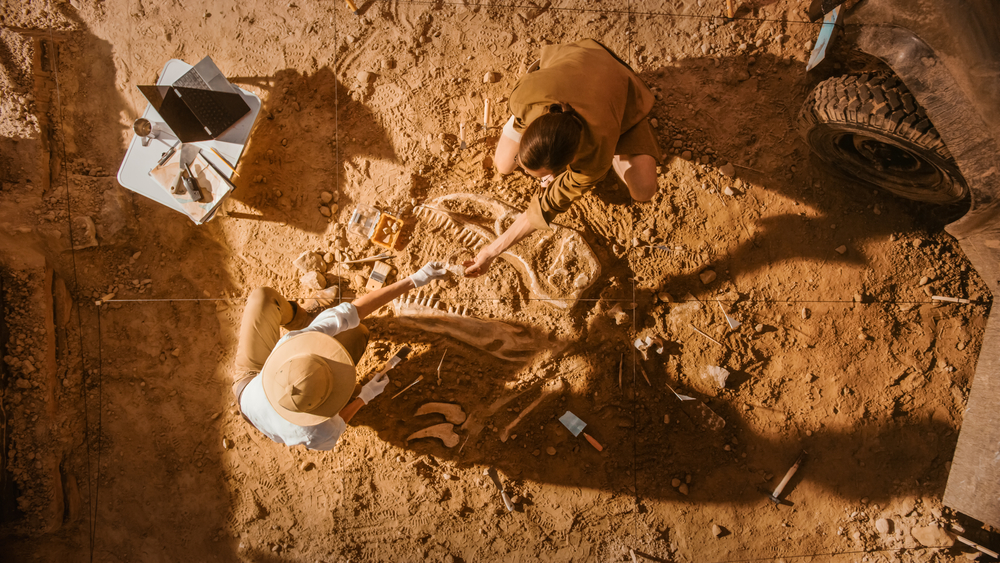
When scientists first pulled a heavily deformed skull out of the ground in Hubei Province, China, more than 30 years ago, they thought they had simply found another specimen of Homo erectus. That ancient human species is already famous for its long survival and wide geographic spread, so the assumption made sense. The skull, known as Yunxian 2, was battered and warped from the forces of fossilization, making its true features difficult to recognize. For decades it sat in collections, studied but never quite understood.
Recently, a new wave of technology allowed researchers to re-examine this relic with fresh eyes. Using digital reconstruction techniques, including 3D imaging and computer modeling, they virtually “uncrushed” the skull to restore its original shape. What they found surprised them. Instead of fitting neatly into the Homo erectus category, the skull appeared to belong to a lineage much closer to the mysterious Denisovans, sometimes grouped under the name Homo longi. If this is correct, then the fossil is not just another data point—it is evidence that our evolutionary timeline may need to be redrawn.
This skull is estimated to be between 940,000 and 1.1 million years old. That makes it far older than most fossils linked to the Denisovan line, which were previously thought to be much younger. If these researchers are right, then the separation of lineages that led to Homo sapiens, Neanderthals, and Denisovans may have happened hundreds of thousands of years earlier than we once believed. It suggests that our human story stretches back in more directions, and far further, than conventional textbooks acknowledge.
The implications are enormous. Human evolution was never a tidy, linear path from ape-like ancestors to modern people. Instead, it was a branching tree with overlapping species, migrations, and interactions. This skull may represent one of those early, tangled branches—a reminder that the human story is more complicated and fascinating than we imagined.

Rewriting the Timeline of Human Evolution
For much of the twentieth century, the dominant idea was that modern humans evolved in Africa about 200,000 years ago and spread outward, replacing archaic populations like Neanderthals. Genetic evidence later pushed our lineage’s split with Neanderthals and Denisovans back to around 500,000 to 700,000 years ago. That was already pushing the boundaries of how far back we thought our distinct line began. Now, the Yunxian skull may shift that moment even further, closer to the million-year mark.
What does that mean in practice? If the skull does indeed represent an early Denisovan or Homo longi, then the divergence between them and the ancestors of modern humans must have occurred well before 940,000 years ago. That means our evolutionary family tree was already splitting into multiple branches far earlier than researchers had assumed. It challenges the neat timelines that place major evolutionary steps at specific points. Instead, it reveals a long, messy, and overlapping story.
This discovery also intensifies the debate over the so-called “Muddle in the Middle,” the confusing period between about one million and 300,000 years ago when multiple species of humans coexisted. Fossils from this period are notoriously hard to classify. Some features look archaic, others more modern, and no single category has ever quite fit. The Yunxian skull now suggests that at least part of this muddle comes from our own limited perspective—we may have been trying to squeeze diverse, branching species into too few boxes.
When viewed through this new lens, the period around a million years ago looks like a vibrant stage of experimentation in human evolution. Different human groups were spreading across Africa, Europe, and Asia, adapting to new environments, and evolving in parallel. Some lineages survived, others died out, but all contributed pieces to the larger story. The Yunxian skull is not just a fossil—it’s a reminder of how much more complex and dynamic our origins really were.
The Asian Puzzle Piece in Human Origins
For a long time, the spotlight in human origins research has shone brightest on Africa. The “Out of Africa” model explained much about how modern humans spread and became the dominant species. But discoveries like the Yunxian skull remind us that Asia, too, was an important stage in the human drama. Far from being a backwater, it may have been home to diverse populations of humans who shaped our evolutionary history in lasting ways.
The Denisovans themselves are a striking example. We know them almost entirely from genetic traces and a few fragments of bone and teeth found in Siberia and Tibet. Yet their DNA is present in many modern human populations, particularly in parts of Asia and Oceania. This means they once ranged widely across the continent and mingled with our ancestors. The Yunxian skull may represent a much earlier stage in this lineage, showing that Denisovan-like humans had already spread into East Asia nearly a million years ago.
This forces us to rethink how migrations unfolded. Instead of a single, dramatic “out of Africa” event, there may have been waves of dispersal, with humans moving back and forth between continents over hundreds of thousands of years. Some groups disappeared, others thrived, and still others blended with newcomers. Asia was not just a recipient of human migrations but a crucible where lineages mixed and evolved in unique ways.
Placing Asia firmly within the story of human evolution also broadens our sense of identity. It underscores that human origins were not the tale of a single population in a single place, but a mosaic of populations across the globe. The skull from Yunxian, battered and distorted yet preserved for a million years, is a testament to the richness of that story. It connects us to ancestors who lived in landscapes far from Africa but who still contributed to the tapestry of what it means to be human.

How Fragile Our Conclusions Can Be
While the headlines may suggest this single skull overturns everything, scientists are cautious. Fossil interpretation is an art as much as a science, shaped by technology, perspective, and debate. The Yunxian skull’s reconstruction is a powerful use of digital tools, but it still relies on assumptions about how the skull deformed and what its original features looked like. Other researchers may challenge these interpretations, suggesting alternative reconstructions or classifications.
Dating is another source of uncertainty. Fossils can only be placed within ranges, and different methods may give slightly different results. While the skull is almost certainly close to a million years old, whether it is closer to 940,000 or 1.1 million matters a great deal for placing it within evolutionary timelines. That margin of error can fuel competing interpretations and delay consensus.
There is also the question of evidence. One skull, however intriguing, cannot alone redefine an entire field. Paleoanthropology relies on accumulating fossils, comparing them across sites, and integrating them with genetic evidence. Without DNA, which is unlikely to survive in such old fossils, we are left with morphology alone. This makes every interpretation provisional, waiting for further finds to either confirm or contradict it.
For now, the Yunxian skull is best seen as a tantalizing clue. It is a piece of a puzzle that is far from complete. Yet even as one piece, it sparks debates that ripple across the entire field. It reminds us that science is never static. Every fossil discovery has the potential to surprise us, unsettle us, and force us to rethink what we thought we knew.
Why Ancient Discoveries Still Matter to Us
You might wonder why it matters whether modern humans diverged from Denisovans 500,000 or 1 million years ago. After all, it doesn’t change how we live our daily lives today. But discoveries like the Yunxian skull speak to something deeper than timelines. They remind us of our shared roots, our interconnectedness, and the resilience of the human story.
By learning about ancient human species, we gain perspective on our own uniqueness—and our commonality. Denisovans, Neanderthals, and other archaic humans were not just evolutionary dead ends; they contributed genes, ideas, and survival strategies to the people who came after them. Modern humans carry fragments of their legacy in our DNA, our physiology, and perhaps even in aspects of our culture.
These discoveries also feed our natural curiosity. To be human is to ask where we come from, how we became who we are, and what paths we might take in the future. Each fossil adds a new chapter, a fresh reminder that our story is not simple or singular but complex and ongoing. The skull from Yunxian is one such chapter—one that could reshape entire sections of the book.
Finally, these finds humble us. They remind us that we are not the pinnacle of evolution but part of a long chain of experiments, adaptations, and survivals. Our ancestors lived in harsh conditions, adapted to shifting climates, and developed creative ways to endure. By remembering them, we are reminded of our own capacity for adaptation, endurance, and growth.

A Story Still Being Written
The million-year-old skull from China is more than an object locked in stone. It is a messenger from the deep past, carrying whispers about who we are and where we came from. It challenges us to rethink our evolutionary map, to open ourselves to the possibility that the human story is far older and richer than we imagined.
Science will continue to debate and refine its interpretations. New fossils may confirm this skull’s significance or force us to reconsider yet again. That is the nature of the scientific journey. It is less about final answers than about constantly updating our understanding as new evidence comes to light. Each discovery reminds us that the past is alive, waiting to be rediscovered.
For readers outside the scientific field, the real takeaway is not whether the skull belongs to Homo longi or Homo erectus. It is that human history is full of surprises. Our ancestors were diverse, resourceful, and interconnected. We inherit not only their DNA but also their curiosity, their adaptability, and their drive to make sense of the world.

As we stand here today, looking back across nearly a million years, we are connected to that ancient skull by more than bone and stone. We are connected by the enduring human quest to understand who we are, where we come from, and how we might carry that knowledge into the future.
