
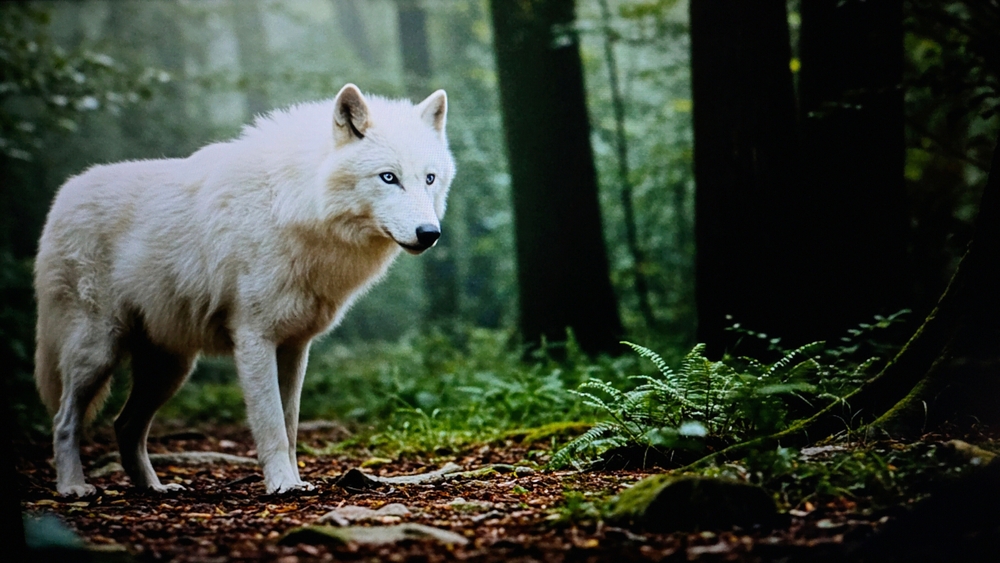
They once roamed prehistoric North America alongside saber-toothed cats and mammoths. Massive, muscle-bound, and mysterious, dire wolves were the apex predators of their time. But after disappearing from the fossil record over 10,000 years ago, they’ve now reemerged—at least partially—thanks to an ambitious experiment from Colossal Biosciences.
Today, the buzz isn’t just about ancient DNA—it’s about living creatures who look and behave more like their extinct ancestors than anyone thought possible. The gene-edited wolf pups have stunned scientists by more than doubling in size within months, rekindling debates around de-extinction, ethics, and the limits of synthetic biology.

The Science Behind the Resurrection
In early 2024, Dallas-based Colossal Biosciences made headlines by announcing the birth of three pups genetically engineered to mimic dire wolf traits. This wasn’t Jurassic Park-style cloning. Instead, the team used gene-editing technology to splice ancient DNA segments—recovered from a 13,000-year-old tooth and a 72,000-year-old skull—into the genome of modern grey wolves.
A total of 20 genes were modified to express anatomical and metabolic traits that resemble those of dire wolves, including size, jaw strength, and growth patterns. The embryos were then carried to term by domestic dogs, chosen for their ability to safely deliver hybrid pups. The result? Healthy, fast-growing canines with an uncanny resemblance to a long-extinct predator.

These animals are not clones, nor are they technically “resurrected” species. Scientists refer to them as phenotype reconstructions: organisms that outwardly mimic extinct species based on known gene functions. Yet even with this distinction, the observable changes—especially their size and behavior—have reignited public imagination and scientific scrutiny alike.
Meet Romulus, Remus, and Khaleesi
Named after figures from Roman mythology and fantasy fiction, the pups—Romulus, Remus, and Khaleesi—have become minor celebrities in the world of biotech. At just over six months, the two male pups weigh more than 90 pounds each. That’s about 20% heavier than a typical grey wolf of the same age. Their sheer size, coupled with their snow-white fur and piercing gaze, has made them an internet sensation.
Their sister, Khaleesi, is three months younger and still developing. But even at her age, she’s already 15-20% larger than an average wolf pup. Scientists believe she will continue this accelerated growth trajectory, eventually catching up to her brothers in size and potentially surpassing them in physical power.
Behaviorally, the pups are also making headlines. Remus has taken on the role of the alpha—an unexpected twist given his slightly smaller frame. Caretakers describe him as highly observant and strategic, often leading the pack during feeding and social interactions. Romulus, while more physically imposing, exhibits beta traits, preferring to follow rather than lead.
This early formation of social roles has fascinated researchers. It suggests that even with synthetic genetic alterations, deeply ingrained behavioral patterns—perhaps echoing those of their ancient ancestors—can still emerge and organize modern pack dynamics.
What Makes a Dire Wolf “Dire”?
Dire wolves (†Canis dirus) were once widespread across North and South America. Larger and stockier than grey wolves, they could weigh up to 150 pounds and had a more massive skull with stronger jaw muscles. Fossil evidence suggests they hunted in packs and were highly effective predators, capable of bringing down megafauna like horses and bison.
Unlike modern grey wolves, dire wolves belonged to a distinct evolutionary lineage. Genetic studies have shown that despite their similar appearance, the two species were only distantly related. This difference makes the re-creation of dire wolf traits through grey wolf DNA editing even more remarkable—and scientifically complicated.

The decision to replicate physical characteristics rather than fully resurrect the species stems from both ethical and technical constraints. Cloning a dire wolf would require an intact genome and a viable egg from a compatible host—both of which are currently unavailable. By using gene editing instead, researchers can at least approximate the lost phenotype.
Still, this partial resurrection raises complex questions. If a creature looks, behaves, and functions like an extinct animal—but isn’t genetically identical—is it the same species? Or is it something entirely new?
The Role of Behavior in Genetic Expression
While physical size and structure are relatively easy to measure, behavioral traits offer a more nuanced window into the success of this experiment. Colossal’s care team has documented the pups’ developing personalities and their interaction patterns with increasing interest.
Remus, the smaller of the two brothers, consistently displays leadership qualities. He watches, waits, and then acts—often being the first to assert control in a given situation. Romulus, by contrast, tends to defer, letting his brother take the lead in both play and food dominance. This mirrors the alpha-beta dynamics observed in natural wolf packs and may suggest that behavioral hierarchies are emerging based on inherited neurological cues.
Khaleesi, still in her formative stage, is being introduced slowly to ensure compatibility. Caregivers monitor subtle body language and stress indicators, such as ear position, tail movements, and play behavior, to determine the ideal timing for her full integration into the pack.
These behavioral observations provide early evidence that genetics may influence not just anatomy but also social tendencies, which could have wider implications for understanding both animal and human behavior.
What This Means for Humans and Health
While this may seem like science fiction or niche zoology, the principles driving this project intersect closely with human biology. Understanding how specific genes affect size, strength, and social behavior can offer valuable insights into genetic therapy, mental health, and even longevity.
For example, traits like leadership, anxiety response, and social bonding are influenced by gene expression and neurotransmitter pathways—many of which are conserved across mammalian species. Observing these traits in animals with newly activated ancient genes offers a novel model for studying how behavior evolves and is inherited.
Moreover, this kind of gene editing research could pave the way for future advancements in medicine, including treatment for genetic disorders or tailored therapies that consider an individual’s unique genome. Ethical challenges aside, the applications of such studies are vast, especially as we deepen our understanding of epigenetics and its role in health and disease.
Ethical and Environmental Considerations
Not surprisingly, the revival of dire wolf traits has stirred ethical debates within the scientific community. Critics argue that focusing on resurrecting extinct traits distracts from pressing conservation needs. With countless species facing extinction today, should resources be diverted to recreate animals that no longer have a place in the ecosystem?
Others warn of potential unintended consequences. What if these gene-edited animals develop health problems later in life? What if their reintroduction into the wild causes ecological imbalance? These concerns are valid and underscore the need for cautious, transparent experimentation.
Colossal Biosciences insists that their work serves as a prototype for more practical applications. They envision a future where gene editing could support endangered species, bolster biodiversity, or even reintroduce extinct ecosystem functions that benefit today’s fragile habitats.
As the pups grow and develop, long-term monitoring will be critical. Only time will tell if this bold endeavor represents a step toward scientific enlightenment—or a slippery slope into unchecked bioengineering.
Natural Lessons From Engineered Creatures
At a glance, these gene-edited wolves might seem like a novelty—part curiosity, part spectacle. But look closer, and their existence invites profound reflection. In trying to bring back a lost piece of Earth’s natural history, we are forced to ask deeper questions about what it means to belong to nature—and to shape it.
The behaviors emerging in Romulus, Remus, and Khaleesi echo patterns that have governed wild canines for millennia. Their instincts, postures, and roles appear uncoached, suggesting that certain elements of social intelligence may be hardwired, not learned. This insight alone offers valuable perspective on how genetic coding influences complex behavior.
For humans, who face rising mental health challenges, loneliness, and social disconnection, these findings could hold unexpected lessons. If wolves still remember how to connect and lead through genetically inherited behavior, perhaps we too can reconnect with our biological heritage to restore balance in our own lives.
The story of these pups is far from over. But already, they remind us that the ancient and the modern are not so far apart—and that nature, no matter how carefully edited, has wisdom worth listening to.
Echoes of the Wild: What Gene-Edited Wolves Teach Us About Balance
From the resurrection of Ice Age traits to the rediscovery of pack behavior, the revival of dire wolf features through genetic science is more than an experiment—it’s a mirror. A mirror showing us the power of biology, the reach of modern science, and the persistent echo of nature in all living things.
As we reflect on what it means to revive a species, we might also consider what it means to revive balance in our own lives. How we sleep, eat, connect, and lead are all influenced by invisible threads of DNA, environment, and social structure. Observing these dynamics in wolves might be the nudge we need to remember our own instincts—and protect the ecosystems we depend on.
