
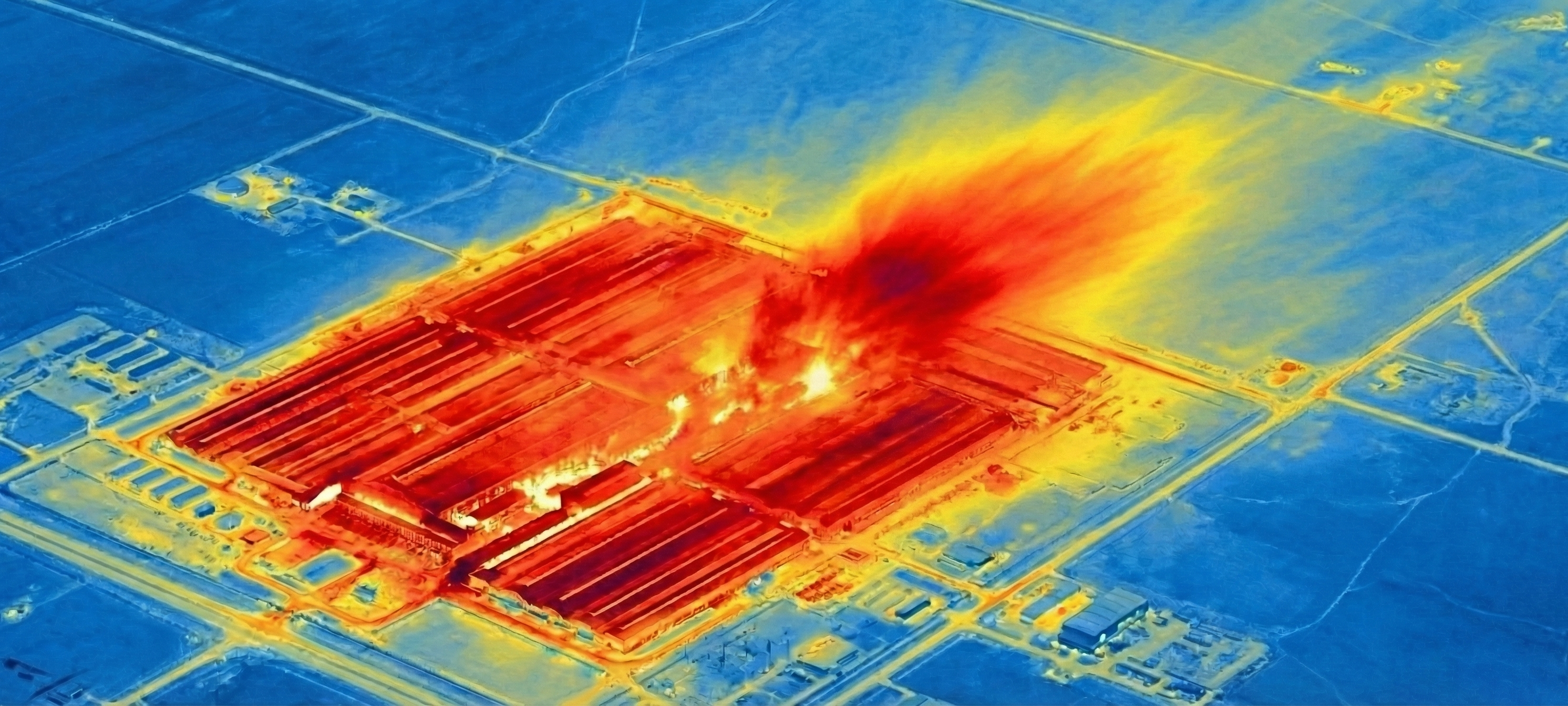
It is easy to imagine the digital world as invisible, existing strictly on screens and in the cloud. However, advanced technology is now proving that “virtual” assets leave a heavy, physical footprint on the earth. A heat-seeking satellite recently captured a striking image over rural Texas, revealing a massive leak of thermal energy radiating from a single facility. This visual evidence challenges the assumption that cryptocurrency exists in a vacuum, forcing a hard look at the tangible waste generated by an industry usually defined by lines of code.
Staggering Energy Demand of Crypto
High-resolution thermal cameras recently captured a clear view of massive energy consumption from orbit. A UK-based company called SatVu released images showing a significant heat footprint emanating from a facility in Rockdale, Texas. While the company did not explicitly name the site, Rockdale houses Riot Platforms, considered the largest Bitcoin mining facility in the United States.

The image offers a resolution of roughly 11.5 feet, which is sharp enough to identify specific active equipment. The data reveals distinct thermal signatures radiating from rooftop chillers, transformers, and electrical yards. This level of detail allows observers to determine exactly which cooling systems are under heavy load and which parts of the plant are dormant at any given time.
Thomas Cobti, SatVu’s VP for Business Development, noted that this thermal data provides an objective view of operational activity as it occurs. It offers real-time insight rather than relying on delayed reports or public announcements. This specific facility consumes an estimated 700 megawatts of power. To put that into perspective, that is roughly the same amount of electricity required to power 300,000 homes. These images provide concrete evidence of the massive energy transfer happening on the ground, revealing physical indicators of energy usage that are usually invisible to the naked eye.
The Real-World Cost of Digital Currency

The heat visible from space highlights a massive appetite for power that continues to grow. According to McKinsey, a global consultancy firm, investment in these computing centers is expected to top $7 billion by 2030. While digital currency might feel abstract, keeping the system running requires physical power on a scale that is difficult to visualize without a concrete comparison.
To put this energy usage into perspective, consider your daily commute. A recent study estimated that processing just a single Bitcoin transaction creates a carbon footprint equivalent to driving a gasoline car for 1,600 miles. That is roughly the distance of a road trip from New York City to Dallas. Now, imagine millions of those transactions occurring constantly. This is not simply a battery drain; it is a major industrial activity with a heavy environmental price tag.
Researchers at the Harvard T.H. Chan School of Public Health recently analyzed the energy bills of the 34 largest Bitcoin mines in the United States. They found that between mid-2022 and mid-2023, these facilities combined consumed 33% more electricity than the entire city of Los Angeles. Think about the millions of lights, refrigerators, and air conditioners running in Los Angeles; these few dozen server farms used significantly more power than that whole metropolis.
The issue is not just how much power these facilities consume, but where that power comes from. The Harvard team discovered that the vast majority of electricity supplying these mines is generated by burning fossil fuels. When a data center of this magnitude plugs into the grid, local power plants often have to ramp up coal or gas production to meet the relentless, 24/7 demand. This directly links the digital mining industry to the smokestacks of traditional power plants.
Bitcoin’s Air Pollution Problem

While carbon emissions affect the global climate, the pollution generated to power these facilities has immediate, local health consequences. The recent study led by Harvard T.H. Chan School of Public Health highlights a disturbing connection between cryptocurrency mining and exposure to fine particulate matter, known as PM2.5. This type of microscopic air pollution is small enough to penetrate deep into the lungs and enter the bloodstream, linking it to increased risks of serious conditions like heart disease, cancer, and dementia.
The researchers estimated that approximately 1.9 million Americans are being exposed to higher levels of this pollution specifically due to the electricity demands of Bitcoin mining. The areas seeing the most significant increases in pollution include New York City, the Houston/Austin metropolitan area, northeast Texas, and the border region between Illinois and Kentucky.
A critical finding in this research is the “cross-state domino effect.” Because electricity grids are interconnected, the pollution doesn’t always stay where the mining happens. You might live in a state with strict environmental regulations but still breathe bad air caused by a mine operating hundreds of miles away.
The study provides a concrete example of this phenomenon: a Bitcoin mine located in North Carolina sources its power from a plant in Kentucky. As that plant burns more fossil fuels to meet the demand, the wind carries the resulting PM2.5 pollution into Metropolis, Illinois. Consequently, residents in Illinois end up breathing high concentrations of dangerous particulates generated to power a digital operation in North Carolina. This complex web means that states often cannot protect their own citizens from emissions generated by their neighbors’ industrial activities.
The Accountability Gap: Pollution Crossing Borders

We often have to trust what companies choose to disclose to understand their environmental impact. These paper reports can be delayed by weeks or lack specific details. The satellite imagery over Texas changes this dynamic by providing hard evidence that does not rely on corporate permission. As SatVu executive Thomas Cobti noted, this thermal data offers an objective view of activity as it happens. It serves as a real-time fact-check against official announcements.
This independent verification is becoming necessary because the current laws are struggling to keep up. The power grid and wind patterns do not stop at state lines. As the Harvard researchers discovered, pollution is often a multi-state issue. A power plant in Kentucky might burn coal to run a mine in North Carolina, while the smoke drifts into Illinois.

Scott Delaney, a scientist involved in the study, pointed out that individual states generally cannot regulate business activities across their borders. This creates a loophole where one community breathes bad air caused by an industry in a neighboring state that they have no control over. Delaney suggests that federal agencies like the EPA may need to step in with tighter cross-border restrictions. Without central oversight or independent monitoring tools like heat-seeking satellites, it is difficult to hold these operations accountable for the costs they pass on to the public.
Visibility Drives Accountability
The rapid expansion of computing infrastructure represents a permanent shift in energy demand, with investment projected to exceed $7 billion by 2030. However, the days of these facilities operating in obscurity are ending. Advanced satellite monitoring now exposes the exact thermal footprint of these operations, replacing delayed corporate reports with undeniable, real-time evidence. This visibility makes it impossible to hide the sheer scale of energy consumption and waste generated by the sector.

For a long time, this connection was easy to ignore because the machinery was hidden behind walls and the pollution drifted across state lines. Now, that secrecy is gone. We have medical studies proving the damage to human lungs, and we have heat-seeking cameras showing exactly where the energy is being used. We can no longer claim ignorance about where the power goes or why the air quality is dropping. The tools to see the problem finally exist; the next step is acknowledging that the price of Bitcoin is paid not just in dollars, but in the air we breathe.
