
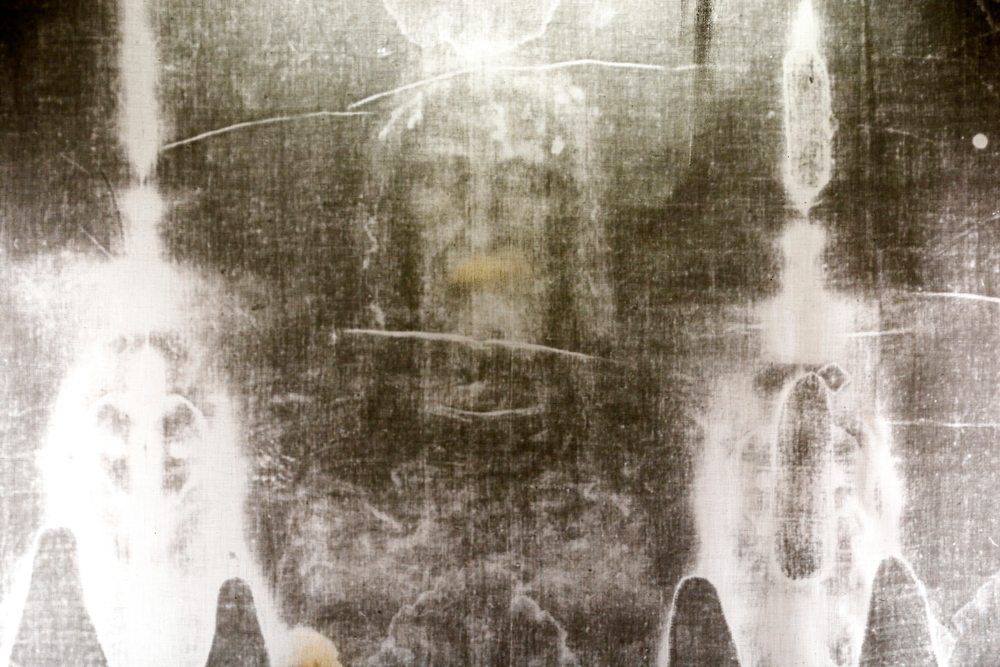
Blood stains tell stories. Scientists examining one of Christianity’s most debated relics just decoded patterns that might confirm a brutal detail from Christ’s final hours. What artificial intelligence revealed in centuries-old fabric has reignited arguments about authenticity, suffering, and whether modern technology can solve ancient mysteries.
A length of linen bearing an image that appears to show a crucified man has sparked controversy for generations. Now, a researcher claims digital mapping of wound patterns proves something specific about how Jesus died. His findings challenge previous assumptions and offer new evidence about an instrument of torture mentioned in Biblical accounts.
Ancient Cloth Holds Image of Crucified Man
Measuring roughly 14 feet long, a piece of fabric stored in Turin, Italy, displays what looks like the front and back impression of a human body. Features visible on the cloth suggest a man who endured severe physical trauma. Believers claim Jesus was wrapped in exactly such material for burial between his crucifixion and resurrection.
Many Christians accept the artifact as a genuine burial wrapping from approximately 33 AD. Skeptics point to scientific tests and historical gaps that cast doubt on its origins. Both groups agree that the image itself remains mysterious.
Marks on the linen appear to show wounds consistent with Roman execution methods. Blood patterns, scourge marks, and what might be puncture injuries cover the figure. Scientists have spent decades trying to determine whether the image formed through natural processes, artistic skill, or something unexplained.
Self-Taught Researcher Takes on Centuries-Old Mystery
Otangelo Grasso describes himself as a Young Earth Creationist and Intelligent Design proponent. Without formal archaeological training, Grasso published a detailed analysis examining head wounds visible on the Shroud. His approach differs from traditional academic methods but arrives at specific conclusions about Christ’s suffering.
Grasso focused on blood transfer patterns around the head region. Previous researchers noted these marks but disagreed about their meaning. Some suggested they came from a cap covering the entire scalp. Others proposed a band or wreath that sat lower on the head.
Publishing his findings, Grasso made a case for one design over another based on where blood appeared and where it didn’t. His methodology combined botanical knowledge, biomechanics, and geometric analysis to reverse engineer an instrument mentioned in Gospel accounts.
AI Technology Maps Blood Stains and Injuries

Grasso employed artificial intelligence to generate projections of the image outline. Computer analysis isolated individual wound locations and blood flow paths. Digital mapping allowed precise counting of puncture sites and measurement of distances between injury clusters.
Results showed 28 to 37 separate puncture wounds across the visible anterior and posterior head regions. Blood appeared in specific patterns on the forehead and temples. Rivulets ran vertically down the face following natural skin contours. Yet a gap of roughly 15.7 centimeters across the top of the head showed no blood transfer at all.
AI processing revealed details invisible to casual observation. Enhanced imaging picked up faint stains and distinguished them from fabric discoloration. Grasso then compared these patterns against known botanical specimens and historical accounts of Roman torture implements.
Crown of Thorns Left Specific Injury Pattern
Gospel writers recorded that soldiers placed a crown of thorns on Jesus’ head before crucifixion. Artistic depictions usually show a woven circlet with spikes pointing inward. Grasso’s research claims to identify which type of crown matches the actual wound evidence.
According to his paper, blood patterns prove thorns penetrated the skin at angles pointing toward the skull center. Grasso wrote “From the front, the crown sits below the apex and compresses the hair at the brow and temples; inward-angled thorns enter tangentially and create vertical rivulets that follow skin furrows and, at the temples, the course of trigeminal branches, echoing the Shroud’s forehead/nasion clots.”
Puncture locations appear concentrated around the periphery of the head rather than scattered across the entire scalp. Vertical blood trails match the path of facial nerve branches. Where thorns entered, blood pooled and then ran down following gravity and skin topology.
Cap Versus Circlet Debate Gets Settled

Two main theories compete to explain the head wounds. A full cap design would cover most of the scalp like a helmet. A circlet would sit as a band around the head, leaving the crown area exposed.
Grasso examined where blood stains appeared and where they conspicuously didn’t. He noted “A helmet-like dome implies frequent superior-scalp lesions; with other head wounds still transferring at burial, one would expect traces across the bridge. Their absence pushes the solution toward a low-seated circlet or shallow capiform wreath.”
If thorns had covered the entire head, blood transfer should appear across the vertex. Since that area remained clean while other head wounds left clear marks, Grasso concluded a low-seated circlet fit the evidence better. A cap-style crown would produce a different injury distribution.
Circlet construction also makes practical sense. Roman soldiers needed to assemble a torture device fast. Weaving flexible branches into a band requires less time and skill than crafting a full helmet shape. Soldiers could bend thorny stems into coils, bind them together, and force the assembly onto a prisoner’s head.
Desert Plant Likely Provided Torture Weapon
Grasso didn’t stop at crown shape. He investigated which plant species could create the observed puncture patterns. Levantine thorn plants vary in spine length, branch flexibility, and growth habits. Not all would work for Crown Construction.
Analysis identified Ziziphus spina-christi as the most probable candidate. Known as Christ’s thorn jujube, it grows throughout the Middle East. Each node bears paired stipular spines measuring two to four centimeters long. Branch diameter runs between 0.6 and 1.0 centimeters, thick enough for structure but flexible enough to bend.
Someone could gather branches, remove leaves, and coil them into three or four loops. Paired thorns at regular intervals would project inward when the crown tightened around someone’s head. As the victim moved or was struck, thorns would tear skin and create puncture wounds.
Botanical evidence matters because it grounds the theory in materials actually available in first-century Jerusalem. Roman soldiers wouldn’t have imported exotic plants for torture. They grabbed whatever thorny shrubs grew nearby.
Medieval Records First Mention Mysterious Cloth

Documentation of the Shroud begins surprisingly late. No reliable records exist before 1354, when a French knight named Geoffroi de Charnay, seigneur de Lirey, possessed the cloth. How he acquired it remains unknown.
Charnay displayed the artifact in a small wooden church. Word spread about a burial cloth bearing Christ’s image. Pilgrims traveled to see it. Money changed hands. Church officials grew suspicious.
For an object supposedly central to Christian history, the absence of earlier documentation troubles historians. If the Shroud wrapped Jesus in 33 AD, why did it take 1,300 years to surface? Gaps like this fuel skepticism about authenticity.
Bishop Declared It Painted Forgery in 1389
When the Shroud went on public display in 1389, Pierre d’Arcis, Bishop of Troyes, denounced it as fraud. He claimed it was “cunningly painted, the truth being attested by the artist who painted it.” According to the bishop, someone had confessed to creating the image through artistic means.
Church authorities found themselves caught between popular devotion and potential scandal. Antipope Clement VII took a middle position. He didn’t declare the Shroud authentic but allowed its veneration as a representation or devotional image rather than a historical relic.
Allowing worship of an object while refusing to confirm its authenticity created useful ambiguity. Believers could maintain faith in the Shroud. Skeptics could dismiss it as medieval art. Everyone could avoid confrontation.
Carbon Dating Places Shroud in Medieval Period

Modern science entered the debate in 1988 when three independent laboratories performed radiocarbon dating on fabric samples. Results from all three converged on dates between 1260 and 1390. Statistical analysis placed the cloth firmly in the medieval period, roughly matching Bishop d’Arcis’s fourteenth-century forgery claims.
Carbon dating measures the decay of radioactive isotopes in organic material. As plants grow, they absorb carbon-14 from the atmosphere. After death, that carbon-14 decays at a predictable rate. Measuring remaining levels reveals when the plant fibers died.
Test results appeared to settle the question. Scientists declared the Shroud a medieval artifact, probably created around the same time it first appeared in historical records. Case closed.
2022 X-Ray Study Contradicts Earlier Tests
Except science doesn’t always provide final answers. Research published in 2022 used wide-angle X-ray scattering to analyze Shroud fibers. Results suggested fabric origins between 55 and 74 AD, much closer to Christ’s lifetime.
X-ray scattering examines molecular structure rather than carbon isotopes. Different testing methods can yield different results. Researchers acknowledged they needed additional studies to confirm findings. Still, the 2022 work reopened questions that carbon dating seemed to have answered.
Dates around 60 AD place fabric creation within the living memory of Jesus’ death. If accurate, the cloth existed during the apostolic period. But even these revised dates fall 30 to 50 years after the crucifixion. Material that old could have wrapped anyone, not necessarily Christ.
Art Historians Challenge Crown of Thorns Story

Some scholars argue that depictions of Jesus wearing a thorny crown represent medieval invention rather than historical fact. According to this view, Bible translations and artistic traditions created the motif centuries after actual events.
Medieval painters popularized images of a bleeding, thorn-crowned Christ. Earlier Christian art rarely showed such details. Art historians suggest that mistranslation or misinterpretation of Greek and Latin texts led to the widespread acceptance of crown imagery.
If crown of thorns depictions stem from later artistic license, analyzing wound patterns on the Shroud to determine crown type becomes circular reasoning. You can’t use medieval art to prove the Shroud’s authenticity when the art itself might be based on the Shroud.
Mystery Continues to Fascinate Believers and Skeptics
Grasso’s research adds new technical analysis to an old debate. AI mapping of blood patterns offers detailed specifications for crown construction. Botanical identification grounds theory in available materials. Geometric analysis explains why certain wound patterns appear while others don’t.
Yet technical sophistication doesn’t guarantee correct conclusions. If the Shroud dates to 1300 AD, analyzing wound patterns tells us about medieval artistic technique, not Roman torture methods. If fabric truly comes from 60 AD but wrapped someone other than Jesus, the crown analysis remains historically interesting but theologically irrelevant.
Carbon dating contradicts X-ray analysis. Medieval bishops cried forgery while modern researchers propose authenticity. Physical evidence points in multiple directions. Faith interpretations vary even more wildly.
Blood patterns on ancient linen won’t settle questions about resurrection or divine nature. Science can date fabric and analyze stains. It cannot prove or disprove religious claims. Believers and skeptics will continue debating the Shroud regardless of what new technologies reveal. Some mysteries refuse simple answers.
