
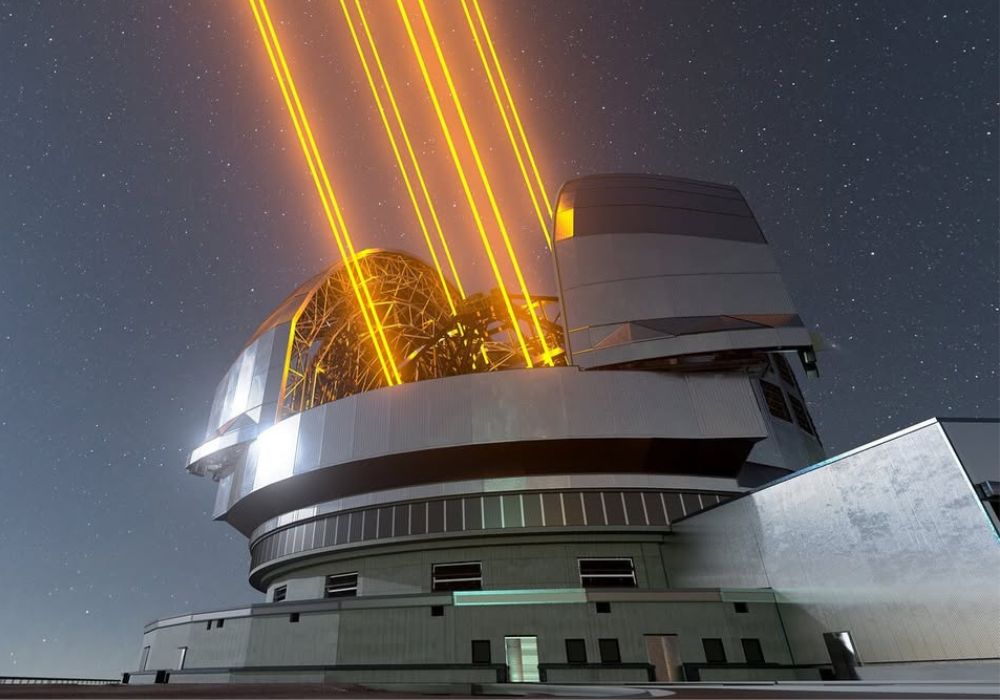
For centuries, humanity’s view of the universe has been limited by the technology of our time. From Galileo’s first telescope to the Hubble Space Telescope, each leap forward has revealed cosmic wonders we never knew existed. Now, perched high in the Chilean Andes, a new generation of astronomers is preparing to take the next great leap in our cosmic vision.
The Extremely Large Telescope, or ELT, represents more than just scientific progress – it’s about to give us capabilities that were pure science fiction just a generation ago. Imagine being able to study distant planets with the same clarity we once reserved for our solar system neighbors, or detecting chemical signatures that might reveal the presence of life light-years away. This isn’t just another telescope; it’s our first real chance to search for answers to questions that have haunted humankind since we first looked up at the stars.
Dr. Sarah Kendrew, an instrument scientist working on the project, puts it simply: “The ELT will see farther and clearer than anything we’ve ever built before. We’re not just improving our view – we’re fundamentally changing what kinds of questions we can ask about the universe.”
Why Chile? The Perfect Cosmic Observatory
The Atacama Desert isn’t just dry – it’s the driest place on Earth outside Antarctica. Some weather stations here have never recorded rain. While this makes it inhospitable for most life, these conditions create astronomer’s paradise. The ELT’s home on Cerro Armazones enjoys:
- Over 320 clear nights per year
- Minimal atmospheric water vapor (which distorts observations)
- Virtually no light pollution for hundreds of miles
“Chile’s Atacama offers the most stable atmospheric conditions we’ve found anywhere on Earth,” explains Dr. Claudio Melo, ESO’s representative in Chile. “For infrared astronomy especially, the dryness is crucial – water vapor absorbs these wavelengths, so we need to be above as much atmosphere as possible.”
At 3,046 meters (9,993 feet) elevation, the ELT site sits above 40% of Earth’s atmosphere. Engineers had to blast away the mountain’s peak to create a level foundation, removing enough rock to fill 70 Olympic-sized swimming pools. The result? A stable platform for what will soon be the most advanced optical telescope ever built.
The location’s advantages go beyond altitude. Its position in the Southern Hemisphere provides:
- Unobstructed views of our galaxy’s center
- Access to the Magellanic Clouds (dwarf galaxies orbiting the Milky Way)
- Clear sightlines to numerous star-forming regions
This remote desert location, far from cities and their light pollution, means the ELT can operate under near-perfect conditions nearly every night of the year. When combined with its revolutionary adaptive optics system (which we’ll explore next), these geographical advantages will allow the telescope to see farther and clearer than any ground-based instrument before it.
The ELT’s Vision Revolution: Seeing Through Earth’s Blurry Atmosphere
Even in Chile’s pristine skies, Earth’s atmosphere distorts starlight – that familiar twinkle comes from air turbulence scattering light. For astronomers, this atmospheric shimmer has always been the ultimate obstacle. The ELT overcomes this limitation through revolutionary adaptive optics that essentially “erase” atmospheric distortion in real time.
Here’s how it works: The telescope creates artificial guide stars by firing lasers 90 kilometers into the atmosphere, exciting sodium atoms to glow like celestial beacons. These artificial stars reveal exactly how the atmosphere is distorting light at any given moment. The ELT’s 4.2-meter secondary mirror then reshapes itself up to 1,000 times per second – each adjustment precise to within a few nanometers – to cancel out the distortion.
“This system gives us space telescope clarity from the ground,” explains Dr. Robin Arsenault, ELT Adaptive Optics Lead. “We’re not just compensating for atmospheric blur – we’re essentially removing it entirely from our observations.”
The adaptive optics work in tandem with the telescope’s staggering light-gathering power. The 39-meter primary mirror collects enough light to study objects 100 million times fainter than what’s visible to the naked eye. Combined with the atmospheric correction, this allows the ELT to:
- Resolve details on exoplanets just 30 light-years away
- Detect oxygen signatures in planetary atmospheres
- Study star formation regions with unprecedented detail
Unlike space telescopes which are limited by their fixed size, the ELT’s ground-based location allows for future upgrades and instrument swaps. Already, engineers are planning next-generation spectrographs that will exploit the telescope’s full potential when operations begin in 2028.
How the ELT Will Hunt for Habitable Worlds
For millennia, humans could only wonder whether other Earth-like worlds existed beyond our solar system. Within the next decade, we may finally get answers. The ELT is poised to revolutionize exoplanet research by doing what was previously impossible: directly studying the atmospheres of distant, Earth-sized planets for signs of life.
What sets the ELT apart is its ability to not just detect exoplanets, but to examine them in remarkable detail. Consider this: while current telescopes struggle to even confirm the existence of rocky planets around other stars, the ELT will be able to analyze the chemical composition of their atmospheres. This means searching for telltale gases like oxygen, methane, and water vapor that could indicate biological processes.
Dr. Lisa Kaltenegger, director of Cornell University’s Carl Sagan Institute, puts the significance in perspective: “For the first time, we’ll have the capability to identify potential biosignatures on worlds dozens of light-years away. The ELT will transform exoplanet studies from planetary detection to planetary characterization.”
The telescope’s capabilities become particularly exciting when applied to our closest exoplanet neighbor, Proxima Centauri b. Located a mere 4.2 light-years away in its star’s habitable zone, this rocky world has tantalized astronomers since its discovery. With the ELT, we’ll be able to do more than just confirm its existence – we could potentially map temperature variations across its surface, detect atmospheric changes that might indicate seasons, or even spot the glint of sunlight reflecting off oceans.
Perhaps most remarkably, the ELT will accomplish in hours what currently takes weeks or months of observation time. This extraordinary efficiency means astronomers can study dozens of promising exoplanets in the time it once took to examine just one. Such rapid analysis dramatically increases our chances of finding evidence of life beyond Earth within our lifetime.
As we stand on the brink of these discoveries, it’s worth reflecting on what they might mean. The detection of even simple life elsewhere in our galaxy would fundamentally alter our understanding of biology’s place in the universe. Should we find signs of more complex organisms – or dare we imagine, technological civilizations – the implications would reshape not just science, but philosophy, religion, and our very conception of humanity’s cosmic significance.
The ELT brings us closer than ever to answering questions that have haunted our species since we first looked up at the stars. As construction progresses on this extraordinary instrument, we may soon know whether life on Earth is a cosmic fluke – or just one example of a much more universal phenomenon.
The ELT’s Window to the Early Universe
Beyond its revolutionary studies of planets and black holes, the ELT will serve as humanity’s most powerful time machine. By capturing ancient light that has traveled across the universe for billions of years, this extraordinary instrument will reveal secrets from the cosmic dawn—the epoch when the first stars and galaxies ignited.
The telescope’s ability to observe the early universe surpasses even the remarkable James Webb Space Telescope in one crucial aspect: resolution. While both can detect extremely distant objects, the ELT’s massive 39-meter mirror provides the sharpness needed to study their structures in detail. Dr. Richard Ellis, a leading cosmologist at University College London, emphasizes this advantage: “Where Webb shows us smudges of light from the first galaxies, the ELT will reveal their shapes, rotations, and internal motions. We’ll essentially watch cosmic history unfolding in unprecedented clarity.”
Among the most sought-after targets are the legendary Population III stars—the universe’s first generation of stellar objects. Theorized to be massive, short-lived giants composed purely of hydrogen and helium, these celestial pioneers forged the first heavy elements that seeded future generations of stars and planets. The ELT may finally catch these elusive stars in their death throes, as they explode in supernovae that can be detected across cosmic time.
Equally compelling is the telescope’s potential to map the epoch of reionization—when the first starlight burned through the primordial hydrogen fog that filled the early universe. By studying how this cosmic dawn progressed across different regions of space, astronomers hope to solve the mystery of how the universe transitioned from darkness to light. The ELT’s spectroscopic capabilities will allow scientists to trace the fingerprints of this transformation in the chemical composition of ancient gas clouds.
These observations could rewrite our understanding of cosmic evolution. Current models struggle to explain how some early galaxies grew so large so quickly. The ELT’s sharp vision may reveal whether supermassive black holes or intense star formation drove this unexpectedly rapid growth. Each discovery will bring us closer to understanding how the infant universe matured into the cosmic web of galaxies we see today.
As the ELT turns its gaze across both space and time, it promises to illuminate not just where we are in the universe, but how we got here. The telescope’s observations of these primordial eras will complete our family album of cosmic history, filling in pages that have remained blank since the beginning of time itself.
From Blueprint to Reality
After years of meticulous planning and engineering breakthroughs, the Extremely Large Telescope is finally taking shape on its remote mountaintop in Chile. The construction site buzzes with activity as workers assemble what will soon become the world’s most advanced optical telescope.
The project reached a major milestone in 2024 when German manufacturer Schott delivered the final segment of the primary mirror. Each of the 798 hexagonal segments—precisely shaped and polished to within a nanometer of perfection—represents years of painstaking craftsmanship. These mirror pieces now undergo final coating before their journey to Chile, where teams will begin the delicate assembly process in 2026.
“The mirror assembly alone is an unprecedented challenge,” says Dr. Michele Cirasuolo, ELT Program Scientist. “We’re essentially building a 39-meter puzzle where each piece must align perfectly with its neighbors—to within a fraction of a human hair’s width.”
The telescope’s massive dome, now more than halfway complete, presents another engineering marvel. When finished, this 80-meter-tall rotating structure will weigh about 6,000 tons—yet must move with precision to track celestial objects. Specially designed vents will maintain perfect thermal conditions inside, preventing air turbulence that could distort observations.
Current Projections Estimate
- 2026: Mirror assembly begins
- 2027: Full optical system integration
- 2028: First light (initial test observations)
- 2030: Full scientific operations commence
While construction progresses smoothly, the team remains vigilant. At this scale, even minor issues—like unexpected wind patterns or thermal expansion—require innovative solutions. Yet the potential rewards justify the effort. When completed, the ELT will gather more light in one night than all the photons that have entered every human eye throughout our species’ entire history.
As the pieces come together on Cerro Armazones, astronomers worldwide prepare for a new era of discovery. The ELT’s revolutionary capabilities won’t just expand our knowledge of the universe—they’ll redefine what’s possible in ground-based astronomy for generations to come.
Opening Humanity’s Sharpest Eye on the Universe
When the ELT’s massive mirror captures its first photons in 2028, it will mark more than a technological triumph—it will launch a new epoch of cosmic understanding. This extraordinary instrument combines humanity’s collective ingenuity with our deepest curiosity about the universe we inhabit.
The telescope’s true power lies in its ability to transform philosophical questions into scientific certainties. As Dr. Rob Ivison of ESO observes, “The ELT won’t just show us more of the universe—it will show us the universe differently.” Its observations may settle debates about life elsewhere, reveal how the first galaxies formed, and test the fundamental laws of physics near black holes.
This moment represents the culmination of four centuries of astronomical progress since Galileo. Where his small lens revealed moons orbiting Jupiter, the ELT’s 39-meter eye will expose cosmic truths hidden since the dawn of time.
The night sky has never looked so full of promise. As the ELT prepares to gaze deeper into space—and further back in time—than any instrument before it, we stand ready to discover not just what we’ve imagined, but wonders we’ve yet to dream. The universe’s greatest revelations await.
Featured Image Source: The European Southern Observatory on Instagram
