
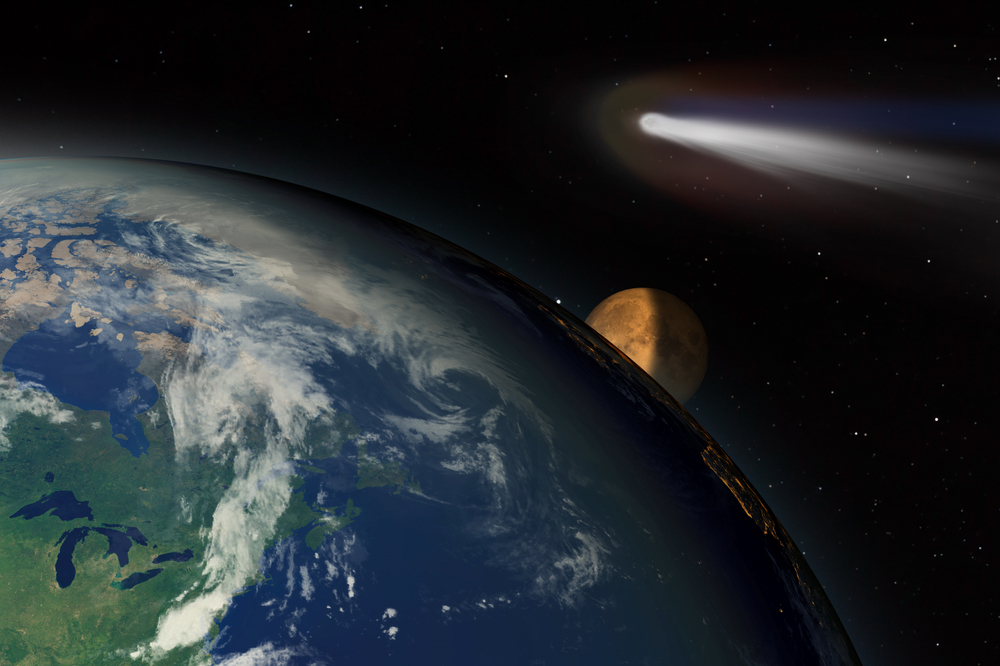
Harvard professor Avi Loeb sent shockwaves through the astronomy community when he suggested an interstellar visitor racing toward our solar system might be something far more sinister than a typical space rock.
According to Loeb’s controversial paper, 3I/ATLAS could represent an alien probe designed to monitor or potentially attack Earth. His warning carried ominous implications about “dire consequences for humanity” that would require desperate defensive measures.
Space agencies worldwide took notice when one of academia’s most prominent astronomers raised such extraordinary claims. NASA found itself in the unusual position of having to address speculation about extraterrestrial threats from respected scientific sources.
What started as routine observations of an unusual comet quickly evolved into a public debate about alien intelligence, scientific methodology, and the line between legitimate research and sensational speculation.
Harvard Professor Drops Alien Bomb on Astronomy Community
Avi Loeb, head of Harvard University’s Galileo Project, which actively searches for evidence of extraterrestrial intelligence, published research suggesting 3I/ATLAS exhibited characteristics inconsistent with natural space objects.
His paper proposed that the massive interstellar visitor could be “a technological artifact” possessing “active intelligence” rather than a simple comet or asteroid formed through natural processes.
Loeb’s hypothesis gained immediate attention across social media and news outlets worldwide. Scientists rarely suggest that space objects might represent alien technology, especially when those objects appear headed toward our planetary neighborhood.
Academic colleagues expressed surprise at Loeb’s willingness to propose such extraordinary explanations before collecting sufficient observational data. Many questioned whether speculation should precede thorough scientific analysis.
Public fascination with potential alien contact amplified media coverage of Loeb’s claims, creating pressure on NASA and other space agencies to provide official responses.
Meet 3I/ATLAS: The Interstellar Speed Demon
Astronomers discovered 3I/ATLAS on July 1, 2025, using the Asteroid Terrestrial-Impact Last Alert System survey telescope in Chile. Initial observations revealed an object moving at unprecedented velocities through our solar system.
At 130,000 miles per hour, 3I/ATLAS travels nearly twice as fast as previous interstellar visitors 1I/Oumuamua and Comet Borisov. Such extreme speeds immediately confirmed its origin from beyond our solar system.
Size estimates suggest a nucleus approximately 5.6 kilometers (3.5 miles) in diameter, making it far larger than the previous two confirmed interstellar objects. Hubble Space Telescope imagery provided detailed measurements of its dimensions and trajectory.
Scientists believe 3I/ATLAS may originate from completely different galactic regions and could be billions of years older than any known objects in our solar system. Such ancient visitors offer rare glimpses into distant cosmic neighborhoods.
Only three confirmed interstellar objects have ever passed through our solar system, making each discovery scientifically precious for understanding planetary formation beyond our local environment.
When Size Doesn’t Add Up to Normal

Loeb’s initial concerns centered on 3I/ATLAS’s anomalous size relative to statistical expectations for interstellar objects. His calculations suggested something measuring approximately 20 kilometers in diameter based on brightness observations.
Compared to 1I/Oumuamua, which was roughly 200 times smaller, finding such a massive interstellar object seemed statistically improbable. Mathematical models predict that astronomers should discover millions of smaller objects before encountering anything approaching 20 kilometers.
Asteroid impact statistics from Earth’s geological history support these size distribution expectations. Non-avian dinosaurs died from an asteroid half the estimated size of 3I/ATLAS, while meter-scale rocks strike Earth annually without major consequences.
Loeb calculated that detecting a 20-kilometer interstellar asteroid during typical survey periods would have a probability of only 0.0001 based on known object populations. Such extreme rarity suggested alternative explanations might be necessary.
Initial brightness measurements led to these size estimates, but subsequent observations would prove these calculations premature and potentially misleading.
The Comet That Doesn’t Act Like a Comet
Early spectroscopic analysis of 3I/ATLAS failed to reveal typical signatures of cometary activity expected from objects approaching the sun. Scientists looked for atomic or molecular gas emissions that normally create visible tails.
Instead of gaseous plumes, observations showed only surface reddening from reflected sunlight. Such reddening could indicate dust particles or organic compounds called tholins formed through cosmic ray exposure over billions of years.
Loeb argued that genuine comets should display obvious spectral fingerprints of carbon-based molecules as solar heating vaporizes surface materials. Absence of these signatures suggested 3I/ATLAS might not be a normal comet.
However, scientists noted that large distances from Earth could make weak spectral features difficult to detect with current telescope capabilities. Observational limitations might explain the apparent absence of cometary characteristics.
Later observations would eventually reveal subtle cometary features as 3I/ATLAS approached closer to Earth-based telescopes with improved sensitivity and resolution.
Loeb’s Dark Theory: Earth Under Alien Surveillance

Building on his size and spectral concerns, Loeb proposed that 3I/ATLAS could represent an alien probe sent to study or potentially threaten Earth. He referenced the “Dark Forest” hypothesis from science fiction literature.
According to this theory, advanced civilizations might preemptively attack other species before they become competitive threats. Finite cosmic resources could motivate such aggressive expansion strategies across galactic distances.
Loeb noted that 3I/ATLAS would reach its closest approach to the sun in October 2025 while positioned on the opposite side from Earth. Such timing could facilitate clandestine operations while hidden from terrestrial observations.
“The consequences, should the hypothesis turn out to be correct, could potentially be dire for humanity, and would possibly require defensive measures to be undertaken (though these might prove futile),” Loeb wrote in his controversial paper.
His calculations suggested the object could potentially redirect toward Earth using gravitational assists during its hidden passage behind the sun, arriving near Earth by late 2025.
NASA Scientists Fire Back with Cold Hard Facts
NASA’s response came swiftly and definitively through Tom Statler, the agency’s lead scientist for solar system small bodies. Statler dismissed Loeb’s alien spacecraft hypothesis based on extensive observational evidence.
“It looks like a comet. It does comet things. It very, very strongly resembles, in just about every way, the comets that we know,” Statler explained to reporters addressing the extraordinary claims.
Space agency scientists had been monitoring 3I/ATLAS continuously through ground-based and space telescopes since its discovery. Multiple independent observations confirmed its natural origins and cometary behavior patterns.
Statler emphasized that evidence “overwhelmingly” pointed toward 3I/ATLAS being a natural object rather than artificial technology from alien civilizations. Scientific analysis supported conventional explanations over speculative alternatives.
NASA stated categorically that the object poses no threat to Earth based on trajectory calculations and behavioral observations. Such definitive safety assurances directly contradicted Loeb’s warnings about potential dangers.
Why Comets Are Naturally Weird and Unpredictable

Statler explained that all comets, including those from our own solar system, exhibit anomalous characteristics that can seem mysterious to casual observers. Cometary behavior often defies simple predictions.
Mixtures of dust and ice respond unpredictably to solar heating as comets approach the sun. Different materials sublime at various temperatures, creating complex patterns of brightening and tail formation.
Even familiar solar system comets can suddenly brighten when particular ice pockets sublimate rapidly, driving off large amounts of dust and creating spectacular displays. Comet experts anticipate such unpredictable behavior.
Interstellar comets face additional complications from their extended journeys through cosmic radiation and extreme cold. Billions of years in interstellar space could alter surface chemistry in ways that affect their appearance.
Statler noted that apparent anomalies present opportunities to gather new information about cometary composition and behavior rather than evidence of alien intervention.
Loeb’s Track Record of Alien Claims
Harvard astronomer Avi Loeb has previously suggested extraterrestrial explanations for other unusual space objects, establishing a pattern of speculative interpretations. His 2017 analysis of 1I/Oumuamua proposed it might be an alien light sail.
Oumuamua’s unusual acceleration and elongated shape prompted Loeb to suggest artificial origins, though most scientists attributed these features to natural outgassing processes typical of comets.
Loeb’s willingness to propose alien explanations for space phenomena has made him both famous and controversial within astronomical circles. Colleagues appreciate his creativity while questioning his methodology.
His current role leading Harvard’s Galileo Project, which specifically searches for extraterrestrial intelligence, might influence his interpretation of ambiguous observational data toward technological explanations.
Scientific peer review processes typically require extraordinary evidence for extraordinary claims, a standard that Loeb’s alien hypotheses have not yet met according to most experts.
What Makes 3I/ATLAS Actually Fascinating

Beyond speculative alien theories, 3I/ATLAS represents a genuine scientific treasure for understanding planetary formation processes in other star systems. Interstellar visitors provide direct samples of alien solar system materials.
Scientists can analyze their composition, structure, and behavior to learn how comets form in different stellar environments. Such data helps test theories about planetary system evolution across the galaxy.
Observations of 3I/ATLAS create unprecedented opportunities to study pristine materials preserved in interstellar space for billions of years. These ancient samples predate our solar system’s formation.
Spectroscopic analysis could reveal chemical signatures from its parent star system, potentially identifying its origin and providing clues about galactic chemical evolution over cosmic timescales.
Future spacecraft missions to intercept interstellar objects might become feasible as detection capabilities improve, offering even more detailed scientific investigations.
The Real Trajectory: No Earth Collision Course
NASA’s orbital calculations demonstrate conclusively that 3I/ATLAS will not approach closer than approximately 170 million miles to Earth due to planetary positioning over the coming months.
Instead of threatening Earth, the interstellar visitor will make close passes by Mars, Jupiter, and Venus during its journey through the inner solar system. These encounters provide excellent observational opportunities.
Precise trajectory modeling accounts for gravitational influences from all major planets, solar radiation pressure, and potential cometary outgassing effects. No plausible scenario results in an Earth impact.
Space agencies maintain continuous monitoring of all potentially hazardous objects approaching Earth. 3I/ATLAS has never appeared on any threat assessment lists maintained by international space surveillance networks.
Public safety considerations require accurate communication about space object trajectories to prevent unnecessary panic about non-existent threats.
October 2025: When Earth Can’t Watch
During its closest approach to the sun in late October 2025, 3I/ATLAS will indeed be positioned on the opposite side from Earth, making terrestrial observations challenging during its brightest phase.
However, space-based telescopes like Hubble and the James Webb Space Telescope can observe objects regardless of their position relative to Earth’s day-night cycle. Solar occultation doesn’t blind all astronomical capabilities.
Loeb suggested this timing might indicate intentional concealment by alien intelligence, but orbital mechanics explain the positioning through natural gravitational dynamics rather than deliberate planning.
Many space objects experience similar observational challenges during their solar approaches. Astronomers routinely plan observation campaigns around such limitations using multiple telescope platforms.
Scientific observation networks will continue monitoring 3I/ATLAS throughout its solar system passage using available instruments positioned at different vantage points.
Scientific Method vs. Sensational Headlines
Loeb acknowledged that his alien spacecraft hypothesis represents primarily a “pedagogical exercise” intended to explore possibilities rather than claim factual discoveries. He admitted the theory was “fun to explore, irrespective of its likely validity.”
“Let us instead maintain our childhood curiosity and seek evidence rather than pretend to be the adults in the room that know the answers in advance,” Loeb wrote, defending speculative inquiry as scientifically valuable.
Media coverage often amplifies sensational aspects of scientific papers while minimizing uncertainty and speculation disclaimers. Headlines about alien threats generate more attention than discussions of observational limitations.
Responsible science communication requires distinguishing between hypotheses worth exploring and conclusions supported by evidence. Speculation serves important roles in generating testable predictions.
However, extraordinary claims require extraordinary evidence before gaining scientific acceptance, particularly when those claims involve potential threats to human civilization.
What Happens Next with 3I/ATLAS
Continued observations through advanced telescope networks will resolve remaining questions about 3I/ATLAS’s composition, behavior, and origins as it approaches its closest point to the sun.
Both ground-based facilities, like the upcoming Rubin Observatory, and space telescopes will monitor the object throughout its solar system passage. Multiple observation campaigns are already planned.
Scientists expect to identify clear cometary features including gas and dust emissions, as solar heating intensifies during approach. Spectroscopic analysis should reveal detailed chemical composition.
International collaboration between space agencies ensures continuous monitoring despite Earth’s changing position relative to the object. Scientific cooperation transcends national boundaries for such discoveries.
Within months, accumulated observational data should definitively resolve debates about 3I/ATLAS’s nature and put alien spacecraft speculation to rest through comprehensive evidence.
