
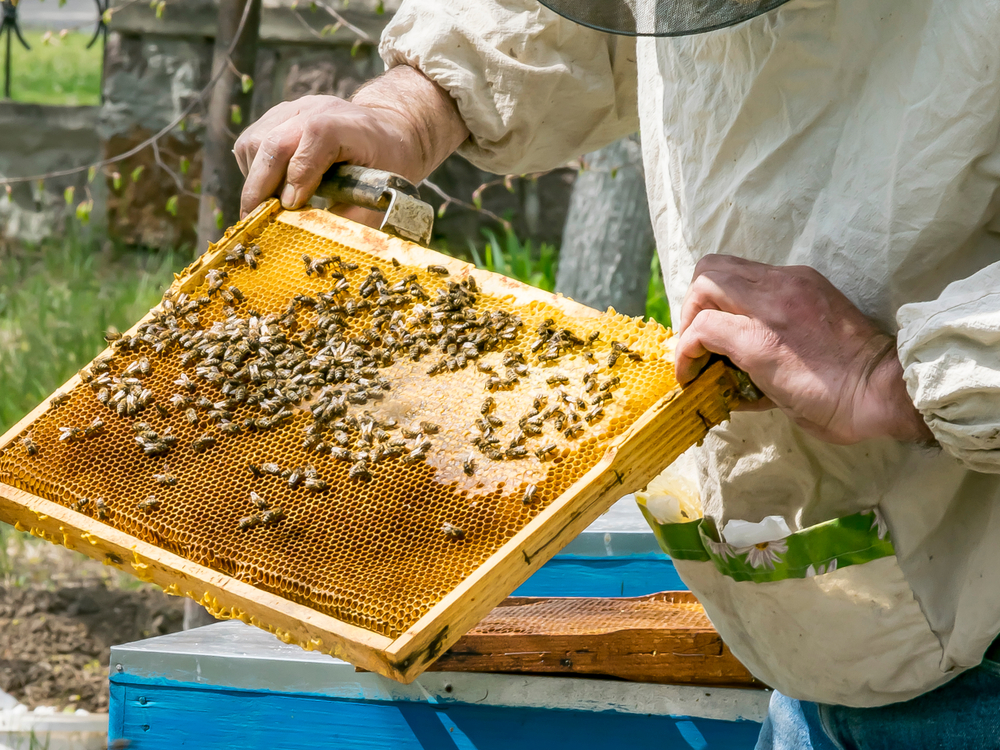
Something unusual is happening inside beehives in Greece, and it’s challenging what we think we know about animal behavior. Beekeepers have noticed that when religious icons—images of Christ, the Virgin Mary, or saints—are placed inside hives, the bees build their honeycombs around the figures instead of covering them. This goes directly against how bees normally respond to foreign objects in their space, which they typically seal off with wax or propolis.
What makes this even more notable is that it’s not a one-off. It’s been observed repeatedly, across different regions and over several years. The pattern is consistent: bees construct their combs around the central images, often leaving the faces and bodies entirely untouched.
There’s no verified explanation yet. Researchers have floated possible theories—related to shape, texture, or visual processing—but none fully account for what’s happening. Meanwhile, local communities and beekeepers are interpreting the phenomenon through spiritual or cultural lenses, seeing it as a gesture of reverence from nature itself.
Bees don't build hives over religious icons
— Carnivore Aurelius ©🥩 ☀️🦙 (@AlpacaAurelius) February 18, 2025
Divine creatures pic.twitter.com/ua4Uf1FUV2
What Exactly Are the Bees Doing?
In Greece, several beekeepers have observed something highly unusual: when religious icons—images of Christ, the Virgin Mary, or various saints—are placed inside beehives, the bees don’t treat them like any other foreign object. Normally, bees cover anything unfamiliar in their hive with wax or propolis, essentially sealing it off as a protective instinct. But in these documented cases, bees are deliberately building their honeycombs around the religious figures, leaving the faces and central parts of the images untouched.
This pattern has been repeated over several years, across multiple beekeeping sites and with different religious icons. The bees still construct their combs, but they stop short of obscuring the images. In some photos, you can clearly see intricate honeycomb formations that curve precisely around faces and hands, as if intentionally avoiding them.
The behavior stands out because it contradicts what we know about bee instincts. Bees don’t typically discriminate in this way. Anything introduced into a hive—wood, plastic, glass, or metal—gets treated the same. It’s covered. The fact that these icons are being preserved rather than obscured raises legitimate curiosity, not just among beekeepers, but also among scientists and religious observers.
This is not an isolated or anecdotal incident. The consistency over time suggests a behavioral pattern worth investigating, rather than dismissing it as coincidence or anomaly.
What Science Can—and Can’t—Explain
Scientists and experienced beekeepers agree on one thing: bees are highly organized, instinct-driven insects that respond to their environment with remarkable precision. Inside a hive, bees regulate temperature, manage space, and neutralize threats—all without centralized control. When foreign objects are introduced into their space, bees usually encapsulate them in wax or propolis, a resin-like substance they produce to insulate or sanitize what doesn’t belong. This reaction is so reliable that it’s used in research to test how bees respond to changes in their hive environment.
Given this, the decision to not cover a foreign object—in this case, religious icons—is abnormal. It runs counter to what bee colonies do naturally. One hypothesis is that the bees may be responding to physical properties of the icons themselves. For instance, the colors, textures, or even chemical residues on the icons might somehow deter the bees from covering them directly. Some icons are painted with materials or finishes that could contain substances bees avoid. Alternatively, the images’ contours—particularly the human faces—might trigger different spatial behavior. Bees are sensitive to geometry when constructing combs, so it’s plausible that certain shapes might influence how they build around rather than over them.
However, none of these theories fully hold up under scrutiny. Bees have been known to cover all kinds of surfaces, regardless of material, including glass, metal, and plastic. And yet in these particular cases, across multiple settings and years, they’ve shown a consistent pattern of avoidance specifically around the central figures of religious icons. There is no clear chemical or material explanation that accounts for this specificity.
Neuroscientist and bee cognition researcher Dr. Lars Chittka, known for his work on bee perception and intelligence, has pointed out in past studies that bees can recognize and differentiate between complex visual patterns, even human faces, under lab conditions. But translating that lab capability into a hive behavior like selective comb building is a major leap. There’s currently no peer-reviewed research that confirms bees can interpret images or assign them significance, especially in a natural hive environment.
In short, while there are some working hypotheses, none offer a complete or satisfying explanation. The bees’ behavior doesn’t conform to standard biological responses, and the consistency of the phenomenon across different hives and beekeepers complicates attempts to dismiss it as coincidence or artifact. It leaves scientists in a rare position: aware that something out of the ordinary is happening, but without a tested framework to fully explain why.
Greek bees building their hives 𝗮𝗿𝗼𝘂𝗻𝗱 icons of 𝗖𝗵𝗿𝗶𝘀𝘁, the 𝗛𝗼𝗹𝘆 𝗩𝗶𝗿𝗴𝗶𝗻, and 𝗦𝗮𝗶𝗻𝘁𝘀—never covering their images. 🙏
— 𝚕𝚒𝚝𝚝𝚕𝚎 𝚘𝚗𝚎 ♱ (@BillArnoldTeach) October 1, 2024
For over 𝗮 𝗱𝗲𝗰𝗮𝗱𝗲, beekeeper 𝗜𝘀𝗶𝗱𝗼𝗿𝗼𝘀 𝗧𝗶𝗺𝗶𝗻𝗶𝘀 has witnessed this mysterious phenomenon.
𝗗𝗶𝘃𝗶𝗻𝗲… pic.twitter.com/eHSoOPYqkU
How Beekeepers and Communities Are Interpreting It
In Greece, where Orthodox Christianity plays a strong role in daily life and cultural identity, the bees’ unusual behavior hasn’t gone unnoticed. Beekeepers who’ve witnessed these patterns often interpret them through a spiritual lens. For many, the fact that the bees avoid covering the faces and bodies of Christ, the Virgin Mary, or saints is seen as a sign of reverence or divine recognition. While these are personal or communal interpretations rather than scientific claims, they reflect the deep connection between local religious traditions and natural life.
In Orthodox iconography, images aren’t just decorative. They’re considered sacred and are treated with great care. So when bees—creatures often viewed symbolically as models of purity and order—appear to protect these images rather than obscure them, it’s easy to understand why people see more than chance. Some beekeepers now intentionally place icons in their hives, not only out of faith but also as a form of spiritual stewardship, believing that the bees’ behavior reflects something meaningful beyond instinct.
This reaction isn’t limited to rural or deeply religious communities either. The story has circulated on social media and in regional news outlets, sparking broader discussions among people who may not normally engage with beekeeping or theology. For many, it invites a different kind of curiosity—not just about what bees can do, but about how humans interpret the natural world when something unexpected happens.
Importantly, none of the beekeepers involved are claiming miracles or rejecting science. Instead, most seem to hold a dual perspective: they’re open to scientific inquiry but are also comfortable framing the bees’ actions within their own values and beliefs. It’s a reminder that for many people, science and spirituality aren’t always in conflict—they coexist, especially when nature doesn’t behave the way we expect.
https://x.com/trad_west_/status/1926375720340566452?ref_src=twsrc%5Etfw%7Ctwcamp%5Etweetembed%7Ctwterm%5E1926375720340566452%7Ctwgr%5Eb83cf278d63aefdfd4ae26020ccfdccd1d754e95%7Ctwcon%5Es1_c10&ref_url=https%3A%2F%2Fprinceea.com%2Flook-bees-are-building-honeycombs-around-holy-images-instead-of-covering-them-beekeepers-in-greece-noticed%2FWhat the Average Person Can Take From This
You don’t have to be a beekeeper or religious to find value in what’s happening inside these hives. At its core, this phenomenon is a reminder that bees—like many creatures we often overlook—operate with a complexity that science is still trying to understand. Whether or not you think there’s something symbolic happening, the fact remains: bees are doing something highly specific and consistent, and we don’t yet know why.
For the average person, that raises a larger point: paying attention matters. These patterns only came to light because local beekeepers noticed something unusual and kept track of it over time. In a world driven by fast information and quick conclusions, the patience to observe and document without rushing to explain is a skill worth reclaiming. You don’t need a hive to do this. It could mean paying closer attention to how your body reacts to certain foods, noticing subtle changes in your sleep, or being more present in daily interactions. The principle is the same—listen, watch, and don’t assume you already know everything.
Second, the behavior of bees around these icons underscores how little control we really have over nature. Even highly studied species like honeybees continue to surprise us. And while much of modern life separates us from natural processes, this is one of those rare reminders that animals still act on cues we don’t fully understand. It’s a good reason to stop treating natural ecosystems as predictable or fully mapped out. The more respect we give them—by preserving habitats, avoiding harmful pesticides, or supporting local pollinators—the more we allow space for complexity to show itself.
Lastly, this story reinforces the idea that not everything meaningful has to be explained right away. It’s okay to sit with the unknown. Whether you’re someone who sees sacred symbolism here or someone looking for a testable hypothesis, both reactions can coexist. What matters is that we stay curious—and honest—about what we don’t know.
Final Takeaway—Stay Curious, Even When There’s No Clear Answer
The honeycomb patterns forming around religious icons aren’t just a viral curiosity—they’re a case study in what happens when instinctive behavior doesn’t line up with what science expects. The bees aren’t giving us answers. They’re asking better questions. That matters more than it seems.
In a time when we often want fast conclusions and data to explain everything, this story stands out because no one can pin it down—not yet. There’s no published paper that confirms a cause, no verified model to predict the behavior. Just repeatable observations and a growing number of people paying attention. That’s science at its earliest stage: noticing something that doesn’t fit the pattern.
You don’t have to believe it’s divine, and you don’t have to dismiss it as coincidence. The more productive space is in between—staying open to possibility without falling for superstition. Whether it’s bees building around holy images, or any natural behavior that breaks from expectation, the invitation is the same: observe without rushing, respect what you don’t fully understand, and be willing to rethink what you think you know.
In the end, the real story isn’t just about bees or icons. It’s about what we do when nature doesn’t behave the way we predicted. That’s where the learning starts.
