
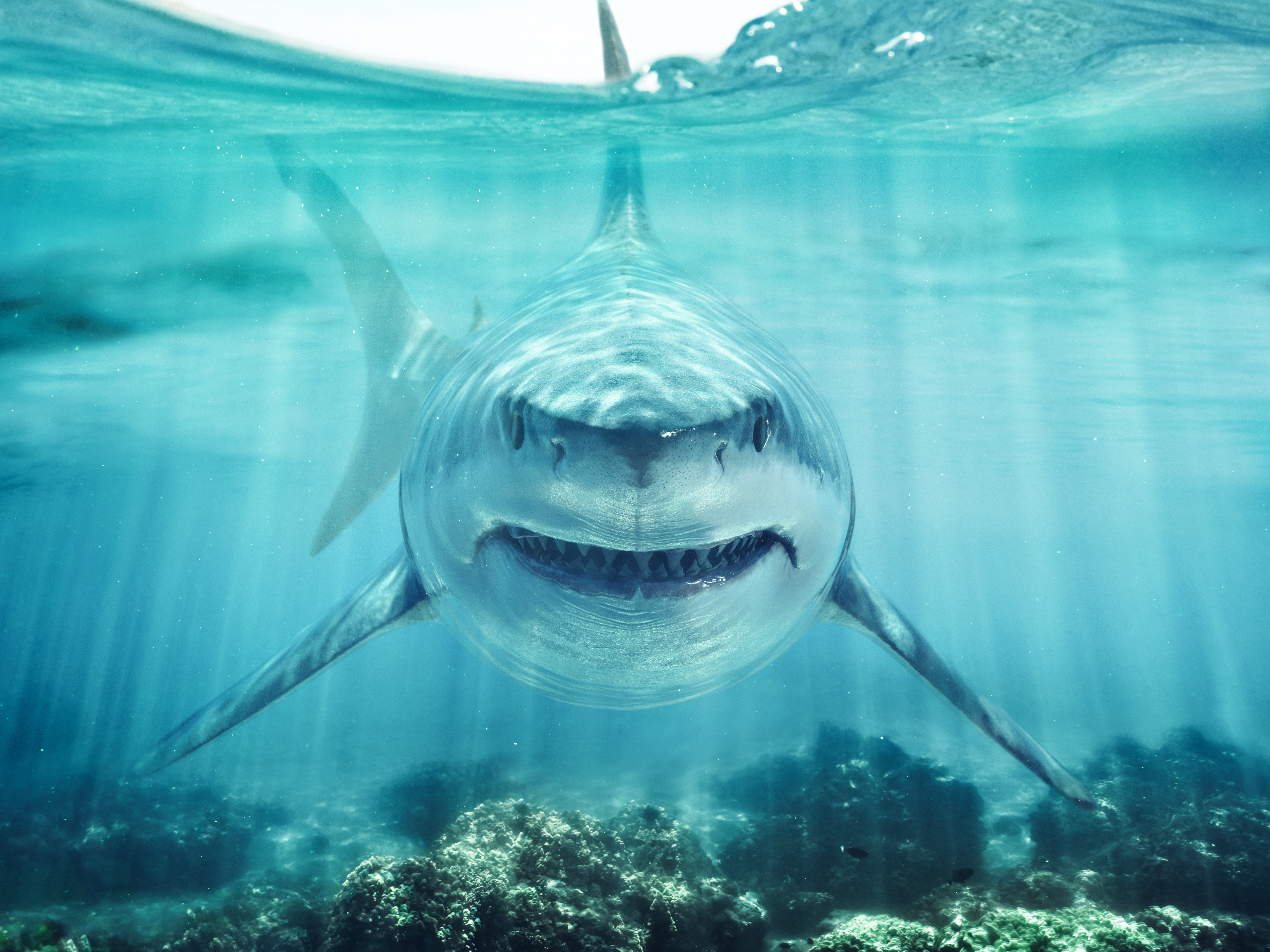
A 1,653-pound mature male great white shark, named ‘Contender’, has captured public and scientific attention after he “pinged” at one of the most northern locations ever recorded for his species in the Atlantic.
While headlines tout him as the “biggest ever,” the scientific story behind this 13-foot-9-inch predator is about far more than just his size. His movements are providing critical data that could help solve one of the biggest mysteries in marine biology.
Contender: A Key to Understanding Mature Great White Sharks

Contender is a mature male great white shark, estimated to be in his early 30s. He was measured, sampled, and tagged by the non-profit research group OCEARCH on January 17, 2025, approximately 45 miles off the Florida-Georgia border. He was named ‘Contender’ in honor of Contender Boats, a long-standing partner of the research organization.
His size is impressive, but his scientific value comes from his maturity. Male great whites typically reach maturity around 26 years of age. Contender, in his 30s, is a fully developed and experienced adult. Researchers have found it difficult to tag and study sharks of this size. As OCEARCH’s chief veterinarian, Dr. Harley Newton, noted, “animals of adult size have proven elusive.” Much of the existing data comes from smaller, sub-adult sharks, which can skew scientific models of population dynamics and behavior.
Contender provides a rare opportunity to fill this knowledge gap. Because he is a confirmed adult, his data offers a vital baseline for understanding the behavior of the “effective breeding population.” Dr. Newton described him as an “important part of the effective breeding population and will hopefully contribute to the rebuilding of the western North Atlantic white shark population.”
Furthermore, during the 15-minute workup, scientists collected a full suite of biological samples, including urogenital material. This gives them crucial information on his reproductive condition. This creates a powerful synergy between two datasets. The tracker answers “where” and “when,” while the biological samples help answer “why.” This elevates the research from simple observation to explanatory science, allowing researchers to form data-driven hypotheses about his behavior.
The ‘Biggest Ever’ Claim

The “biggest ever” description requires important context. This distinction is a key example of scientific precision versus media headlines. OCEARCH‘s official statement is that Contender is the “largest male white shark ever caught, SPOT tagged, released and now studied in the NW Atlantic white shark population” by their organization.
This specific phrasing matters because every word is a qualifier. It limits the claim to males (excluding larger females), to a specific method (physically caught and SPOT tagged, not just observed), a specific region (NW Atlantic), and a specific dataset (OCEARCH’s).
First, the claim is specific to males. Great white sharks exhibit sexual dimorphism, meaning females get significantly larger than males. This is an evolutionary adaptation thought to be necessary for carrying large litters of pups. An average mature female runs 15 to 16 feet long. Males, by contrast, average 11 to 13 feet. Contender, at 13′ 9″ and 1,653 pounds, is therefore an exceptionally large and impressive male, at the very top end of the scale for his sex.
However, he does not approach the size of the largest known females, such as ‘Nukumi’ (a 17 ft 2 in, 3,541-pound female also tagged by OCEARCH) or the famous ‘Deep Blue’ (estimated at ~20 ft and ~5,000 pounds).
Second, the claim is specific to the method. Contender’s length and weight are high-quality, verifiable data obtained through direct measurement. He was physically secured on the OCEARCH research lift, allowing scientists to use a tape measure. This is the gold standard for accuracy. In contrast, many of the “largest” sharks on record are estimates derived remotely from photographs or videos using photogrammetry. While modern techniques have improved, these estimates are still subject to a wider margin of error due to water distortion, perspective, and the lack of a fixed reference. Contender’s precise data provides a high-quality, high-certainty anchor point for scientific models. In research, a certain measurement can be more valuable than a larger, less certain estimate.
An Unprecedented Northern Journey

Since his tagging in January 2025, Contender has traveled more than 3,120 miles. His journey followed a typical pattern at first: north to the U.S. Mid-Atlantic and then to the foraging hotspots off Cape Cod by July. After leaving Massachusetts, he traveled more than 850 miles in just over 70 days.
In early October, however, he resurfaced in the Gulf of St. Lawrence and then off the Labrador Peninsula. This is an exceptionally rare track. Chris Fischer, OCEARCH’s founder, described the location as a place “we’ve never tracked a shark to” and “right on the northern edge of what’s considered the white shark range.”
This northern migration is not random. It is understood to be a period of intensive foraging, or hyperphagia. The shark is feasting on the area’s rich food supply, particularly high-density seals and schooling fish, to build up critical fat stores in his liver. These energy reserves are necessary to fuel his long migration back south and to provide the energy needed for reproduction.
His presence this far north also indicates a healthy local food web capable of supporting a top predator. This journey into historically cold waters also makes him a potential sentinel for changing ocean conditions. While white sharks are partially warm-blooded (a trait called regional endothermy) that- allows them to tolerate cooler water, his ability to thrive there raises questions about whether warming waters are expanding their viable foraging grounds.
This movement also appears to be proactive, not just reactive. Chris Fischer noted that the migration south is often triggered by the fall equinox. This suggests the sharks operate on a precise internal clock, or circannual rhythm, synchronized with Earth’s cycles, rather than simply reacting to dropping water temperatures.
How to Follow Contender in Real Time
The Contender is equipped with a SPOT (Smart Position or Temperature Transmitting) tag, a device carefully affixed to its dorsal fin. This tag has wet/dry sensors. When the fin is out of the water long enough for the sensors to dry, the tag activates and transmits its precise GPS location to the Argos satellite system. This event is logged as a “ping” that appears as a dot on a map, allowing researchers and the public to follow his movements.
OCEARCH makes this data available to the public in near real-time through its free Global Shark Tracker website and mobile app. Anyone can access this platform to see Contender’s full migratory path, watching as his track line extends over thousands of miles.
This transparency is part of a larger effort to demystify sharks and replace long-held fears with factual data. Instead of being seen only as a threat, animals like Contender become scientific ambassadors. The public can follow their natural movements, fostering a personal connection and a greater understanding of their true behavior, which in turn contributes to conservation awareness. The tag is expected to last for about five years, offering a valuable long-term look into his life.
The Ultimate Goal: Solving the Mating Mystery

Contender’s long-term value is his potential to help solve the “holy grail” of white shark research: finding their mating grounds.
To date, no one has ever definitively confirmed a mating site for any of the world’s white shark populations. Identifying and protecting these areas, where the sharks are vulnerable, is the top priority for long-term conservation.
The leading hypothesis for the Western North Atlantic population is that mating occurs in the spring off the coast of the Carolinas. Because Contender is a confirmed mature male with a known reproductive profile, his location during the spring 2026 mating season is expected to provide a “massive clue” to pinpoint these grounds.
The data from his tag could provide the hard evidence needed for policymakers to establish Marine Protected Areas (MPAs) or other seasonal protections, safeguarding the future of the entire species.
