
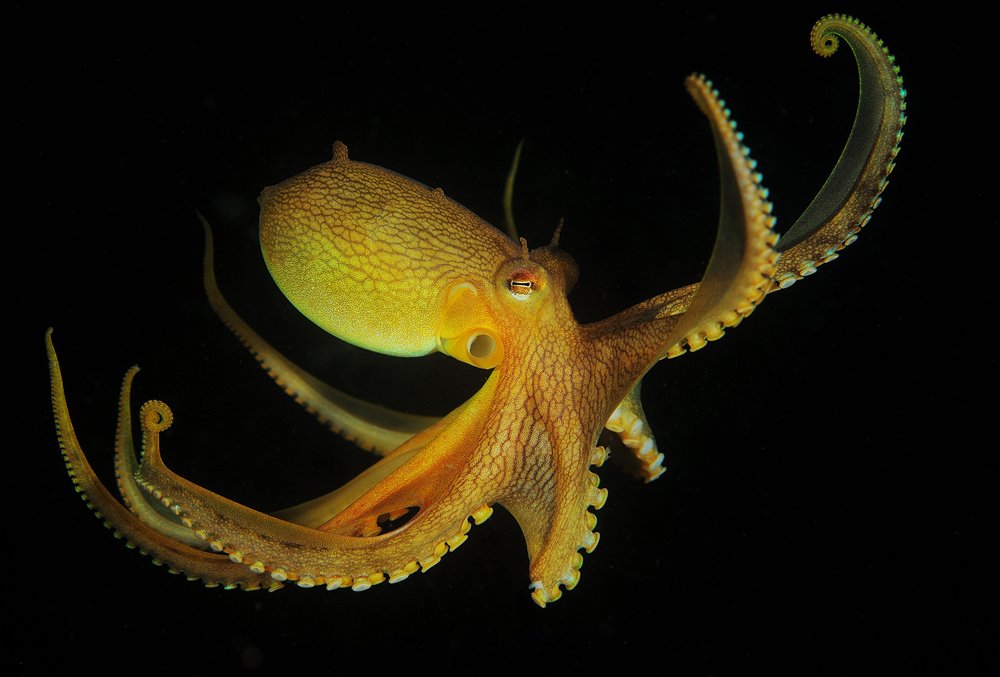
Inside the Aquarium of the Pacific in Long Beach, California, visitors gather in quiet awe before a tank that has become the setting of one of the most touching natural stories of recent memory. The star of this bittersweet tale is Ghost, a giant Pacific octopus who has captured the hearts of thousands. Once a lively, curious, and highly interactive creature, Ghost is now in the twilight of her short life, devoting her remaining energy to an act of devotion that is both deeply beautiful and heartbreakingly futile: protecting her unfertilized eggs. It is a cycle etched into the very biology of her species a biological destiny that sees her life drawing to a natural close even as her legacy swells in human memory.
What makes Ghost’s story so magnetic is not simply her impending death, but the profound connection she has managed to forge with people. Fans have written farewell messages on social media, worn sweaters emblazoned with her likeness, and even immortalized her through tattoos. She is, in many ways, a creature who transcended her tank, becoming not just an ambassador for her species but also a symbol of resilience, intelligence, and the curious bonds that can form between humans and animals. As she spends her final days tending to eggs that will never hatch, Ghost leaves behind something more enduring: a legacy of wonder that inspires reflection about life, devotion, and the fragile marvels of the natural world.
Ghost’s Journey from British Columbia to California Fame
Ghost’s story begins far from the aquarium lights of Southern California, in the cold and wild waters of British Columbia, Canada. It was here that she was first collected for scientific purposes, a tiny three-pound cephalopod no larger than a household cat. In May 2024, she arrived at the Aquarium of the Pacific and quickly began growing not just in size, but in reputation. Over the course of her stay, Ghost blossomed into a 48-pound powerhouse of personality, shattering the stereotype of the octopus as an aloof, solitary creature.
Caretakers and visitors alike recall Ghost’s spunky character. She was described as outgoing and even mischievous, sometimes shoving aside food not because she was disinterested but because she wanted to play. Staff members trained her to voluntarily climb into a basket for weigh-ins, a testament to her intelligence and adaptability.

She mastered mazes, solved puzzles, and manipulated toys with astonishing speed, showing off the cognitive brilliance octopuses are famous for. In fact, on one occasion, aquarium staff spent hours designing a complex acrylic maze, only for Ghost to master it almost instantly. These daily enrichment activities weren’t just for entertainment they simulated the problem-solving challenges of life in the wild, from cracking open clams to outmaneuvering crabs.
For the staff, Ghost was never just another animal. Her personality demanded acknowledgment. She engaged in ways that seemed unusually social for her species, even appearing to enjoy human interaction. In a world where octopuses are typically solitary and shy, Ghost’s willingness to connect with her human caretakers was exceptional, and this bond only deepened the affection people felt for her.
The Poignant Cycle of Senescence

Yet for all her charisma and intelligence, Ghost is still bound to the immutable life cycle of the giant Pacific octopus. Like every female of her kind, she is destined to experience senescence, the final stage of life that follows reproduction. Once an octopus lays her clutch of eggs, she devotes herself wholly to protecting them, sacrificing her own health and strength in the process. She stops eating, her body gradually weakens, and over weeks or months, she fades away.
Ghost laid her eggs in recent weeks, and in doing so, she stepped into this final, inevitable stage. Her clutch, however, is unfertilized. No hatchlings will ever emerge from the eggs she so carefully guards. To human eyes, the image of Ghost fasting and weakening while tending to eggs doomed never to live may appear tragic, but in biological terms, it is a testament to the relentless drive of evolution. Her instincts are absolute, compelling her to prioritize her offspring even if the outcome is predetermined.
According to Nate Jaros, the aquarium’s vice president of animal care, this phase is typical of the species, though no less remarkable. “Octopuses only reproduce once,” he explained. “The females spend the remainder of their lives caring for the eggs and ensuring they have the best chance of hatching and survival.” In the wild, this devotion increases the odds that at least a small fraction of offspring will survive, despite the staggering numbers stacked against them. A single female giant Pacific octopus can lay up to 100,000 eggs, yet fewer than one percent will survive to adulthood. Ghost’s eggs will never hatch, but her care embodies the same ancient evolutionary script.
A Viral Sensation Beyond the Tank
Even before she entered senescence, Ghost had already become a viral celebrity. Her charm and intelligence made her a fan favorite, and the aquarium’s posts about her quickly spread across social media. Videos of her exploring mazes, interacting with staff, or simply resting in her tank drew in thousands of views. She inspired an emotional connection that few expected from a cephalopod. Ghost wasn’t just another marine exhibit she was a personality, a symbol, a creature with a story.
Now, as news of her decline spreads, the outpouring of love has only intensified. Fans have taken to Instagram to leave heartfelt comments, with the aquarium itself posting, “She is a wonderful octopus and has made an eight-armed impression on all of our hearts.” Visitors arriving at the aquarium are sometimes surprised to find her tucked away in a quieter, private tank, moved there so she could spend her last days in peace. For some, a final visit has been more than just a chance to say goodbye; it’s been a way of honoring a creature who changed the way they see marine life.
One such admirer is Jay McMahon, a marine biology student from Los Angeles, who spoke of how meaningful Ghost’s presence has been in his life. Having visited the aquarium since childhood, McMahon described seeing Ghost as a source of inspiration for his studies. “When you make a connection with an animal like that and you know they don’t live for that long, every moment means a lot,” he reflected. Ghost’s story has encouraged him, and many others, to deepen their interest in the natural world.
The devotion of Ghost’s fans has been tangible: sweaters bearing her likeness, tattoos inked in her memory, and online tributes filled with messages of thanks. In the world of viral sensations, Ghost has proven that sometimes the most powerful icons aren’t pop stars or politicians, but animals who quietly capture human imagination with their own silent but extraordinary stories.
Ghost’s Extraordinary Intelligence and Human Connection

What truly sets Ghost apart, beyond her viral fame, is the way she exemplifies the intelligence and personality of octopuses. Scientists have long marveled at cephalopods, with their complex nervous systems, color-changing camouflage, and problem-solving abilities. Ghost demonstrated all of this and more, reminding us that intelligence is not confined to mammals or birds.
Caretakers frequently observed Ghost making choices that hinted at preference, curiosity, and perhaps even playfulness. She was known to push aside food when she preferred to interact with staff, suggesting that social engagement mattered as much as her meals. On other occasions, she demonstrated remarkable dexterity, unscrewing jars or manipulating puzzle boxes designed to challenge her. These behaviors underscore why octopuses are often compared to primates in their cognitive sophistication.
Her intelligence also created opportunities for caretakers to build trust-based routines. Training her to voluntarily enter a basket for weigh-ins was no small feat. It required patience, trust, and communication between species a remarkable achievement when one considers that octopuses are evolutionarily distant from us, separated by more than 600 million years of divergence. And yet, Ghost bridged that gap. She engaged with humans in a way that many visitors found profoundly moving, blurring the line between human and animal connection.
The Legacy Ghost Leaves Behind

While Ghost’s life is nearing its natural end, her story will outlive her. The aquarium has already welcomed a new octopus a young, two-pound cephalopod who has yet to be named but is already showing signs of curiosity and outgoing personality. This newcomer will carry on Ghost’s mission of educating the public about marine life, intelligence, and the fragile balance of ocean ecosystems. But even as the next generation steps in, Ghost’s impact lingers.
Her legacy is not just scientific or educational but emotional. She has reminded countless people that animals, even those as alien-seeming as octopuses, are capable of sparking deep human connection. For some, she has been a symbol of maternal devotion, embodying the paradox of life’s cycles: a creature giving everything to eggs that will never hatch. For others, she has been a mirror of resilience and grace in the face of inevitability. And for children and young students, she has been a source of inspiration to pursue science, to care about the ocean, and to see intelligence in unexpected forms.
Ghost’s story has also drawn attention to the importance of aquariums as spaces of learning and connection. While debates around animal captivity persist, stories like Ghost’s highlight the potential for ethical care and education that inspire people to see the natural world differently. Ghost was not just on display; she was a participant in shaping human understanding of her species. Through her, thousands of visitors and online followers gained a more intimate glimpse into the mysteries of ocean life.
The Enduring Eight-Armed Impression
Ghost’s journey from the icy waters of British Columbia to her final days in California has become more than a biological inevitability it has transformed into a narrative about love, connection, and the profound impact that one creature can have on countless human lives. She has shown the world the beauty of octopus intelligence, the poignancy of natural cycles, and the enduring mystery of the ocean’s most charismatic creatures.
As fans continue to leave messages, wear Ghost-themed sweaters, or ink her likeness into their skin, they testify to the bond she created. Ghost’s eggs may never hatch, but her story has seeded something else: a collective memory, a sense of awe, and a reminder of the fragile brilliance of life beneath the waves. In her quiet final days, Ghost is still teaching us about devotion, about wonder, and about the threads that connect all living things.
Her story closes not in silence, but in resonance. The eight-armed impression she leaves behind will linger, reminding us that sometimes the most powerful teachers are found in unexpected places, and that even as life fades, its impact can expand infinitely outward.
