
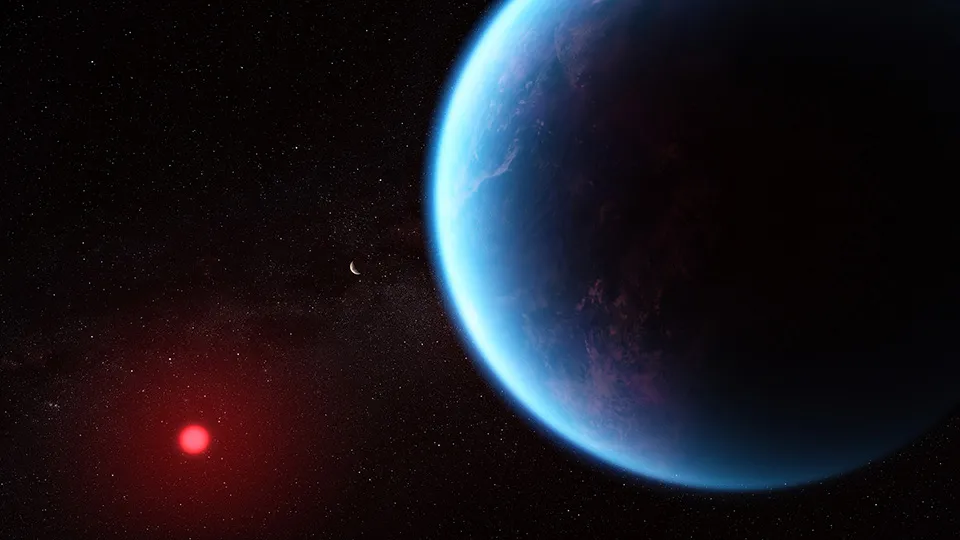
The cosmos has always sparked our imagination, and over the years, astronomers and scientists have looked to the stars with a profound question: Are we alone? While this question may have seemed speculative just a few decades ago, today, thanks to the cutting-edge technology of the James Webb Space Telescope (JWST), we’re getting closer to the truth. Recently, a groundbreaking discovery has brought us closer to answering that question.
Astronomers, using JWST, detected a molecule called dimethyl sulfide (DMS) in the atmosphere of an alien planet, K2-18 b. As scientists emphasize, this molecule is uniquely produced by life on Earth—specifically, by microscopic plant-like organisms called phytoplankton. Even more extraordinary, this detection occurred on an exoplanet 120 light-years away, orbiting a distant star.
While still in its early stages, this discovery could be a game-changer in the search for life beyond Earth. Let’s dive into the details of this remarkable breakthrough and explore why K2-18 b, a distant world, could hold the key to finding extraterrestrial life.
Life’s Building Blocks Found

Webb’s sensitive instruments detected several key molecules in K2-18’s atmosphere. Methane and carbon dioxide appeared in significant amounts – both gases play crucial roles in supporting life as we know it. Living organisms produce much of our methane on Earth, making its presence on K2-18 b particularly intriguing.
The most exciting discovery was finding DMS, a molecule produced by microscopic sea life on Earth. Marine plankton releases DMS as part of their life processes. Finding similar chemistry on K2-18 b hints at a possible parallel evolution of life in space.
Scientists emphasize caution about DMS detection. More observations must confirm its presence. Yet finding such a specific chemical signature excites researchers – it’s like discovering a fingerprint that might point to alien life.
K2-18 b: An Alien World Worth Our Attention
Located in the constellation Leo, K2-18 b is not your average exoplanet. This world, about 8.6 times as massive as Earth, is orbiting a cool dwarf star in what’s known as the “habitable zone.” The habitable zone is the sweet spot around a star where conditions are just right for liquid water to exist—one of the essential ingredients for life as we know it.
K2-18 b stands out from many other exoplanets we’ve discovered. Its size places it in the category of “sub-Neptunes,” a class of exoplanets larger than Earth but smaller than Neptune. While these planets don’t exist in our solar system, they are among the most common planets found in our galaxy. Despite their prevalence, sub-Neptunes remain poorly understood, especially regarding their atmospheres.
The intrigue surrounding K2-18 b is compounded by its possible classification as a “Hycean” world. This newly proposed class of exoplanets features hydrogen-rich atmospheres and vast water-covered oceans. These unique conditions could make them much more suitable for studying alien life than rocky planets, which, until now, have been the primary focus of astronomers.
Comparing Earth and K2-18 b
While K2-18 b may seem like a distant, alien world, comparing it to Earth helps put its potential for life into perspective. Earth, our home, is a small, rocky planet with a rich, oxygen-rich atmosphere and diverse life forms that depend on liquid water. It is ideally positioned in our Sun’s habitable zone, where conditions are just right for life to thrive.
In contrast, K2-18 b is far larger—about 8.6 times the mass of Earth—and classified as a “sub-Neptune” with a hydrogen-rich atmosphere. Instead of a rocky surface like ours, it likely has a thick, ocean-covered surface. Its atmosphere, rich in hydrogen, methane, and carbon dioxide, differs greatly from Earth’s oxygen-nitrogen mix. Yet, its position in its star’s habitable zone and the possibility of liquid water beneath its clouds make it a compelling candidate for life. While the specifics of life on K2-18 b remain unknown, its unique features present an entirely different environment from Earth but with some key similarities, making it an intriguing subject for further exploration in the search for life beyond our planet.
The Power of the James Webb Space Telescope

The James Webb Space Telescope, launched by NASA in collaboration with the European Space Agency (ESA) and the Canadian Space Agency, has proven invaluable in the search for life beyond Earth. Unlike its predecessors, such as the Hubble Space Telescope, JWST is equipped with state-of-the-art technology that allows astronomers to peer deeper into the universe and observe exoplanets with unprecedented detail.
One of JWST’s most powerful features is its ability to perform transmission spectroscopy. This technique involves analyzing the light from a distant star as it passes through a planet’s atmosphere orbiting that star. The starlight is absorbed by different molecules in the atmosphere, and scientists can identify the gases present by studying the missing wavelengths of light.
This is precisely how the team of astronomers studying K2-18 b was able to detect the presence of methane (CH4), carbon dioxide (CO2), and, most remarkably, dimethyl sulfide (DMS) in the planet’s atmosphere. This discovery was made possible by JWST’s incredible sensitivity and the wide range of wavelengths it can observe. The data from just two transits of K2-18 b provided the most detailed spectrum of a habitable-zone sub-Neptune to date—information that took years to gather with previous telescopes.
The Molecule That Could Change Everything

Bin im Garten Wikimedia Commons
Dimethyl sulfide (DMS) is the key molecule buzzing among scientists. DMS is a chemical compound that is unique to life on Earth. It is primarily produced by marine phytoplankton, tiny plant-like organisms that live in Earth’s oceans. DMS is released into the atmosphere in large quantities on our planet, and its presence is a clear sign of biological activity.
That’s why detecting DMS in the atmosphere of K2-18 b is so exciting. If confirmed, it would be the first time scientists have found a molecule on an exoplanet linked directly to biological processes. “This (dimethyl sulfide) molecule is unique to life on Earth: There is no other way this molecule is produced on Earth,” said astronomer Nikku Madhusudhan in a University of Cambridge video. “So it has been predicted to be a very good biosignature in exoplanets and habitable exoplanets, including Hycean worlds.”
However, as thrilling as this discovery is, scientists remain cautious. The detection of DMS is still tentative, and more observations are needed to confirm its presence at significant levels. As Madhusudhan pointed out, “The detection of DMS is not robust and requires further validation.” While this is undoubtedly a tantalizing clue, it’s far from definitive proof of life on K2-18 b.
The Other Key Findings: Methane, Carbon Dioxide, and the Ocean Beneath

Alongside DMS, the team also detected methane and carbon dioxide in the atmosphere of K2-18 b. These two gases are commonly associated with life on Earth, but non-biological processes can also produce them. However, their presence on K2-18 b is significant because it supports the hypothesis that the planet could have a water ocean underneath its hydrogen-rich atmosphere. This is consistent with the idea that K2-18 b could be a Hycean world.
Interestingly, the researchers did not find ammonia in the planet’s atmosphere, which further supports the idea of a water ocean beneath the atmosphere. Ammonia would likely be present in large quantities if the planet’s surface were too hot for liquid water. The absence of ammonia, combined with methane and CO2, suggests that the planet may harbor conditions suitable for liquid water—potentially making it more hospitable for life.
In addition, scientists could study the composition of K2-18 b’s atmosphere in greater detail thanks to JWST’s ability to detect molecular signatures across a wide range of wavelengths. “This result was only possible because of the extended wavelength range and unprecedented sensitivity of Webb, which enabled robust detection of spectral features with just two transits,” said Madhusudhan. The team was able to collect more information about K2-18 b in two transits than would have been possible with eight years of observations from Hubble.
What’s Next for K2-18 b and the Search for Life?

While discovering DMS and other key molecules is groundbreaking, it’s just the beginning. The team’s next step is to conduct further observations of K2-18 b using JWST’s Mid-Infrared Instrument (MIRI), which will help confirm the presence of DMS and provide additional insights into the planet’s atmosphere and potential for life.
The team’s goal is nothing short of transformational: “Our ultimate goal is the identification of life on a habitable exoplanet, which would transform our understanding of our place in the universe,” Madhusudhan said. While we are still far from confirming life on K2-18 b, this discovery has certainly opened up new possibilities for the search for extraterrestrial life.
Could This Be the First Step Toward Finding Life Beyond Earth?
The idea of finding life beyond Earth is no longer confined to science fiction. With each discovery, we are inching closer to a future where we can answer whether we are alone in the universe. K2-18 b is one of many exoplanets being studied by astronomers, but it has quickly become one of the most intriguing candidates for further exploration.
As scientists continue to study exoplanets, they will look for more signs of life—whether through molecules like DMS or other potential biosignatures. And while it may take years—or even decades—to confirm whether life exists on K2-18 b, the implications of this discovery are far-reaching. If life can exist in a world so far from Earth, it would mean that life is potentially more common in the universe than we’ve ever imagined.
A New Era in the Search for Life
The discovery of dimethyl sulfide on K2-18 b is one of the most significant breakthroughs in the search for extraterrestrial life. While the evidence is still tentative, it represents a significant leap forward in our understanding of exoplanetary atmospheres and the potential for life beyond Earth. With the JWST continuing its observations, we may be on the brink of uncovering more evidence that could one day transform our view of the universe.
So, while we may not have definitive proof of life on K2-18 b just yet, this discovery brings us closer to understanding whether we are alone in the cosmos. As scientists continue to peer deeper into the vastness of space, the possibility that we are not the only ones in the universe becomes more honest with each passing day. The journey has only begun, and the stars are waiting for us to uncover their secrets.
