
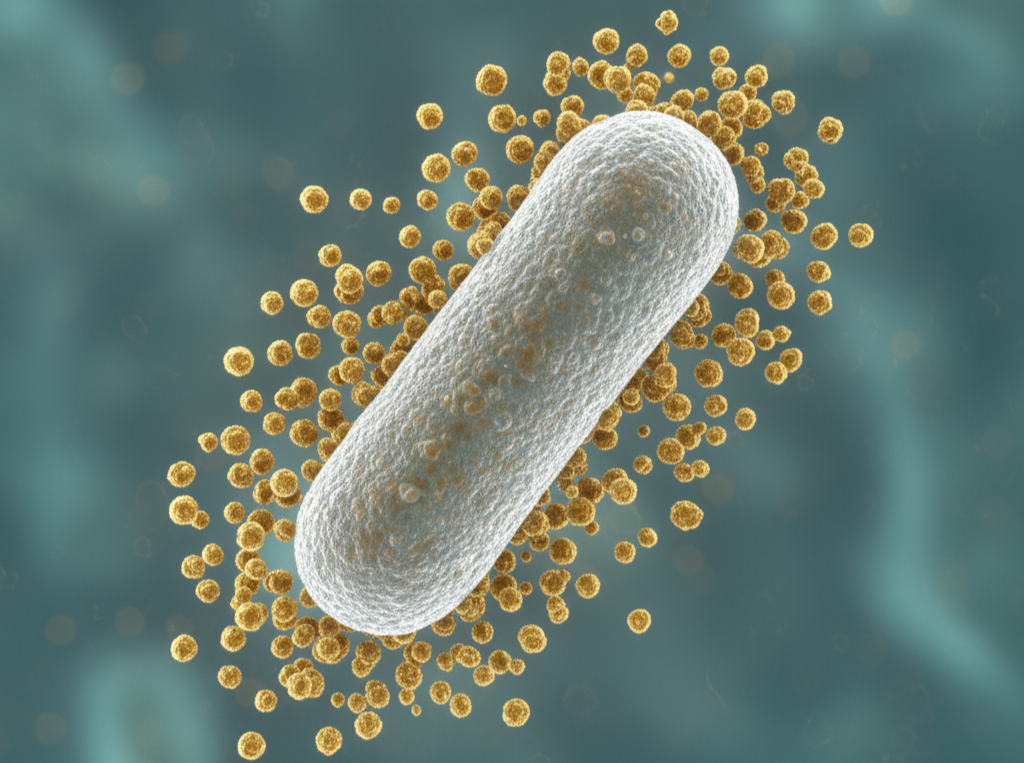
What if a living creature could perform alchemy? It sounds like a myth: a tiny, microscopic bug that reportedly “eats” deadly metal and “poops” out pure, 24-karat gold. This fantastic story has captured headlines, but it also hints at a far more complex and bizarre survival story hidden in some of the most toxic places on Earth, where the line between poison and treasure is surprisingly thin.
What is This “Gold-Making” Bug?

The star of our story is Cupriavidus metallidurans, a bacterium fittingly nicknamed the “metal-lover.” It thrives in places that would kill most other life: industrial waste sites and soils packed with toxic heavy metals. These environments are like a chemical warzone, but for this bug, it’s home.
So how does it live there? This brings us to a big myth: the idea that it “eats” metal. Biologically, that’s not true. This bug doesn’t eat metal for energy. Its official title is “chemolithoautotroph,” a fancy term meaning it makes its own food from simple chemicals. Much like a plant uses sunlight, this bug uses hydrogen gas for energy and pulls carbon dioxide from the air to build its body. For this organism, metals are not food; they are a deadly threat.
Why would it live in such a poisonous place? The answer is evolution. Think of it like finding an apartment in a crowded city. All the nice, safe neighborhoods are full. But if you could find a way to survive in an abandoned, toxic factory, you’d have the whole place to yourself. That’s what this bug did. By evolving a tolerance for heavy metals, it carved out its own “ecological niche” where it has no competition. But this survival comes at a cost: the bug must constantly fight and “detox” its poisonous surroundings just to stay alive.
The Real Story: A Genius Survival Trick

The biggest challenge for this bug isn’t just one metal, but a deadly combination. When both gold and copper are present, they create “synergistic toxicity”: meaning together, they are far more poisonous than either one alone.
Here’s how this deadly combo works:
- First, dissolved gold particles (gold ions) seep into the bug’s outer layers.
- The gold immediately attacks and breaks the bug’s most important defense: a molecular “pump” that’s supposed to remove unwanted copper.
- With the pump jammed, copper floods the bug’s insides and builds up to fatal levels, poisoning it from within.
Faced with this chemical attack, the bug activates a biological emergency kit. The most important tool is an enzyme called CopA, which acts like a personal bodyguard. The bug sends CopA to a “security zone,” the space between its inner and outer membranes.
Here, the CopA bodyguard intercepts the toxic gold ions before they can break the pump. It then performs an amazing bit of chemistry: it transforms the dangerous, dissolved gold (Au³⁺) into harmless, solid, stable gold (Au⁰). These solid particles are, at the nanoscale, pure 24-karat gold.
In a brilliant act of self-defense, the bug turns a deadly poison into a harmless speck of metal. This process, first understood in the early 2000s, is how it survives. However, the amount of gold created is minuscule. We’re talking about “nanoparticles”—particles so small you’d need millions just to see a tiny glint, far too little to ever be useful for mining.
The Truth Behind the “Gold-Pooping” Myth

So, what about those “gold-pooping” headlines? As you can probably guess, that’s not really accurate.
The words “eating” and “pooping” describe processes that happen inside a body. You eat food, your body digests it internally, and you… well, you get the idea.
This bug’s process is totally different. The entire transformation from poison to gold happens outside the bug’s main body. It all happens in that “in-between” space, the security zone between its inner and outer skins.
The bug isn’t digesting gold; it’s imprisoning it.
A better way to think of it is that the bug is building a tiny, nanoscale jail cell for the toxins. Or, even better, it’s building a suit of armor for itself. It traps the dangerous gold on its “skin,” turning it into a solid, metallic shield. Once the gold is in this solid form, it’s immobilized. It’s stuck, harmless, and can’t hurt the bug anymore. It just stays there, glittering on the outside of the microbe.
What Does This Mean for Humans?

Despite the exciting headlines, this discovery is not going to start a new gold rush. No one is going to get rich by farming these bacteria. The amount of gold they create is invisible to the naked eye. It’s just not a practical way to get gold.
This myth of a “gold-making” bug actually became famous back in 2012, not from a mining company, but from an art-science project. An artist named Adam Brown created an exhibit called The Great Work of the Metal Lover. He used these real bacteria in a lab to explore ideas of alchemy, science, and turning something worthless (toxins) into something priceless (gold). It was meant as a beautiful metaphor, not a business plan.
So, if it won’t make us rich, what’s the big deal?
The real potential of this bacteria is in a totally different area: sustainable, “green” technology. The tiny gold particles it creates, called “biogenic nanoparticles,” are incredibly valuable to science.
The Rise of “Green Synthesis”

We already use gold nanoparticles in many high-tech fields. They are used in sensitive medical sensors, in electronics, and even in advanced treatments to target and kill cancer cells. But the way we usually make these nanoparticles is a big problem.
The traditional method is “brute-force” chemistry. It involves high temperatures, high pressure, and a lot of toxic, environmentally harmful chemicals. It’s expensive, energy-hungry, and dirty.
This is where our metal-lover bug offers a brilliant alternative. The bug makes perfect gold nanoparticles at room temperature, with zero toxic chemicals and almost no energy. It’s a clean, safe, and completely sustainable process. Scientists call this “green synthesis”: using biological systems to build valuable materials for us in an eco-friendly way.
What’s more, the nanoparticles made by this bug are special. They come “biologically capped,” meaning they are coated with natural molecules from the bug. This natural coating makes them more stable and, for medical uses, potentially safer and more effective in the human body. Researchers are already exploring how to use these nature-made nanoparticles to fight viruses, deliver drugs, and create new diagnostic tools.
A Window Into Earth’s Hidden Alchemy

Beyond technology, these little bugs also help us solve one of geology’s oldest puzzles: how do gold nuggets form?
We know gold comes from stars and is deep in the Earth’s core. But we also find it in “secondary” deposits, as grains and nuggets in riverbeds and soil near the surface. How did it get there?
Our metal-lover bug gives us a clue. In nature, these bugs don’t live alone; they live in slimy colonies called “biofilms” that coat rocks and tiny gold particles. As generations of these bugs live and die, they are all constantly performing their self-defense trick—turning dissolved gold poison into solid gold specks.
In nature, these bugs don’t live alone; they live in slimy colonies called “biofilms” that coat rocks and tiny gold particles. As generations of these bugs live and die, they are all constantly performing their self-defense trick: turning dissolved gold poison into solid gold specks.
Over millions of years, these microscopic coatings of gold accumulate. They build up, layer upon layer, fusing together. This slow, patient, biological process may be exactly how those gold grains and nuggets grow. … existingG code …
The Bigger Picture: Nature’s Ingenious Survival
In the end, this story isn’t really about gold. It’s about survival and adaptation. Cupriavidus metallidurans is a powerful symbol of how life finds a way to thrive in even the most impossible, uninhabitable environments.
It doesn’t create gold out of greed or for wealth. It creates gold out of necessity, to protect itself from a harsh world. In turning its greatest enemy, poison, into a harmless, beautiful treasure, it shows us a deep truth: evolution can transform adversity into brilliant innovation.
This discovery reminds us that microorganisms, the invisible life all around us, are not just “simple” germs. They are the planet’s greatest chemists. For billions of years, they have been shaping our world, from the minerals in the ground to the air we breathe.
So, while the idea of a “gold-eating bacterium” sounds like a tall tale, it’s actually one of nature’s most brilliant and beautiful survival strategies. These microscopic alchemists won’t make us rich, but they might just inspire a new generation of clean, sustainable technologies. And they remind us that sometimes, the smallest and most overlooked organisms can create the most dazzling wonders.
