
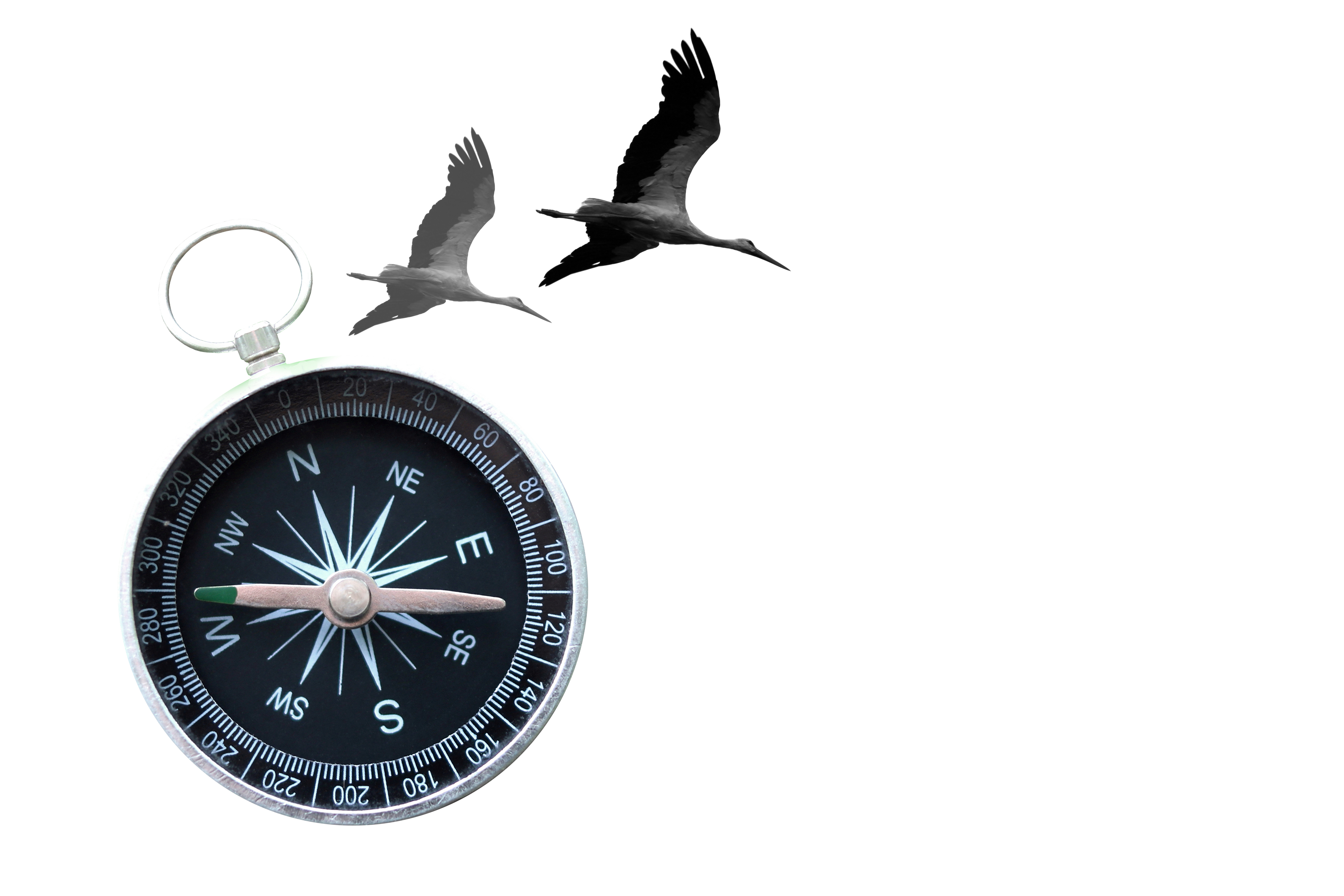
Picture a young Bar-tailed Godwit standing on Alaska’s windswept tundra. Weighing barely a pound, this leggy shorebird faces one of nature’s most impossible challenges. Winter approaches, and an ancient instinct pulls at its core—time to fly. Not just any flight, mind you. A nonstop transequatorial flight lasting at least seven days and nights across the Pacific Ocean to New Zealand, 12,000 kilometers away. It’s do or die.
No experienced guides lead the way—no GPS chirps directions. Yet somehow, this feathered navigator will thread the needle across 7,500 miles of open ocean with pinpoint accuracy. How?
Scientists have wrestled with this puzzle for decades, but recent discoveries reveal something extraordinary happening inside those tiny bird brains—something that sounds more like science fiction than biological reality. Prepare to discover how evolution equipped migratory birds with quantum-powered vision that allows them to see Earth’s invisible magnetic highways.
When Navigation Becomes Superhuman
Human navigators rely on instruments, maps, and satellites. Birds? Birds came equipped with something far more sophisticated—multiple navigation systems working in perfect harmony. As researchers discovered, “Migratory birds have an internal clock with an annual rhythm that tells them, among other things, when to migrate. They also inherit from their parents the directions in which they need to fly in the autumn and spring,” creating a biological GPS that makes our technology look primitive.
Birds possess three distinct compass systems. Solar navigation tracks the sun’s position across the sky. Stellar navigation reads star patterns like a cosmic roadmap. But the third system—magnetic navigation—operates on principles that challenge everything we thought we knew about biological sensing.
Unlike a traditional compass needle that swings toward magnetic north, bird compasses work differently. Birds detect the inclination angle where magnetic field lines meet Earth’s surface. Even more remarkably, flipping a magnetic field completely backward doesn’t confuse them. Their compass responds to field geometry, not polarity—a design feature that would make human engineers jealous.
Seeing What Humans Cannot

Here’s where the story gets wild. Birds don’t just sense magnetic fields—they see them. Imagine looking up at the sky and witnessing shimmering streams of magnetic energy overlaying your normal vision, creating a three-dimensional map of invisible highways stretching across continents.
Research teams discovered that a brain region called Cluster N processes both visual information and magnetic data simultaneously. When scientists damaged this area in European Robins, the birds could still navigate using the sun and stars but lost their magnetic abilities entirely. Magnetic sensing happens directly through their eyes, not through some separate organ.
But how do eyes, evolved for detecting light, suddenly become magnetic field detectors? Scientists suspected something unprecedented was happening at the molecular level.
Quantum Mechanics Takes Flight

Enter the realm of quantum physics, where particles behave in ways that defy common sense. In the 1970s, physicist Klaus Schulten proposed a radical idea: bird navigation might rely on quantum effects occurring inside their retinas.
Specifically, Schulten theorized that magnetically sensitive chemical reactions involving “radical pairs”—molecular fragments with unpaired electrons—could detect Earth’s magnetic field. Initially, this seemed impossible. Earth’s magnetic field is millions of times too weak to affect normal chemical bonds.
But radical pairs aren’t normal. When two radicals form simultaneously through chemical reactions, their unpaired electrons can exist in quantum-entangled states. External magnetic fields can influence this quantum dance, creating detectible changes in chemical reactions—even when those magnetic fields are incredibly weak.
Molecular Machinery of Navigation

Deep within the retinas of birds lies a protein called cryptochrome, particularly a variant called Cry4a, which is found in migratory species. When blue light hits cryptochrome, it triggers a remarkable molecular chain reaction.
Buried in cryptochrome’s core sits a yellow molecule called flavin adenine dinucleotide (FAD). Connected to this FAD are chains of tryptophan amino acids that stretch toward the protein’s surface, much like molecular wires. When FAD absorbs blue light, electrons hop along this tryptophan chain, creating radical pairs separated by just two nanometers.
Here’s the quantum magic: “Immediately after a radical pair is created in a singlet state, internal magnetic fields cause the two electronic spins to undergo a complex quantum ‘waltz’ in which singlet turns into triplet and triplet turns back into singlet millions of times per second for periods of up to a few microseconds.” Earth’s magnetic field subtly influences this quantum waltz, creating directional information that translates into visual signals.
How Scientists Proved Birds Use Quantum Navigation

To test how birds might use quantum physics to navigate, scientists needed to study the special protein involved—cryptochrome. This wasn’t easy, but researchers managed to extract a type called Cry4a from European Robins, a migratory bird.
They exposed this protein to weak magnetic fields similar to Earth’s. The results were striking: Cry4a reacted strongly, proving it could sense even very faint magnetic signals.
To learn more, scientists compared Cry4a from robins with the same protein from birds that don’t migrate, like pigeons and chickens. The robin’s version was much more sensitive, suggesting that evolution has fine-tuned it for long-distance navigation.
Even more fascinating, they found that robins produce higher levels of Cry4a only during migration season, then reduce it afterward. This shows that the birds switch on their quantum navigation system only when they need it, saving energy the rest of the year.
When Human Technology Disrupts Quantum Biology

Modern cities present an unexpected threat to quantum-powered navigation. Weak radio frequencies from electronic devices create “electrosmog” that scrambles bird compasses. European Robins tested in Oldenburg, Germany, became completely disoriented in normal laboratory buildings but navigated perfectly when researchers lined test chambers with aluminum shielding.
Even more remarkably, moving the same birds to rural locations far from electronic interference restored their navigation abilities instantly. Radio waves millions of times weaker than those affecting human electronics can completely disrupt quantum processes in bird eyes.
These findings provide powerful evidence for the radical pair mechanism. Iron-based magnetic sensors wouldn’t respond to rapidly fluctuating radio frequencies, but quantum spin states would. Birds essentially carry biological quantum computers optimized for navigation—computers vulnerable to interference from our electromagnetic world.
Quantum Biology’s Evolving Horizons

Scientists are racing to prove that radical pairs form in the eyes of living birds during navigation. Current evidence strongly supports the quantum hypothesis, but direct observation of quantum effects in living tissue remains challenging. As one researcher noted, “If we can prove that a radical-pair mechanism is behind the magnetic sense in vivo, then we will have shown that a biological sensory system can respond to stimuli several million times weaker than previously thought possible.”
Artificial quantum sensors inspired by bird vision could revolutionize human technology. Imagine navigation systems that work underwater, underground, or in space—anywhere magnetic fields exist. Military applications include quantum compasses immune to electronic jamming.
Biomedical research explores whether similar quantum processes occur in human cells. Some studies suggest that human cryptochromes may retain vestigial magnetic sensitivity, albeit at a level far weaker than that of bird versions.
Mind-Blowing Reality Check
Next time you spot a small songbird, pause and consider the quantum computer housed inside its gram-sized brain. Evolution discovered quantum mechanics millions of years before human physicists, embedding cutting-edge physics into everyday biological processes.
Migratory birds navigate using quantum entanglement, see magnetic fields as visual overlays, and process directional information through molecular machinery that would impress quantum engineers. Science fiction has become a biological fact, hidden in plain sight above our heads.
Every spring and fall, billions of birds launch quantum-powered journeys across continents and oceans. Armed with nothing but inherited programming and quantum vision, they navigate our planet’s invisible highways with precision that continues to humble human technology.
Perhaps the most astonishing revelation isn’t that birds use quantum physics—it’s that quantum effects operate routinely in biological systems we’re only beginning to understand. Birds aren’t just flying; they’re quantum computing their way across the world.
Source:
- Hore, P. J., & Mouritsen, H. (2024, February 20). How migrating birds use quantum effects to navigate. Scientific American. https://www.scientificamerican.com/article/how-migrating-birds-use-quantum-effects-to-navigate/
