
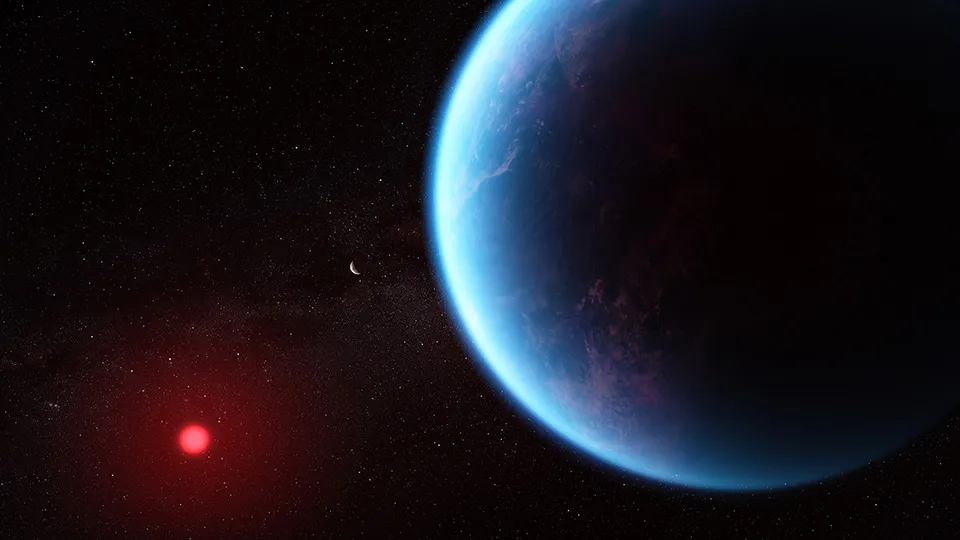
In a groundbreaking announcement quietly rocking the scientific community, astronomers at the University of Cambridge have revealed the strongest hints yet of biological activity outside our solar system. While celebrities making brief jaunts to the edge of space might grab headlines, this discovery could fundamentally change our understanding of life in the universe.
This incredible finding focuses on an exoplanet called K2-18 b, located roughly 120 light-years away from Earth. Using the James Webb Space Telescope (JWST), researchers have detected chemical signatures in this distant world’s atmosphere that are only produced by living organisms on Earth.
The study, titled “New Constraints on DMS and DMDS in the Atmosphere of K2-18 b from JWST MIRI” and published in The Astrophysical Journal Letters, represents a significant milestone in humanity’s search for extraterrestrial life.
Meet K2-18 B

K2-18 b is what astronomers call a “sub-Neptune” – larger than Earth but smaller than Neptune – with a mass approximately 8.6 times Earth’s. It orbits a cool dwarf star called K2-18 in the habitable zone, where temperatures could allow liquid water to exist on a planet’s surface.
The planet is considered a prime example of a “Hycean world” – a type of planet with a hydrogen-rich atmosphere above what could be a planet-wide ocean. This planetary classification, developed in recent years, significantly expands the search for habitable environments beyond Earth-like planets.
Previous observations had already suggested K2-18 b might have an ocean-covered surface beneath its hydrogen-rich atmosphere. The new findings support this hypothesis, as DMS and DMDS are associated with marine biological activity on Earth.
What Exactly Did They Find?
Astronomers found two chemicals in K2-18 b’s atmosphere that suggest possible life: dimethyl sulfide (DMS) and dimethyl disulfide (DMDS). Think of these as the “breath” of ocean microbes. On Earth, these chemicals only come from living things—specifically, tiny marine organisms like the algae in our oceans.
Why is this such a big deal? Unlike other gases like methane or carbon dioxide (found earlier on this planet), these sulfur compounds aren’t typically produced by non-living processes. On Earth, when we detect DMS in the air, it means there’s life in the water below.
The scientists are 99.7% confident that they’re seeing these chemicals and not just random noise in their data. That’s impressive, but to officially declare, “We found alien life,” they need to be 99.99994% certain, which is why they’re planning more observations.
This discovery builds on previous findings that K2-18 b has other molecules like methane and carbon dioxide that could support life. But finding DMS and DMDS is like the difference between seeing a house with the lights on (could be habitable) versus seeing someone moving around inside (strong evidence someone’s home).
Why the Evidence Is Not Yet Conclusive

Despite the promising findings, the evidence for life on K2-18b is far from certain. Scientists typically require extremely high confidence—known as a five sigma level—before confirming such a discovery. The current results stand at about three sigma, meaning there is roughly a 0.3% chance the signal is a statistical fluke.
Beyond statistical uncertainty, there are alternative explanations for the presence of these molecules. While DMS on Earth is produced by life, it is not guaranteed that the same applies to an alien environment. Some researchers point out that non-biological chemical processes could generate similar gases under certain conditions.
There is also debate about K2-18b’s physical characteristics. Some studies suggest it could be a mini gas giant without a solid surface or ocean, while others propose it may have a molten rock surface, conditions unlikely to support life. These different scenarios affect how the atmospheric data should be interpreted.
Furthermore, analyzing exoplanet atmospheres is extremely challenging. The signals are faint and must be extracted from data with inherent noise. Instruments like JWST are powerful but still limited by distance, faint light, and the complexity of atmospheric chemistry. Small differences in data processing or assumptions can lead to very different conclusions.
For these reasons, many experts emphasize caution. Confirming life beyond Earth requires ruling out all other possible explanations, and that work is ongoing. Additional observations and independent analyses will be critical before the scientific community accepts any claims.
Independent Reviews and Scientific Debate

Following the initial announcement, several independent teams have revisited the data from JWST and have raised questions about the strength of the evidence. Some researchers combined multiple datasets from JWST’s different instruments to get a more comprehensive picture and found that the signals attributed to DMS and DMDS were weaker or sometimes absent.
One study pointed out that the spectral features thought to indicate these molecules could also be explained by other gases that do not require biological origins. This highlights how complex and ambiguous interpreting atmospheric data can be, especially when molecules with similar chemical structures produce overlapping signals.
Other astronomers have noted inconsistencies in temperature estimates and atmospheric models used in the original study, suggesting that the analysis may have led to overestimating the presence of biosignatures.
Experts outside the original research team have cautioned against premature conclusions. They stress that extraordinary claims like detecting life must meet very high standards of evidence. Many feel media coverage may have overstated the certainty of the findings.
These debates reflect normal scientific practice, where results are rigorously tested and challenged. As more data becomes publicly available and more groups conduct independent analyses, the community expects a clearer understanding of what K2-18b’s atmosphere contains.
The Role of JWST and the Future of Exoplanet Life Detection

The James Webb Space Telescope represents a major advancement in the study of distant worlds. Its ability to capture detailed spectra of exoplanet atmospheres allows scientists to search for potential biosignatures—chemical clues that life may exist beyond Earth.
The observations of K2-18b mark one of the earliest uses of JWST’s capabilities to identify molecules like dimethyl sulfide, which have a strong biological association on Earth. This demonstrates how the telescope is opening new possibilities for detecting life in planets previously unreachable by earlier instruments.
Looking ahead, continued monitoring of K2-18b and other exoplanets will help refine our understanding of their atmospheres and surface conditions. These studies will also improve atmospheric models and data interpretation methods, addressing current uncertainties.
Beyond K2-18b, JWST is expected to survey many planets in habitable zones around other stars. Each observation builds toward answering the fundamental question of whether life exists elsewhere in the universe.
While the current findings are not definitive, JWST is providing a powerful tool that moves science closer to that answer than ever before.
What This Means for the Public and Science Enthusiasts

Discoveries like the potential signs of life on K2-18b capture public imagination, but it’s important to understand the scientific context behind them. Claims about alien life require careful validation and take time to confirm or refute.
For those interested in space and science, following updates from credible sources such as NASA, peer-reviewed journals, and recognized science communicators is key. These outlets provide balanced coverage based on verified data.
It’s also useful to remember that scientific progress often involves debate, reanalysis, and refinement of ideas. What may appear as a breakthrough today could be revised or challenged tomorrow as new information emerges.
Supporting scientific research and education helps improve our tools and knowledge, increasing the chances of future discoveries. Staying curious while maintaining a critical mindset ensures a realistic understanding of where we stand in the search for life beyond Earth.
Moving Forward with Caution and Curiosity

The news about possible signs of life on K2-18b is definitely exciting, but it’s important to remember that this is just the beginning. Scientists still need to gather more data and really put these findings to the test before we can say anything for sure.
That’s how science works—slow, steady, and sometimes messy. It’s about asking questions, double-checking results, and being open to changing our minds as new information comes in. The idea of life beyond Earth gets everyone’s attention, but patience is key here.
With tools like the James Webb Space Telescope, we’re in a better position than ever to explore these distant worlds. Who knows what surprises are waiting out there? For now, this discovery reminds us just how much we still have to learn and how close we might be to answering a question that’s fascinated humans for centuries.
Featured Image Source: NASA, CSA, ESA, J. Olmsted (STScI), Science: N. Madhusudhan (Cambridge University)
Source:
- Madhusudhan, N., Constantinou, S., Holmberg, M., Sarkar, S., Piette, A. a. A., & Moses, J. I. (2025). New Constraints on DMS and DMDS in the Atmosphere of K2-18 b from JWST MIRI. The Astrophysical Journal Letters, 983(2), L40. https://doi.org/10.3847/2041-8213/adc1c8
- Luque, R., Piaulet-Ghorayeb, C., Radica, M., Xue, Q., Zhang, M., Bean, J. L., Samra, D., & Steinrueck, M. E. (2025, May 19). Insufficient evidence for DMS and DMDS in the atmosphere of K2-18 b. From a joint analysis of JWST NIRISS, NIRSpec, and MIRI observations. arXiv.org. https://arxiv.org/abs/2505.13407
