
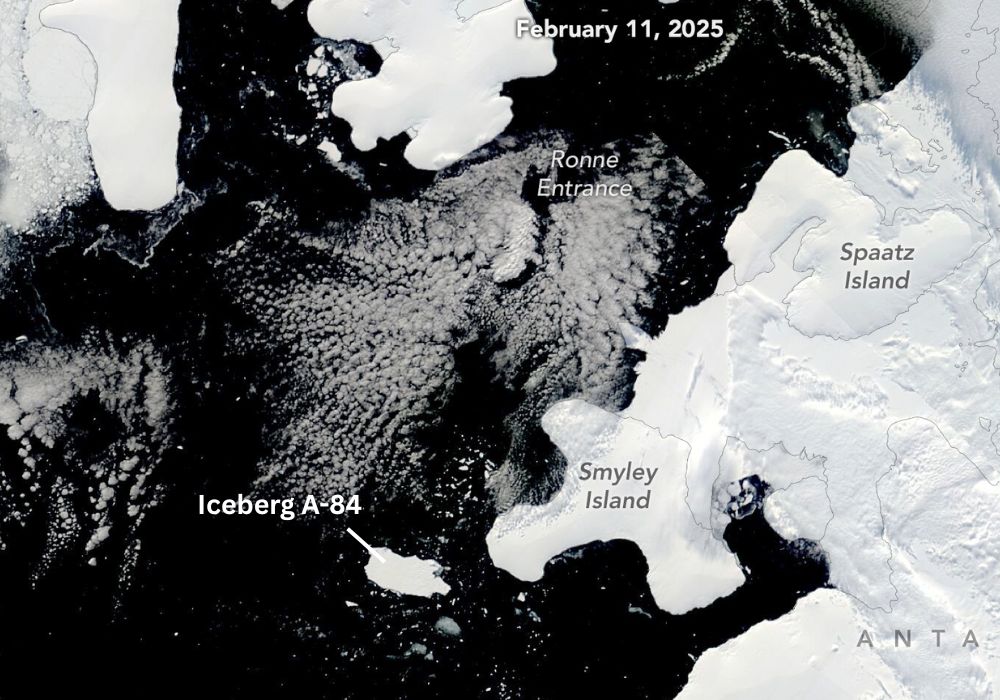
When an iceberg the size of Chicago broke off from Antarctica’s George VI Ice Shelf earlier this year, it wasn’t just another sign of a warming planet. It was a scientific stroke of luck. What lay beneath the ice was something no one had ever seen—a thriving, colorful undersea ecosystem, sealed off for what could be centuries.
This rare event exposed over 200 square miles of seafloor in the Bellingshausen Sea, an area that had long been hidden beneath nearly 500 feet of floating ice. Within days, a team of international researchers altered their expedition plans and navigated to the newly uncovered site. What they found stunned even the most seasoned scientists.
How does life flourish in total darkness, cut off from sunlight and surface nutrients? The answers aren’t fully clear yet—but what’s already been discovered is reshaping how we understand Antarctic marine environments and their potential to adapt in a rapidly changing climate.
The Iceberg That Opened a Lost World

On January 13, 2025, a massive iceberg named A-84 broke away from the George VI Ice Shelf along the Antarctic Peninsula. Measuring roughly 209 square miles—about the size of Chicago—it drifted into the Bellingshausen Sea, unveiling a stretch of seafloor that had been sealed off for centuries under hundreds of meters of ice. The event was quickly detected by satellite imagery, which gave researchers onboard the Schmidt Ocean Institute’s R/V Falkor (too) the first glimpse of a rare opportunity.
The scale of the detachment was enormous, but what excited the scientific team wasn’t just the size. It was what the calving had left behind—a previously inaccessible expanse of the ocean floor, never seen or studied by humans. It was as if the planet had quietly lifted a curtain on one of its most hidden corners, offering a one-time chance to study life in an untouched, frozen world.
“We seized upon the moment, changed our expedition plan, and went for it so we could look at what was happening in the depths below,” said Patricia Esquete, co-chief scientist and marine ecologist from Portugal’s University of Aveiro. The team had been in the region for other research when the iceberg calved. Within days, they rerouted to the newly exposed zone, eager to learn what secrets had been locked beneath the ice for so long.
Scientists Race to Study the Newly Exposed Seafloor

As soon as satellite images confirmed the detachment of iceberg A-84, the research team onboard the Falkor (too) knew they had to act fast. Originally focused on studying oceanic systems in the region, the scientists quickly revised their plans and set course for the newly exposed stretch of the Bellingshausen Sea. What had been a routine mission shifted into a historic opportunity to study one of the least accessible environments on Earth.
Exploring this kind of terrain required specialized equipment. The team deployed SuBastian, a remotely operated vehicle (ROV), capable of descending deep into the ocean’s icy depths and capturing high-resolution footage. Operating in this setting wasn’t easy. With no GPS signals available beneath the thick ice, navigation had to rely on acoustic systems. The extreme cold and high pressure added another layer of complexity to an already ambitious mission.
Despite the challenges, the team worked around the clock for eight days, gathering biological samples, sediment cores, and detailed video of the ecosystem below. According to expedition co-leader Sasha Montelli of University College London, this was the first time a comprehensive, interdisciplinary survey had been completed in a sub–ice shelf environment. The team’s agility and preparedness turned an unpredictable event into a groundbreaking research success.
A Vibrant Ecosystem Flourishes in the Dark

What the scientists found beneath the freshly exposed seafloor was far from barren. Instead of a lifeless void, they discovered a rich tapestry of marine organisms—sponges, anemones, corals, icefish, giant sea spiders, isopods, octopuses, and ethereal deep-sea jellyfish. These weren’t scattered life forms surviving against the odds—they were part of a thriving, well-established ecosystem that had likely existed undisturbed for decades, if not centuries.
One of the clearest indicators of the ecosystem’s age came from the sponges. These organisms are slow-growing, often adding just a few centimeters a year. Some of the specimens observed were massive, suggesting they had been anchored to the seafloor for generations. Found at depths of over 200 meters, these creatures had lived entirely cut off from the outside world beneath an ice ceiling nearly 500 feet thick.

“This was completely unexpected,” said Sasha Montelli. “The sheer density and variety of life took us by surprise.” While marine life has been documented in parts of Antarctica not covered by ice, this was the first time scientists were able to fully document such biodiversity in a region previously sealed off by a floating glacier. What had once been hidden now stood as living proof of nature’s ability to adapt in the harshest of conditions.
How Does Life Survive Under Ice?
One of the biggest questions raised by this discovery is how such a rich ecosystem managed to survive in complete darkness, buried beneath nearly 500 feet of ice. In most ocean environments, nutrients come from the surface—sunlight fuels microscopic algae, which feed small marine animals, and the organic matter eventually drifts down to the seafloor. But here, that process isn’t possible. The thick ice blocked sunlight for centuries, cutting off the traditional food supply.
So how did these animals survive? Scientists believe the answer lies in ocean currents. These currents can slip under the ice, carrying nutrients from nearby open waters or glacial melt zones. This lateral flow may provide a steady stream of organic material—just enough to sustain life in the absence of direct sunlight. “We think the lateral transport of meltwater from the George VI Ice Shelf could be the source of nutrients,” explained Laura Cimoli, a physical oceanographer from the University of Cambridge.
The team still has work to do to fully understand the dynamics at play. But the presence of large, slow-growing creatures like sponges suggests that this ecosystem has had access to a consistent, long-term food supply. If confirmed, this would challenge assumptions about the limits of life in dark, isolated environments—and offer new insights into how ecosystems adapt to extreme conditions.
Clues to Antarctica’s Changing Climate

Beyond the biological surprises, the calving of iceberg A-84 also opened a rare window into Antarctica’s glacial history. By studying the newly exposed seafloor and collecting geological samples, the research team hopes to gain a clearer understanding of how the Antarctic ice sheet has changed over time—and what those changes might mean for the future. This is especially relevant as the continent continues to lose ice at an accelerating pace due to global warming.
“The ice loss from the Antarctic Ice Sheet is a major contributor to sea level rise worldwide,” said Sasha Montelli, a geophysicist from University College London and co-chief scientist of the expedition. He emphasized that tracking these changes is essential for improving future projections. With more accurate data on how ice shelves behave, scientists can better predict how quickly sea levels might rise and which coastal regions may be most affected.
The team’s interdisciplinary approach—combining marine biology, oceanography, and glaciology—provides valuable context for interpreting these changes. By analyzing sediment layers, water chemistry, and meltwater flow patterns, researchers are piecing together a more detailed picture of how this part of Antarctica has evolved. In a region that is both environmentally fragile and scientifically vital, discoveries like these could help shape future climate models and guide global policy decisions.
Unlocking Secrets Beneath the Ice

The iceberg’s dramatic detachment from Antarctica’s George VI Ice Shelf has revealed more than just a hidden ecosystem—it has provided critical insights into the adaptability of life and our planet’s changing climate. While scientists continue to analyze the collected samples, the discoveries already highlight the remarkable ability of nature to thrive in even the harshest environments.
As climate change reshapes our world, understanding these extreme ecosystems becomes increasingly important. Every discovery beneath Antarctica’s ice adds valuable knowledge, helping researchers build accurate predictions and guiding policies for protecting marine life globally. Events like these remind us that beneath the frozen surfaces of our oceans, countless mysteries remain, quietly waiting to be revealed.
Ultimately, the story of this Antarctic iceberg is not just about ice, ocean currents, or even biodiversity—it’s about recognizing how interconnected and resilient life truly is, even in the most unlikely places.
Featured Image Source: NASA Earth Observatory Rift and Calving at Larsen Ice Shelf.
