
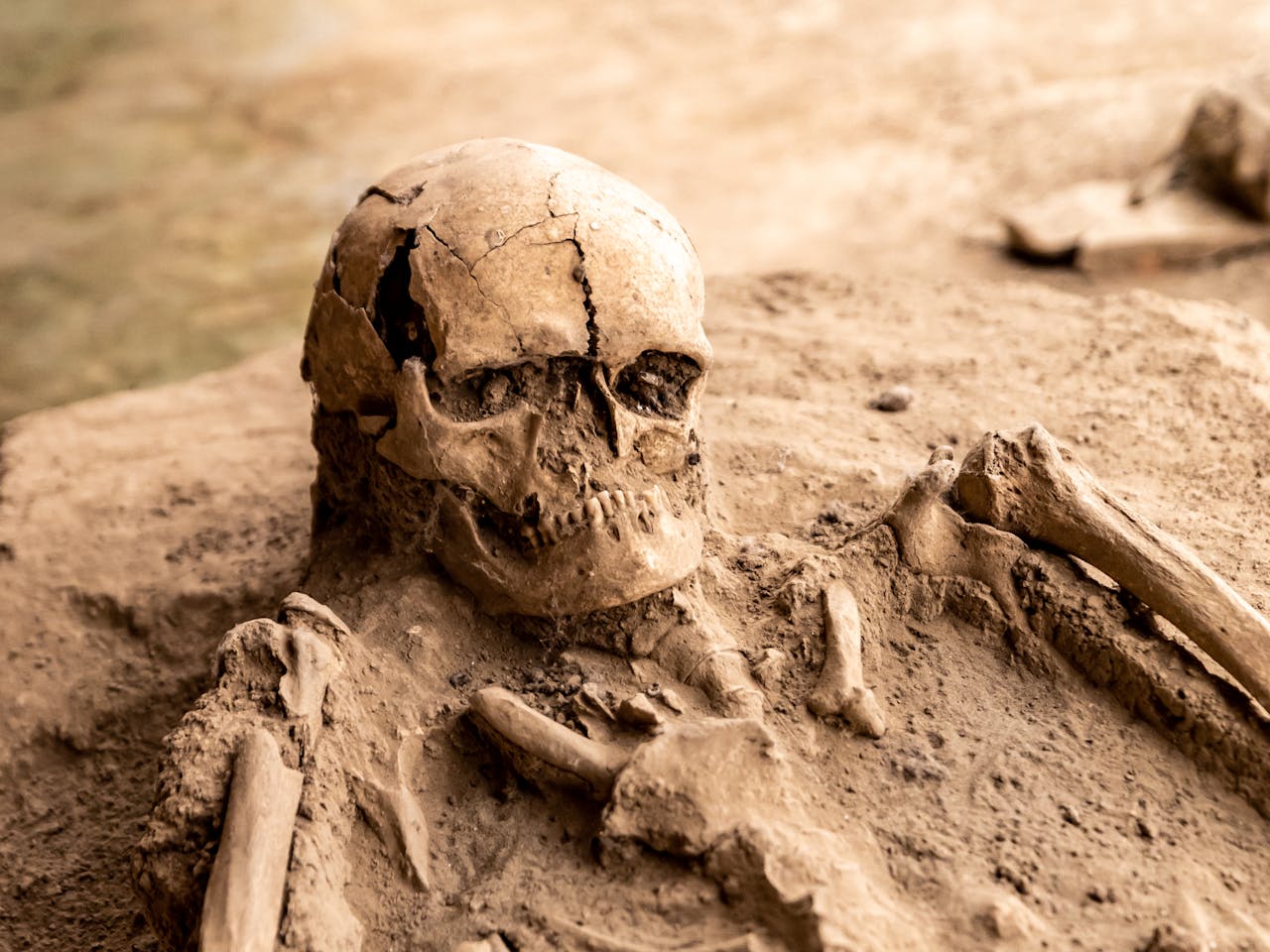
Before researchers uncovered the Takarkori mummies, the idea of a completely unknown human lineage surviving in isolation for thousands of years seemed unlikely. The desert we see today hides a past where small communities lived beside lakes and grasslands and developed genetic histories that left no trace in present day populations.

The discovery of these two women brings that forgotten world into focus. Their remains offer a direct record of a population that lived independently of the groups that shaped modern human ancestry. Their story raises new questions about how many other lost lineages once existed and how much of early human history has yet to surface.
A Hidden Lineage Emerges from the Green Sahara
Two 7000 year old mummies uncovered in the Takarkori rock shelter in southwestern Libya provide detailed evidence of how early human groups in North Africa formed distinct identities in response to their environment. Research led by archaeogeneticist Nada Salem at the Max Planck Institute, reported by Popular Mechanics, shows that the two women carried a genetic profile with no match in any modern population. Their DNA indicates an early divergence from Sub Saharan groups, which suggests that the region once held several independent human communities that did not collapse into a single shared lineage.

The African Humid Period created a setting that supported this separation. The Sahara at the time contained lakes, wetlands, forests and savannas that encouraged settlement but limited long distance movement. Natural barriers such as mountains and water systems created pockets of human habitation that rarely blended. The Takarkori site sat within this patchwork of environments, and the people who lived there developed genetic traits shaped by their specific location rather than widespread interaction.
These conditions explain why the Takarkori lineage stands apart from known populations. Their genetic profile reflects thousands of years of continuity within a confined region, offering a direct look at how environmental structure influences human variation. This discovery strengthens the view that early North Africa supported multiple communities with their own developmental paths.
What the DNA Revealed
The genetic analysis of the two 7000-year-old women from the Takarkori rock shelter in southwestern Libya shows that they descended overwhelmingly from a previously unknown North African lineage that diverged from sub-Saharan African populations roughly 50 000 years ago.The study states: “The majority of Takarkori individuals’ ancestry stems from a previously unknown North African genetic lineage that diverged from sub-Saharan African lineages around the same time as present-day humans outside Africa and remained isolated throughout most of its existence.”
This lineage shows minimal sub-Saharan ancestry and significantly reduced Neanderthal genetic input compared to non-African populations. According to the report, these individuals carried about one-tenth the Neanderthal DNA of non-African humans, while still possessing more than contemporaneous sub-Saharan groups. The combination of ancient divergence, long-term isolation and distinct genetic legacy underlines an evolutionary path in North Africa that followed its own course rather than merging into known populations.

Linking the Takarkori individuals to those from the Taforalt Cave in Morocco, who date to around 15 000 years ago, the research highlights that both groups share ancestry unique to North Africa rather than to neighbouring regions. That connection adds weight to the idea that during the green phase of the Sahara, human populations maintained separate genetic identities even while adopting similar cultural practices such as herding and pottery production.
Overall, the DNA evidence confirms the existence of a long-isolated human branch in North Africa. Though this lineage no longer exists in an unmixed form today, it remains a crucial component of the region’s ancient genetic heritage.
Rethinking How Early Cultures Spread
One of the most meaningful insights from the Takarkori findings concerns how herding practices moved across North Africa. For a long time, researchers assumed that early forms of pastoralism arrived through the movement of new populations who carried their skills and livestock into the region. This model suggested that cultural change was tied to population replacement or the blending of genetically distinct groups.
The Takarkori genomes show a different pattern. There is almost no sign of genetic influence from outside groups during the period when herding became part of life in the area. As Popular Mechanics reports, “herding spread through cultural diffusion, rather than gene swapping.” Communities adopted new practices through contact, observation and shared knowledge rather than through incoming groups with a different ancestry.

This form of cultural transmission reveals that early societies were more capable of exchanging ideas without substantial movement of people than once believed. It also suggests that herding was attractive because it worked well in the changing environment of the Green Sahara. People integrated these practices while maintaining their genetic continuity, which reinforces the idea that cultural innovation can move independently of population movement.
A Connection to the Taforalt Foragers
The Takarkori DNA connects these women to another ancient population from the Taforalt Cave in Morocco. The Taforalt group is also known for its unusual genetic profile, distinct from both Sub-Saharan and Eurasian lineages. Like the Takarkori individuals, they had minimal Neanderthal ancestry.

This link indicates that diverse human groups lived across North Africa for thousands of years, sharing some ancestral roots but developing independently due to geographic and environmental barriers. The Sahara’s lakes, dense vegetation, and patchwork of natural obstacles played a major role in keeping populations separate.
How Geography Shaped Isolation and Its Impact on Human History
During the African Humid Period the Sahara formed a network of lakes, mountains, forests and smaller desert pockets that limited movement and encouraged people to settle near predictable resources. As Popular Mechanics notes, it was “filled with lakes, mountains, forests, and deserts, all crammed together.” This fragmented landscape led communities to develop in separate pockets where contact with distant groups was rare. These long stretches of separation shaped distinct genetic lines, which helps explain why the Takarkori individuals differ so sharply from other ancient and modern populations.
This environmental structure produced a North Africa made up of small communities that evolved in parallel rather than through shared migrations. Cultural practices could spread through interaction, yet populations often retained their own genetic identities because the terrain made long distance movement difficult. The Takarkori findings show that climate, resource distribution and physical boundaries created a region where cultural exchange and genetic separation existed side by side.
The discovery reinforces that early human diversity in North Africa was more complex than earlier models suggested. Africa did not develop through one continuous movement of people but through many smaller communities responding to local conditions. These separate histories also shaped contact with Eurasian populations, reflected in the Takarkori group’s lower levels of Neanderthal ancestry. Their long period of independent development demonstrates how geography can preserve distinct human lineages.
Practical Reflection for Today’s Readers
While the discovery is rooted in archaeology and genetics, it also offers practical insights for modern readers.
1. Human history is rarely straightforward
Scientific findings often overturn long standing assumptions. This is a reminder that health, nutrition, culture and human behavior develop through a combination of internal change and external influence rather than a single driving force. The Takarkori discovery shows how complex and layered human development can be.
2. Cultural exchange does not require large scale movement
Ideas can spread even when people remain in place. The Takarkori findings illustrate how knowledge and practices travel across communities without major population movement. This mirrors the way modern wellness and lifestyle information moves quickly and widely through communication rather than migration.
3. Climate shapes human behavior
Changes in vegetation, water availability and temperature guide how people live, migrate and adapt. The Green Sahara period shows how shifts in climate shape settlement, food choices and movement. These patterns remain relevant today as communities continue to respond to environmental change.
4. Genetic diversity reflects environmental history
Ancient populations adapted to the conditions around them, and modern genetic research continues to show how environment and biology interact over long periods. The Takarkori lineage demonstrates how geography can preserve distinct human histories and why understanding environmental change is essential for understanding ourselves.
A Deeper Look at What These Ancient Lives Reveal
The discovery of the Takarkori mummies introduces a new chapter in early human history. Their DNA reveals a long isolated North African lineage with ties to the mysterious Taforalt foragers. The findings challenge older models of migration, showing that cultural exchange can flourish without large scale population movement.

By examining these ancient remains, researchers gain a clearer view of how geography, climate, and social interaction shaped early societies. For today’s readers, the story highlights a broader truth: human development is adaptive, collaborative, and often more interconnected than it first appears.
As more discoveries emerge from the Sahara and other ancient landscapes, our understanding of humanity’s past will continue to evolve much like the cultures that once thrived in the lush, green heart of North Africa.

