
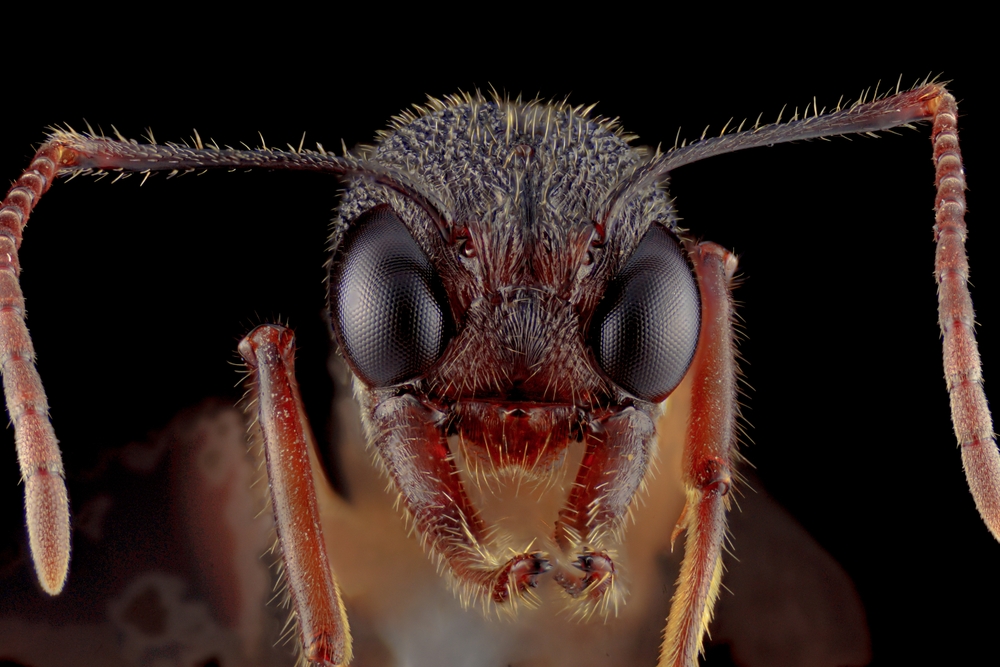
Two scientists studying a small piece of amber expected routine imaging work. Instead they spotted a fossilized ant so well preserved that it instantly shifted their understanding of where this elusive lineage once lived. Its features were intact enough to confirm that the species belonged to a group not known to exist in the Caribbean at all.
Finds of this quality are unusual. The fossil provides solid evidence that dirt ants once occupied the region before disappearing millions of years ago. It also raises new questions about why certain species survive major ecological change while others do not.
When a Grain of Amber Reveals a Lost World
The discovery began not with a dramatic field excavation but with a quiet look at a small piece of Dominican amber. Inside it, researchers from the New Jersey Institute of Technology saw an ant so clearly preserved that it immediately signaled something unusual. Its shape and proportions did not match the dirt ant species that scientists know from present day neotropical forests. That single observation turned what could have been a routine identification into a direct glimpse of a community that no longer exists. Reports from outlets have helped bring this moment out of the lab and into public view, underscoring how much information can be locked inside a drop of ancient resin.

For the team, this was not just another fossil record. It was proof that a secretive lineage of ants once occupied Caribbean soil and then vanished, leaving no living representatives in the region. Gianpiero Fiorentino, corresponding author of the study and PhD candidate at NJIT’s Barden Lab, described the experience of seeing the specimen as “like finding a diamond.” That reaction reflects more than excitement; it captures how rare it is to find an organism preserved well enough to change an entire narrative about where a group of animals once lived. In this case, the fossil does not simply add one more species to a list. It opens a missing chapter in the story of predator ants, island ecosystems, and the long arc of extinction and survival that modern biodiversity research is still trying to understand.
A Hidden Lineage Revealed in Amber
The newly identified species, Basiceros enana, is the first fossilized dirt ant ever documented in the Caribbean. The fossil was recovered from Dominican amber and described in a study published in Proceedings of the Royal Society B. According to the research team, the adult worker ant is noticeably smaller than all known living Basiceros species.
Modern dirt ants are recognized for their camouflage abilities. They blend into soil and leaf litter using particle‑binding hairs that help them stay nearly invisible in their environment. Although they occur today from Costa Rica to southern Brazil, they have never been found living in the Caribbean. This fossil confirms that the group once existed on the islands before vanishing during the Miocene epoch.
Phil Barden, senior author of the paper and associate professor of biology at NJIT, explained why this matters. “Often lineages will have what appear to be fairly straightforward biogeographic histories. If you find a group of animals that only live in South America up to Costa Rica today, you really have no reason to expect that their early relatives lived in the Caribbean,” he said. The fossil “underscores how the distribution of living species can belie the complex evolutionary history of life on our planet.”
What Makes This Ant Unique
The study describes Basiceros enana as a worker ant that combines several hallmark dirt ant traits in a compact body plan. At roughly 5.13 millimeters in length, it is the smallest member known in its lineage, yet it carries the full suite of structures associated with a specialized ground dwelling predator. In the paper published in Proceedings of the Royal Society B. the authors emphasize that this fossil represents a distinct species rather than a miniature version of any modern Basiceros ant.
One of the most striking aspects of B. enana is its coat of two different hair types that work together to hold soil and leaf litter against the body. Longer, more erect brush hairs project outward, while shorter, appressed holding hairs keep particles close to the cuticle. This layered system effectively turns the ant into a moving piece of debris on the forest floor. The fossil shows that this level of structural specialization for concealment was already present 16 million years ago, indicating that advanced camouflage was not a late innovation in the group but a long standing feature of their biology.

The body architecture further sets this species apart. The fossil preserves an upturned propodeal spine and a trapezoid shaped head capsule, both consistent with modern dirt ants yet expressed in a slightly different proportion that helps define the new species. Its mandibles carry 12 triangular teeth, a configuration associated with a predatory lifestyle in which gripping and processing animal prey is essential. Together, these features support the conclusion that B. enana was not a generalist ant but a specialized predator embedded in leaf litter microhabitats.
For Gianpiero Fiorentino and colleagues, the combination of size and anatomy is what makes this fossil so informative. It shows that even the smallest members of the lineage were already equipped with complex tools for hiding and hunting. As Fiorentino put it, finding this specimen preserved in amber was “like finding a diamond,” because it captures in one tiny body the key structural elements that define dirt ants as a group while also revealing a branch of their history that no longer has living representatives.
How Scientists Studied the Fossil
To capture features invisible to the naked eye, the team used high resolution imaging and three dimensional reconstruction techniques at NJIT and Japan’s Okinawa Institute of Science and Technology Graduate University. Micro CT scanning allowed researchers to study the fossil from multiple angles without damaging the amber.
Fiorentino noted the impact of this technology, saying, “The use of Micro CT scanning really amplified this study, enabling us to capture features that were virtually impossible to see otherwise.” The team compared the fossil with all known modern dirt ant species and then used molecular dating techniques to examine where the ancient ant fit into the evolutionary timeline.

Barden added, “Because amber preserves entire organisms in three dimensions, we can extract a ton of data from even a tiny ant.” The combination of imaging and molecular comparisons helped the team trace how body size and morphology changed over millions of years.
Rethinking the Evolution of Dirt Ants
The discovery flips earlier hypotheses about Basiceros evolution. Instead of shrinking over time, these ants appear to have grown larger relatively quickly.
“Our results show that the embiggening of these ants was relatively rapid,” Fiorentino explained. “They almost doubled in size in the span of 20 million years. Previous hypotheses suggested that these ants were ancestrally large and shrank over time, so this flips that on its head and really illustrates how important fossils can be to understanding the evolution of a lineage.”

This indicates that the group’s evolutionary path was more dynamic than expected. Physical changes in ants often reflect broader shifts in habitat, prey, and climate, so body size trends help illu
What This Discovery Means for Human and Environmental Health
The fossil of Basiceros enana may seem far removed from modern health concerns, yet its story connects directly to themes that influence human wellbeing today. Fossils like this help scientists understand how ecosystems respond to long term environmental stress. When predator species disappear, prey populations shift, vegetation patterns change, and entire food webs can reorganize. These changes influence soil quality, nutrient cycles, water stability, and the resilience of environments that humans depend on for food and clean air.

Studies of ancient extinctions also help researchers assess current risks surrounding biodiversity loss. Many of the conditions that caused the disappearance of Caribbean dirt ants involve changes in habitat, climate, and species competition. These pressures are now accelerating in present day ecosystems. When environments lose species that play specific roles such as predators or soil engineers, microbial balance can shift, which can affect disease patterns that reach human populations.
From a wellness perspective, the stability of natural systems supports public health by maintaining cleaner air, more predictable water cycles, and healthier soils that support nutrient rich crops. Insights from fossils like B. enana give researchers a clearer sense of how sensitive ecosystems are to rapid change. They also help identify early warning signs that modern environments may be approaching stress points. Understanding these patterns allows scientists and policymakers to make more informed decisions that protect both ecological and human health.
What We Can Learn From a Tiny Fossil
This discovery is a reminder that evolution rarely follows a simple path. A fossilized ant preserved in amber for 16 million years shows how species can move, adapt, and disappear as their environment changes. It also demonstrates the value of scientific tools that allow researchers to revisit ancient ecosystems with new clarity.
Fiorentino’s description of the fossil as “like finding a diamond” captures the essence of this find: small but incredibly valuable for what it reveals. As researchers continue to study ancient organisms, discoveries like this one contribute to a more accurate understanding of how life evolves and how biodiversity shifts over time.

By piecing together these lost chapters, science gains a better foundation for interpreting present‑day ecological changes and planning for the future.
