
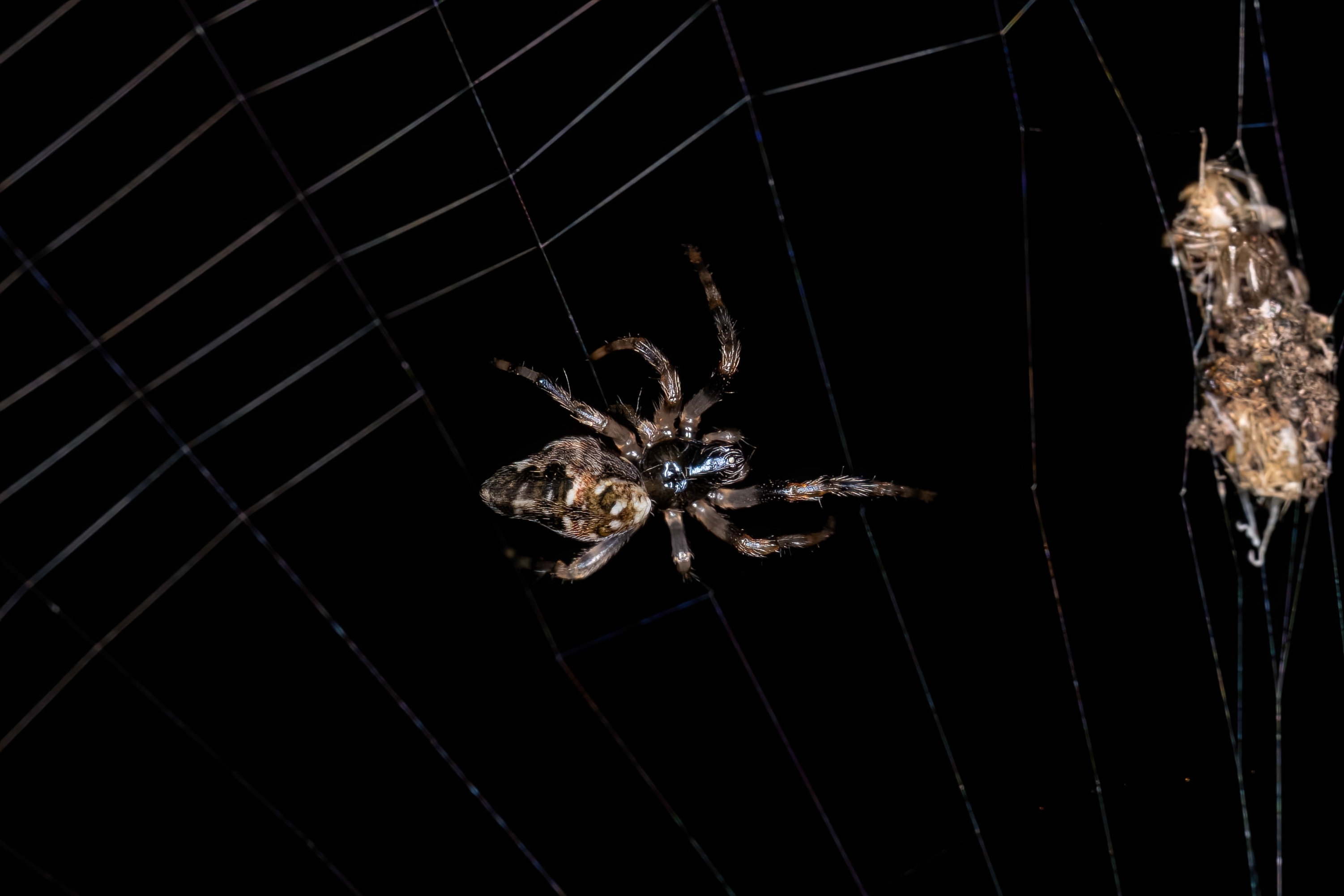
When you think of animal survival tactics, camouflage or hiding might come to mind. But one tiny spider in the Peruvian Amazon is rewriting the rulebook on deception. This creature doesn’t just vanish into the background—it builds life-sized fakes of itself using forest debris, insect carcasses, and silk. It’s a wild, web-bound art project with a single purpose: to stay alive.
This surreal behavior belongs to a spider in the Cyclosa genus. Scientists first documented it in 2012, but it’s still something of a mystery. It’s not just the creativity that’s astonishing—it’s the effectiveness. Through this self-crafted illusion, the spider turns the tables on its predators by making them second-guess what they’re seeing. Let’s take a closer look at this bizarre, clever survival strategy and what it teaches us about life in the wild.
Meet the Cyclosa Spider: The Jungle’s Master Illusionist
The Cyclosa spider was discovered by biologist Phil Torres while he was working near Tambopata, Peru. Unlike other Cyclosa spiders that use simple debris in their webs, this one took the concept to the next level. It carefully assembled fake spiders—complete with legs, a body, and a head—from materials like dead leaves, insect parts, silk, and forest debris. This isn’t just messy clutter; it’s sculpted with intention and precision, forming an unmistakably spider-like silhouette that’s several times larger than the real creature.
These decoys are eerily lifelike. In fact, they’re so convincing that even trained scientists have initially mistaken them for real spiders. Hanging at the center of a web, these fakes can be as much as ten times larger than the actual spider. They sway with the wind, creating the illusion of a large spider on alert, and this subtle movement enhances the visual deception, making the decoy seem not only realistic but alive. This behavior, while unsettling to witness, is a calculated evolutionary adaptation crafted for survival in the harsh jungle environment.
Meanwhile, the real spider usually stays hidden just above or below its creation, blending seamlessly into the background. Its camouflage is so effective that it can be nearly impossible to spot without knowing what to look for. This positioning ensures that any threat is directed at the decoy first, buying the real spider valuable time to escape or simply avoid detection. It’s a brilliant use of camouflage, architectural mimicry, and natural motion—a trifecta of deception that offers the spider a powerful edge against predators.
Why Build a Fake? The Science of Spider Deception

What drives a fingernail-sized spider to invest time and energy building a fake version of itself? The answer lies in survival. The Amazon rainforest is one of the most competitive and dangerous ecosystems on the planet. Predators abound, from birds and reptiles to parasitic insects. For a tiny spider, every moment outside its hiding place can be a risk. But instead of hiding passively, the Cyclosa has evolved a proactive and remarkably creative defense mechanism: illusion.
These decoys serve several interconnected functions. First, they act as decoys in the most literal sense—if a bird or predatory insect strikes, it’s far more likely to attack the conspicuous, motion-swaying decoy hanging in the center of the web. Second, their size and shape can serve as a visual deterrent. A much larger spider, especially one that appears to be guarding a web, might be interpreted as a dangerous or unappetizing target. Lastly, these decoys offer physical cover. By positioning itself close to the decoy, the real spider can blend into the clutter of materials, becoming nearly invisible even to keen-eyed predators.
This behavior suggests a complex evolutionary history. It likely didn’t emerge all at once but developed gradually over generations. Early spiders that placed debris in their webs may have had slightly better survival rates. Those who arranged it more convincingly passed on their genes, eventually leading to today’s Cyclosa with its uncanny spider sculptures. It’s a reminder that even small evolutionary advantages can accumulate over time, resulting in remarkable adaptations that blur the line between instinct and strategy.
A One-of-a-Kind Behavior in the Wild

While other Cyclosa spiders around the world build debris chains or decorate their webs with random materials, none create detailed, life-sized replicas of themselves. This behavior, observed in the Peruvian Amazon species, appears to be a unique evolutionary branch. It’s not just that the spider uses environmental materials—it assembles them with enough intentionality and spatial awareness to mimic its own form. That level of precision sets it apart from nearly every other known mimic in the animal kingdom.
What’s particularly fascinating is that the spider seems to “know” what it looks like, despite not seeing itself. It doesn’t use trial and error or observation of others to create its sculpture. Instead, it constructs the model instinctively, shaping legs, a segmented body, and a central shape that mirrors a spider’s silhouette. This act of building a visual replica of one’s self suggests a genetic program fine-tuned over evolutionary time, rather than learned behavior. And while the act may not be conscious, its outcome is strikingly effective.
The decoy’s design doesn’t just rely on appearance. Its function is enhanced by placement and movement. Hung centrally in the web, the decoy becomes the focal point of the web’s vibrations. When wind rustles the forest or something brushes the web, the decoy swings and trembles just like a real spider. This dynamic realism adds another layer to the illusion, increasing the likelihood that a predator will be tricked. Few species have been observed engaging in this kind of motion-based deception through constructed objects, making this spider a standout case in the study of mimicry.
Other Creatures That Use Decoys and Mimicry
The Cyclosa spider may be one of nature’s most creative mimics, but it’s far from the only species that uses deception to stay alive. Mimicry is a widespread and time-tested survival strategy, with countless species having evolved to either resemble more dangerous animals or fool prey into coming close. What sets Cyclosa apart, however, is the scale and intentionality of its mimicry—it doesn’t just resemble something else; it builds it from scratch.
Consider burrowing owls. When threatened, they mimic the hiss of a rattlesnake to scare off intruders, a sound that sends most would-be predators running. The anglerfish uses a fleshy appendage that mimics prey, luring in other fish with the promise of a meal—only to become the meal themselves. Some caterpillars have eye spots or body shapes that look like snakes, tricking predators into thinking they’re more dangerous than they are. These adaptations are highly effective but are typically part of the animal’s own body.
What makes the Cyclosa spider exceptional is its use of tools and construction. While most mimicry occurs through bodily evolution—color patterns, body shapes, sounds—this spider actively gathers external materials and arranges them into a false image. It’s as though the spider is creating a puppet version of itself to act as a bodyguard. This shift from passive to active deception is rare and represents a remarkable leap in survival behavior. It’s more than mimicry—it’s visual architecture.
What This Means for Understanding Nature’s Intelligence

The decoy-building behavior of the Cyclosa spider challenges many assumptions about instinct, intelligence, and complexity in the animal world. We often associate advanced behaviors like tool use or mimicry with mammals or birds—species that are large-brained and social. But this tiny spider, with its minuscule nervous system, demonstrates a form of intelligence that is both elegant and effective. And it does so not through learning or teaching but through innate behavior passed down across generations.
This forces us to reconsider what intelligence looks like in the animal kingdom. Is it problem-solving ability? Memory? Adaptability? Or is it the ability to survive through ingenious means, even if those means are hardwired through evolution? The Cyclosa spider doesn’t need to understand what it’s doing in human terms. Its behavior works, and in nature, that’s what matters. Success isn’t defined by understanding—it’s defined by survival.
More broadly, this spider’s strategy offers a glimpse into how behavior and evolution interact. The fact that this behavior emerged and became refined over generations shows that evolution can produce extremely complex outcomes from relatively simple beginnings. And while the spider may not be consciously designing its decoy, the result is a highly functional sculpture—one that protects its creator with eerie effectiveness. It’s intelligence in another form, woven from silk and instinct.
Tips for Spotting Natural Deception in the Wild

If you’re someone who loves hiking, birdwatching, or just observing wildlife, developing an eye for deception can open up a whole new layer of appreciation for the natural world. Nature hides in plain sight, and some of its most fascinating moments are the ones that fool us.
Start by looking closely at details that seem “off.” A leaf that’s too symmetrical or a branch that moves unnaturally might not be what it appears to be. Animals that use mimicry rely on us overlooking them. That’s their entire strategy. So slowing down and taking the time to scan your surroundings carefully can reveal hidden marvels.
When observing webs, pay attention to the center. If there’s a large spider-like figure hanging there, don’t assume it’s real. Look around it—above or below. The actual spider may be camouflaged nearby. Bring a camera or use binoculars to examine odd shapes at a distance. Zooming in can help reveal details that are invisible to the naked eye. Finally, study the motion of objects. Real animals often have subtle, intentional movement, while decoys might sway in rhythm with the wind. Or in the case of Cyclosa’s sculptures, the motion might actually enhance the illusion.
When Nature Teaches Us to Think Twice

The Cyclosa spider may be small, but its behavior sends a big message: don’t underestimate the ingenuity of nature. What looks like a clump of leaves might be a masterpiece of survival—constructed with purpose, precision, and a silent kind of brilliance. It reminds us that intelligence and creativity aren’t limited to the species we usually think of as smart. Sometimes, it’s the creatures we overlook that have the most to teach us.
This spider doesn’t fight or flee. It fakes. And in doing so, it reveals the power of illusion as a survival tactic in the wild. In a world where predators dominate and competition is fierce, deception is not just a tactic—it’s an art form. And in the quiet understory of the Amazon rainforest, the Cyclosa spider hangs its puppet in a web, whispering a quiet warning: things are not always as they seem.
