
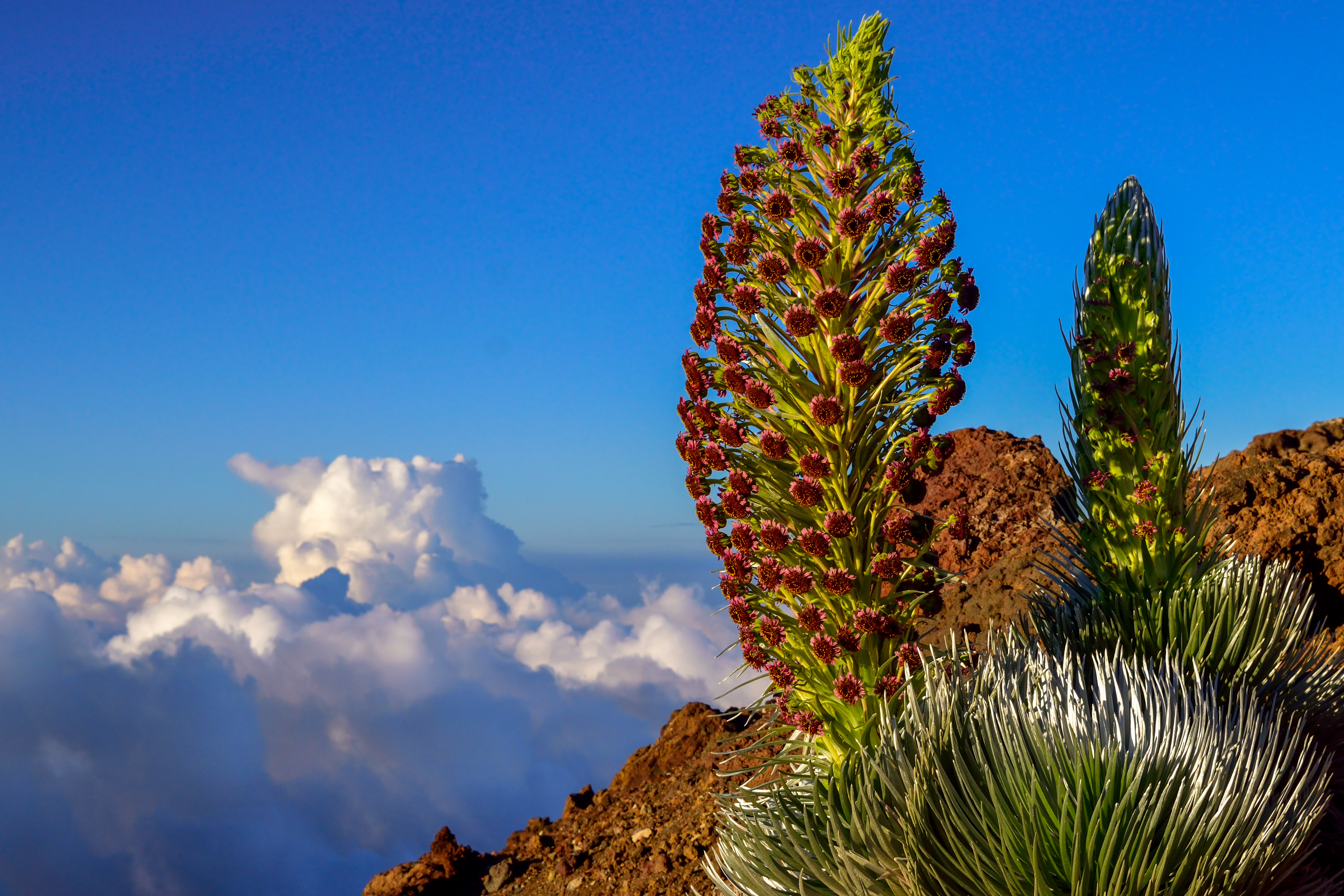
Perched on stark volcanic slopes of Maui, a silvery plant waits patiently for decades, storing energy for a single magical moment. Like an astronomical event in slow motion, Haleakalā Silversword lives most of its life as a modest rosette of shimmering leaves, only to transform dramatically at life’s end.
Silverswords represent patience in plant form—a living example of delayed gratification taken to extraordinary lengths. Found nowhere else on Earth besides Maui’s volcanic crater, these plants face harsh conditions with minimal water and intense sun exposure, yet manage not only to survive but eventually create one of nature’s most spectacular floral displays.
Visitors lucky enough to witness a blooming Silversword will experience aesthetic wonder and philosophical reflection. How might our perspective shift if we consider our lives against this plant’s extraordinary timeline? What drives a living thing to invest decades preparing for a single reproductive event? Such questions make Silverswords fascinating beyond mere botanical curiosity.
A Silver Star on Maui’s Volcanic Slopes
Silverswords look almost artificial from a distance—metallic spheres scattered across dark volcanic cinder. Jack London’s observation that Haleakala is a genuine “workshop of nature still cluttered with the raw beginnings of world-making. “Up close, each plant forms a perfect globe of hundreds of sword-shaped leaves, each coated with fine silver hairs that reflect sunlight and give them a distinctive shimmer. During morning and evening hours, sunlight catches these reflective surfaces, creating spots of brilliance across an otherwise austere landscape.
Scientists know this plant as Argyroxiphium sandwicense subsp. macrocephalum, part of the sunflower family, though it bears little resemblance to its yellow-headed cousins. Its alien appearance serves practical purposes—reflective leaves minimize water loss while capturing precious morning dew, crucial adaptations for survival in its harsh home. With roots anchored into porous volcanic soil, Silverswords extract moisture from seemingly impossible conditions.
No other plant quite matches Silversword’s distinctive appearance—its symmetrical rosette pattern can grow up to two feet in diameter, with leaves ranging from silvery-green to silver-white depending on age and light conditions. Each leaf sports tiny reflective hairs that catch sunlight like thousands of miniature mirrors. During early morning mist, these plants capture water droplets that roll down specialized channels into the central core.
A Lifetime in Stillness

Silverswords grow painfully slowly, adding just a few leaves each year. What takes garden plants weeks takes Silverswords years to accomplish. Young plants start as small silver tufts barely distinguishable among volcanic rocks, gradually expanding their rosette pattern over decades. During this long vegetative phase, they focus solely on gathering resources for flowering while building strong anchors against Haleakalā’s fierce winds.
Such slow growth proves advantageous in harsh mountain conditions. By taking time to establish deep roots and build food reserves, Silverswords gain resilience against drought years. Many plants rush life cycles to completion, but Silverswords exemplify slow, steady resource accumulation—a marathon approach rather than a sprint.
Water conservation defines the Silversword survival strategy. While typical plants might wilt without regular rainfall, Silverswords have mastered extreme efficiency. Silver leaf hairs reflect scorching sunlight, while waxy coatings prevent evaporation. Leaves grow densely packed, creating humidity traps in a central rosette. Plants capture fog and dew that condense on leaves and channel down to the roots each morning. Such adaptations allow survival where rainfall measures just inches annually.
The Silversword’s Ultimate Show

After decades of waiting, mature Silverswords undergo a dramatic transformation triggered by their internal clock and environmental conditions. From the center of the leaf rosette emerges a rapidly growing stalk that can reach six feet tall within weeks. Initially resembling a massive asparagus spear, this flowering structure eventually branches into a candelabra-like form covered with hundreds of purple-red flower buds.
Once flowering begins, Silversword puts all stored energy into reproductive effort. Each flowering stalk can produce over 600 flower heads containing dozens of tiny florets. At peak bloom, hundreds of fuzzy purple flowers cover branches with nectar-rich food for native insects and birds. Bees, butterflies, and Hawaii’s honeycreepers visit blooms, transferring pollen between plants.
Pollinated flowers develop into seed heads containing thousands of tiny seeds adapted for wind dispersal across the volcanic landscape. After completing seed production, the entire plant—roots, leaves, stalk, and all—dies. What took decades to build completes its purpose in mere months, leaving a dried skeleton standing as a marker of a completed life cycle. Seeds scattered by wind represent the plant’s only legacy, with few surviving harsh conditions to continue the cycle.
Rescued from the Edge of Extinction

Silverswords nearly vanished forever. By the 1920s, rampant cattle and goat grazing and tourist vandalism reduced populations to fewer than 100 plants. Visitors routinely uprooted specimens as souvenirs, unaware that each plant represented decades of growth. Long reproductive cycle meant population recovery happened exceedingly slowly, pushing species toward the extinction edge.
Protection came with the establishment of Haleakalā National Park in 1916, though effective conservation measures arrived later. Park rangers built fences to exclude hungry goats, established strict visitor guidelines, and began monitoring remaining plants. Scientists collected seeds for propagation programs, eventually reintroducing young Silverswords to restore the historic range.
Climate change poses the newest threat. Rising temperatures and changing precipitation patterns disrupt the delicate balance Silverswords require. Researchers observe concerning trends: flowering plants produce fewer viable seeds, and seedling survival rates drop during arid seasons. Today’s conservation efforts include climate monitoring, habitat restoration, and continued protection from human disturbance.
ʻĀhinahina and the Soul of the Mountain

For Native Hawaiians, Silversword (ʻāhinahina in Hawaiian language) represents more than botanical curiosity—it embodies cultural and spiritual significance tied to the volcanic mountain home. The name ʻāhinahina” refers to grayish-silver color (“ʻāhina” means gray), with reduplication indicating intensity of color.
Traditional Hawaiian knowledge recorded precise observations about plants’ growth habits and flowering patterns long before Western science documented them. Healers incorporated various plant parts into remedies, while skilled craftspeople used dried flowering stalks for practical items. Healthy Silversword populations indicated a balanced relationship between people and the mountain environment.
Today, Silverswords are prominently featured in educational programs about Hawaiian biocultural heritage. Conservation efforts actively incorporate traditional ecological knowledge alongside scientific research, recognizing the value of cultural connections in protecting species. For many Hawaiians, the restoration of Silversword populations represents a broader healing of the relationship between people and native ecosystems.
Spotting Silver on Maui’s Summit

Seeing Silverswords requires a journey to Haleakalā National Park on Maui, where the best viewing opportunities exist near the summit area at 9,740 feet. Park entrance stations provide current information about blooming status, though flowering remains unpredictable. Any time of year offers chances to see plants in the vegetative stage, with summer months (June-September) providing a higher likelihood of spotting flowering specimens.
Morning visits offer two advantages: better lighting for silver foliage photography and less crowded viewing areas. Early risers might combine Silversword viewing with the famous Haleakalā sunrise experience. Afternoon visits provide warmer temperatures but harsher lighting conditions. Whatever time chosen, bring layers of clothing—summit temperatures often drop 30 degrees below coastal readings.
Photography enthusiasts should bring polarizing filters to manage harsh mountain light and capture silver leaf details. Morning or late afternoon light best brings out textural qualities. For context, include wider shots showing plants in volcanic settings, as the connection to the harsh environment is an integral part of the adaptation story.
What a Plant Can Teach Us About Patience

Few living things demonstrate patience quite like Silversword. Modern life encourages instant gratification and quick results, yet a plant grows, investing decades in preparation for a single reproductive event. Such extreme delayed gratification offers a powerful metaphor for human consideration.
Next time you face impatience or desire for instant results, consider humble Silversword—quietly growing for decades before its moment. Nature’s patience provides a powerful reminder about the value of long-term perspective in a world often focused on immediate gratification. Some things simply cannot be rushed, and the most significant achievements sometimes require the longest preparation.
Conservation efforts protecting Silverswords also preserve something less tangible—a connection to deeper natural rhythms beyond human timeframes. When visitors stand among plants representing 50+ years of growth, perspective shifts. Problems seeming urgent may appear differently against botanical patience measured in decades rather than days.
Why Some Things Are Worth the Wait
The Haleakalā Silversword is a reminder that not everything beautiful comes quickly. For decades, it grows in silence, collecting light, moisture, and strength in one of the harshest places on Earth—just to bloom once, then disappear. That kind of patience isn’t just rare in nature; it’s almost unheard of in modern life.
We’re used to chasing quick wins and instant answers, but the Silversword shows the value of long investment—of preparing carefully for something that may not happen for years. Its bloom is more than a biological event; it’s a reflection of slow purpose, of living with intent. Standing among plants that have taken half a century to flower can shift your sense of time, and maybe your priorities too.
Protecting this species means more than preserving a plant—it means holding on to a way of being that honors patience, care, and resilience. In a world wired for speed, the Silversword offers a different kind of wisdom. It teaches us that some things are worth the wait—and that the most meaningful moments are often the ones that take the longest to arrive.
