
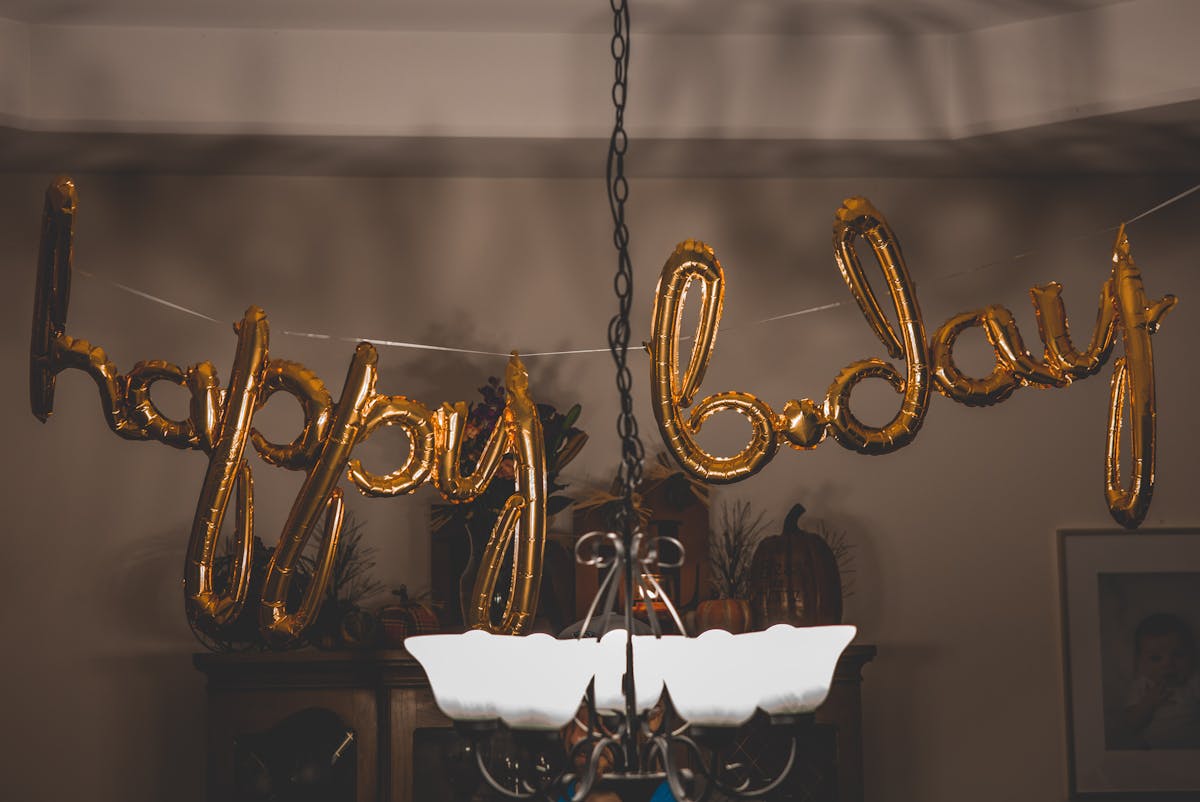
A birthday celebration without a single store-bought item. No glossy wrapping paper, floating balloons, or professionally decorated cake—just plastic bags filled with air, handwritten messages in colored pencil, and a room overflowing with pure intention.
We live in an age where celebrations require a budget. Social media feeds showcase elaborate parties with designer details, quietly teaching that love should look expensive. The pressure to prove our affection through purchases has become so normalized that we’ve almost forgotten what celebration means.
But then a story from the Philippines cuts through all that noise. When a family of children realized they couldn’t buy balloons for their father’s birthday, they refused to let empty pockets mean an empty celebration. Instead, they transformed ordinary plastic bags into makeshift balloons, carefully inflating each one and tying them with whatever string they could find. With colored pencils, they wrote “Happy Birthday, Papa” across their humble creations.
Nobody taught them this solution, and nobody expected such resourcefulness. They simply understood something that many of us have forgotten: celebration isn’t about what you can afford—it’s about what you’re willing to do.
This moment speaks to something more profound than creative problem-solving. It reveals how the most meaningful gestures often emerge from the simplest materials. When we strip away the commercial expectations of how love should look, we discover that its truest expression doesn’t require a single purchase—just presence, creativity, and the decision to show up for the people who matter.
Meaning Matters More Than Money
In today’s culture, celebrations often come wrapped in expectation. Balloons, gifts, cakes, and decorations aren’t just accessories; they’ve become the standard, the symbols of whether love is “enough.” But what happens when those things are out of reach? Does the meaning fade, or does something deeper emerge?
The story of the children who couldn’t afford balloons but still celebrated their father’s birthday with blown-up plastic bags challenges this narrative. They didn’t have money, but they had purpose. They didn’t shop—they created. And in doing so, they reminded us that love, in its most valid form, is not about what you give—it’s about why you provide it.
Each bag, each hand-scrawled message of “Happy Birthday, Papa,” wasn’t just a decoration—it was a declaration. A declaration of love without condition. Of presence without pretense. These children weren’t trying to replicate a store-bought moment but building something more personal. They gave what they had: time, thought, and the courage to care deeply in a world that overlooks invisible gifts too often.
Psychologists call this giving “symbolic value”—when the meaning behind the gift matters more than the gift itself. A study published in the Journal of Consumer Research found that people often experience stronger emotional reactions to gifts that reflect personal effort or creativity than to expensive items. It turns out, we’re wired not just to appreciate what others give us, but to feel more connected when we know it came from the heart.
This family’s celebration wasn’t lacking; it was overflowing with intention, meaning, and a reminder that even in scarcity, we are never poor when we lead with love.
Birthday Joy Doesn’t Need a Big Budget

We live in a world where celebration has been commercialized to the point of comparison. Social media feeds overflow with elaborate birthday setups, towering cakes, and themed décor that looks more like a magazine spread than a moment of connection. Somewhere along the way, celebrating shifted from honoring someone’s presence to showcasing what we could present.
But the story of these children—hanging handwritten plastic bags in place of balloons—cuts through the noise like a quiet revelation. It reminds us that celebration isn’t a transaction. It’s not about how much you spend, but how deeply you feel. These makeshift decorations didn’t just fill a room—they redefined what it means to honor someone.
Their actions ask a powerful question: What are we celebrating? Is it the glitter and confetti—or is it the person, the relationship, the shared history? When the expensive decorations are stripped away, what’s left is the core: love, effort, and human connection.
This isn’t a romanticized idea—it’s a shift in perspective backed by real behavior. According to a 2022 survey by Eventbrite, nearly 65% of people said the most memorable celebrations they’ve experienced weren’t the most expensive—they were the most emotionally meaningful. People remembered who showed up, what was said, how they felt, not what it looked like on Instagram.
In this way, these children didn’t just throw a birthday party for their father—they quietly rebelled against a materialistic norm. They celebrated their dad not with money but with meaning. And in doing so, they returned the word celebration to its roots: to honor, cherish, and be present.
Making Magic From What You Have

According to a Federal Reserve report, nearly 40% of Americans would struggle to cover an unexpected $400 expense without borrowing or selling something. This isn’t a fringe issue—it’s a silent majority. And for families living in this reality, creating moments of joy requires more than money. It demands resilience, creativity, and a willingness to make beauty out of limitation.
The children in this story didn’t let their circumstances define the emotional value of their father’s birthday. Instead, they let it refine their approach. They worked with what they had—plastic bags, colored pencils, a homemade cake—and built something joyful out of nothing. Not because they had to, but because they wanted to. That’s the heart of resilience: the ability to transform lack into love.
This kind of adaptation isn’t rare. It plays out quietly every day in homes where parents skip meals so their kids can eat, where birthdays are celebrated with handwritten cards and improvised games, where love shows up not as a purchase but as a presence. The absence of money doesn’t mean the absence of meaning. If anything, it sharpens it.
There is dignity in making do. There is power in the effort to celebrate, smile, and give, especially when life doesn’t make it easy. These moments reveal hardship and humanity’s unshakable drive to connect, uplift, and love—no matter the cost.
How Love Gets Creative When Cash Is Tight

At its core, love is one of our most potent creative forces. It doesn’t wait for ideal conditions. It works with what’s present—what’s real. It says “Happy Birthday” in a colored pencil. It tapes a plastic bag to the wall like a banner in a palace. It bakes a simple cake without eggs and still calls it a feast. Because when love leads, nothing is too humble to become holy.
Neuroscience even backs this up: when we act from a place of care, the brain engages its reward system, releasing oxytocin—the “bonding hormone”—which strengthens connection and reduces stress. Love fuels not just emotional well-being but adaptive thinking. That’s why, when resources are scarce, people still find a way to give: through art, gestures, and time.
Throughout history, some of the most profound expressions of affection have come from those who had the least to give in material terms—a soldier mailing home a letter written on scraps. A mother braids her daughter’s hair before a long day. A child decorating a wall with whatever they can find. These aren’t small things. They are love made visible—love that insists on being felt.
Being There Beats Bringing Stuff
As you scroll through perfectly curated celebrations and expensive gift guides tonight, pause. Ask yourself: When did you last give something that cost nothing but meant everything? When did you last create instead of purchase, imagine instead of imitate? The children with plastic bag balloons aren’t asking you to abandon all material gifts or live in poverty. They’re extending a different invitation entirely: to remember that your presence—your full, undivided, creative attention is the rarest gift you possess.
Start small. Write a letter by hand. Share a memory instead of buying a memento. Show up early and stay late. Listen without planning your response. These aren’t consolation prizes for when you can’t afford “real” gifts—they’re the real gifts, disguised as ordinary moments. The most revolutionary act in our consumption-driven world might be choosing connection over commodity, meaning over merchandise. It’s choosing to see abundance in what you already carry: your time, creativity, and capacity to make someone feel seen.
So the next time celebration calls, remember those plastic bags dancing on a wall in the Philippines. Remember that love doesn’t need permission from your bank account to show up fully, beautifully, completely.
