
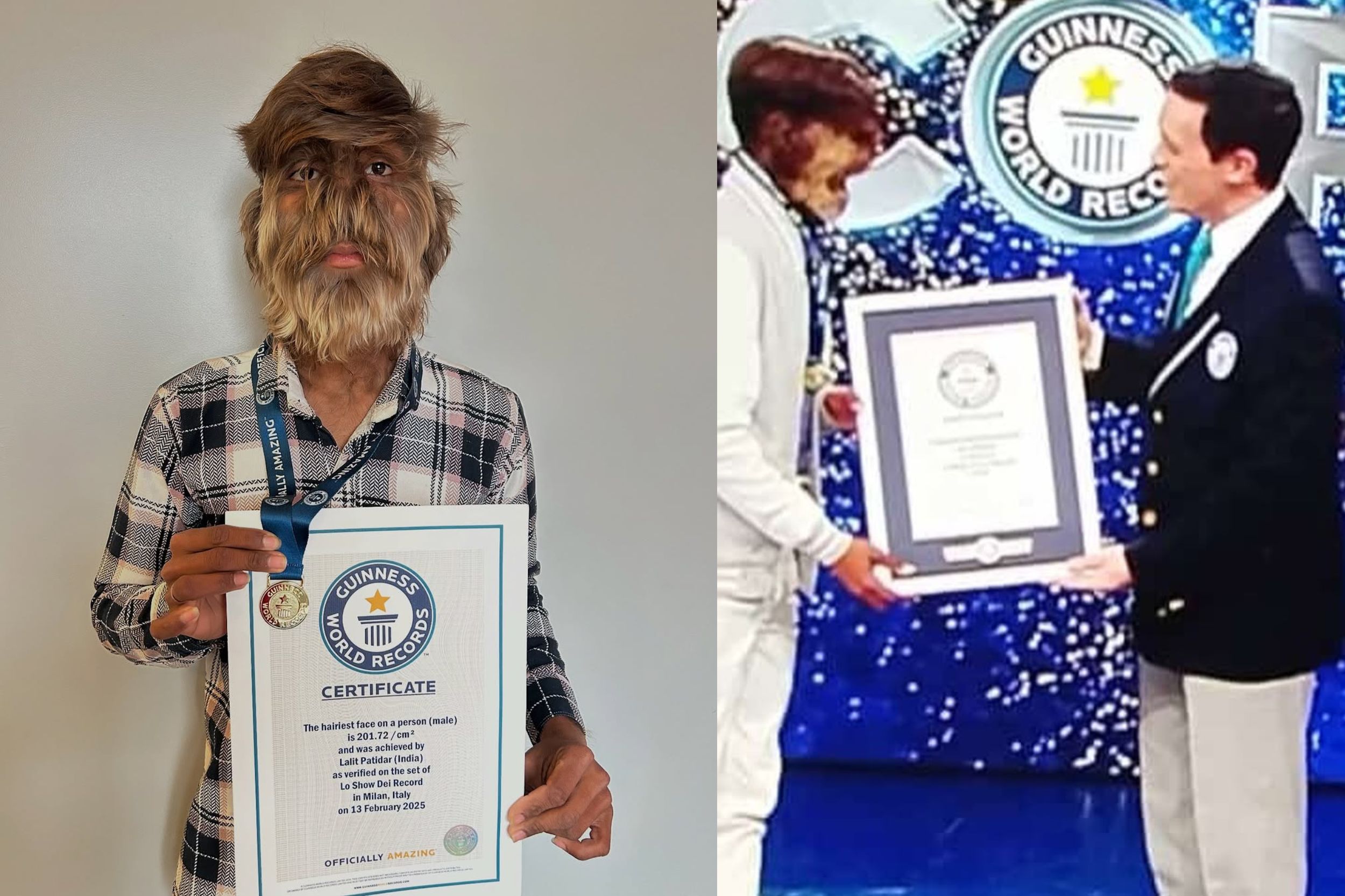
Lalit Patidar, an 18-year-old from India, has recently captured the world’s attention by shattering a remarkable record for having the hairiest face. Diagnosed with hypertrichosis, infamously dubbed “werewolf syndrome,” he stands as a testament to a condition so rare that only a handful of cases—fewer than 50—have been documented since medieval times.
In an extraordinary assessment, Guinness World Records officially validated Patidar’s unique condition, discovering an astonishing density of 201.72 hairs per square centimeter on his face. While many might perceive such an abundance of facial hair as a burden, Patidar has chosen to embrace his distinctive appearance, turning what some may consider a challenge into a source of pride. His acceptance and confidence have not only set him apart but have also garnered him global recognition, inspiring others to celebrate their individuality.
One-in-a-Billion Teen
Born with hypertrichosis, Patidar stands out from his peers due to abnormal hair growth covering 95 percent of his face. Medical experts classify his condition as congenital hypertrichosis, meaning he was born with this rare disorder rather than developing it later in life.
“I was born with hypertrichosis, which caused excess hair on my face,” Patidar explained in an Instagram post. Hypertrichosis affects approximately one in a billion people, making his case exceptionally rare.
Despite facing numerous challenges throughout his life, Patidar maintains a positive outlook. His journey from being bullied to becoming a Guinness World Record holder represents a remarkable story of perseverance and self-acceptance.
Path to World Record Recognition
Patidar’s journey to world record recognition required traveling to Milan, Italy, where medical professionals could adequately assess his condition. During his visit, he appeared on an Italian television program called “Lo Show dei Record” where experts conducted official measurements.
Professional trichologists (hair and scalp specialists) carefully counted his face’s hair density, finding an astonishing 201.72 hairs per square centimeter. Most men have significantly lower hair density on their faces, even with fully grown beards.
Upon receiving recognition from Guinness World Records, Patidar expressed overwhelming joy. “I am speechless, I don’t know what to say because I’m very happy to get this recognition.” he told Guinness World Records representatives.
What Causes Werewolf Syndrome?

Hypertrichosis remains poorly understood in medical communities due to its extreme rarity. Only about 50 documented cases exist in medical literature since medieval times, making research challenging.
Medical professionals classify hypertrichosis as abnormal hair growth that may cover small patches or spread across larger body areas. According to Dr. Amy Huang, a board-certified dermatologist with Medical Offices of Manhattan, “Generalized hypertrichosis, or werewolf syndrome, is an extremely rare type of inherited condition resulting in abnormal amounts of terminal hairs throughout the body.”
Several potential causes exist for hypertrichosis development. Scientists speculate genetic factors play a significant role, particularly in congenital cases like Patidar’s. One fascinating theory suggests gene “reactivation” might trigger excessive hair growth.
Experts at Healthline explain: “Congenital hypertrichosis may be caused by reactivation of genes that cause hair growth. The genes that caused extensive hair growth in early man have “shut down” during the course of evolution. By a mistake that still has no known cause, these hair-growth genes “turn on” while a baby is still in the womb.”
Other potential causes include malnutrition, cancer, eating disorders, or medication side effects, though these typically lead to acquired rather than congenital hypertrichosis.
Currently, no cure exists for hypertrichosis. People with this condition can attempt hair removal through temporary methods like shaving, waxing, or chemical treatments or seek longer-lasting options such as electrolysis or laser surgery.
Life as a Child with Hypertrichosis
Childhood presented numerous challenges for Patidar, as his appearance made him stand out dramatically from other children. When first meeting him, peers often reacted with fear rather than understanding.
“From a young age, I avoided public places and isolated myself at home,” Patidar shared on social media. “People used to call me a ‘monster’ and ‘beast’, because of my hairy face.”
School experiences proved particularly difficult as children struggled to look beyond his unusual appearance. “They were scared of me but when they started knowing me and talking to me they understood I was not so different from them, and it was just on the outside that I looked different, but I’m not different inside.” Patidar recalled.
Bullying led to emotional distress during his formative years. “Due to constant bullying, I cried alone and often asked God, ‘Why me?'” Patidar explained. Many children with visible differences face similar psychological challenges, making social adjustment difficult.
Family support proved crucial throughout his childhood struggles. “My family always supported me and never made me feel different,” he shared. “Their love gave me strength, even when the world [was] against me.”
From Hiding to Hashtags: Finding Fame and Self-Love
Over time, Patidar developed remarkable resilience and self-acceptance. Rather than hiding his face or pursuing aggressive hair removal treatments, he embraced his unique appearance. “I like how I am, and I don’t want to change my look.” Patidar said.
Patidar has leveraged social media platforms to share his story and connect with people worldwide. His Instagram account boasts an impressive 265,000 followers, while his YouTube channel has 108,000 subscribers, where he documents daily activities. His content allows viewers to see beyond his condition and connect with his personality and life experiences.
By sharing his everyday life online, Patidar helps normalize his condition while building awareness about hypertrichosis. Social media provides him a platform to control his narrative rather than allowing others to define him solely by his appearance.
On Instagram, he described traveling to Italy for record verification as “the best moment of my life” and added, “Today, I proudly said I love my appearance and have no wish to change it,” demonstrating remarkable self-confidence despite years of social challenges.
Creating Awareness About Rare Conditions
Medical literature classifies hypertrichosis as an exceptional disorder, with JAMA Dermatology noting its extreme rarity. By putting a face to this condition, Patidar helps medical communities and laypeople better understand how hypertrichosis affects real individuals.
Many rare disorders receive minimal attention or research funding due to limited public awareness. Patidar’s prominence may benefit others with rare conditions indirectly by promoting general awareness about living with unusual medical circumstances.
His story highlights how conditions affecting appearance can create social challenges even without accompanying health complications. As Dr. Huang noted, psychological impacts often prove significant for children with visible differences.
When Different Becomes Distinguished
Patidar’s journey from bullied child to world record holder demonstrates how perceptions of difference can evolve. His story challenges conventional beauty standards and encourages acceptance of human diversity.
Most notably, Patidar refuses to view his condition as requiring correction or concealment. His attitude shows remarkable psychological strength, particularly considering childhood experiences with bullying and isolation.
Many individuals with visible differences face pressure to undergo treatments or surgeries to appear more “normal.” Patidar’s refusal to change his appearance despite having options for hair removal represents a powerful statement about body autonomy and self-acceptance.
His record-breaking hair density is now recognized as unique rather than merely different—a subtle but meaningful shift in perception. What once made him a target for bullying now makes him a Guinness World Record holder.
Looking Forward
At 18, Patidar transformed perceptions about his condition through social media presence and world record recognition. His future likely holds continued opportunities for advocacy and education about rare conditions.
His growing social media following suggests that public interest in his story will continue to expand. Many followers likely appreciate seeing someone embrace their differences rather than hiding them.
Patidar joins a small group whose rare conditions have gained public recognition. His visibility may comfort others with visible differences by demonstrating how acceptance and success remain possible despite social challenges.
Patidar’s case adds valuable documentation to the limited medical literature on hypertrichosis. While approximately 50 cases have existed in medical records since medieval times, few have received detailed documentation and public attention.
Hairy Face, Brave Heart
Lalit Patidar’s record-breaking facial hair represents more than just a medical anomaly – it symbolizes how differences, once viewed negatively, can become sources of distinction and even pride. His journey offers valuable lessons about resilience and self-acceptance for anyone feeling different or excluded.
By documenting his daily life for thousands of YouTube subscribers, Patidar helps normalize his condition while building connections beyond physical appearance. His growing platform allows him to control his narrative rather than being defined solely by medical terminology.
From being called names like “monster” to proudly declaring love for his appearance, Patidar demonstrates how self-perception can evolve dramatically over time. His confidence and self-acceptance stand as his most remarkable achievements – perhaps even more impressive than his world record for having the hairiest face in the world.
Featured Image Source: Lalit Patidar on Instagram
