

Lunchtime chatter usually echoes with laughter, trading stories, and harmless teasing. For most students, the cafeteria is a place of routine—noisy, crowded, yet safe. But on one afternoon in Kilgore, Texas, that sense of safety broke apart in an instant.
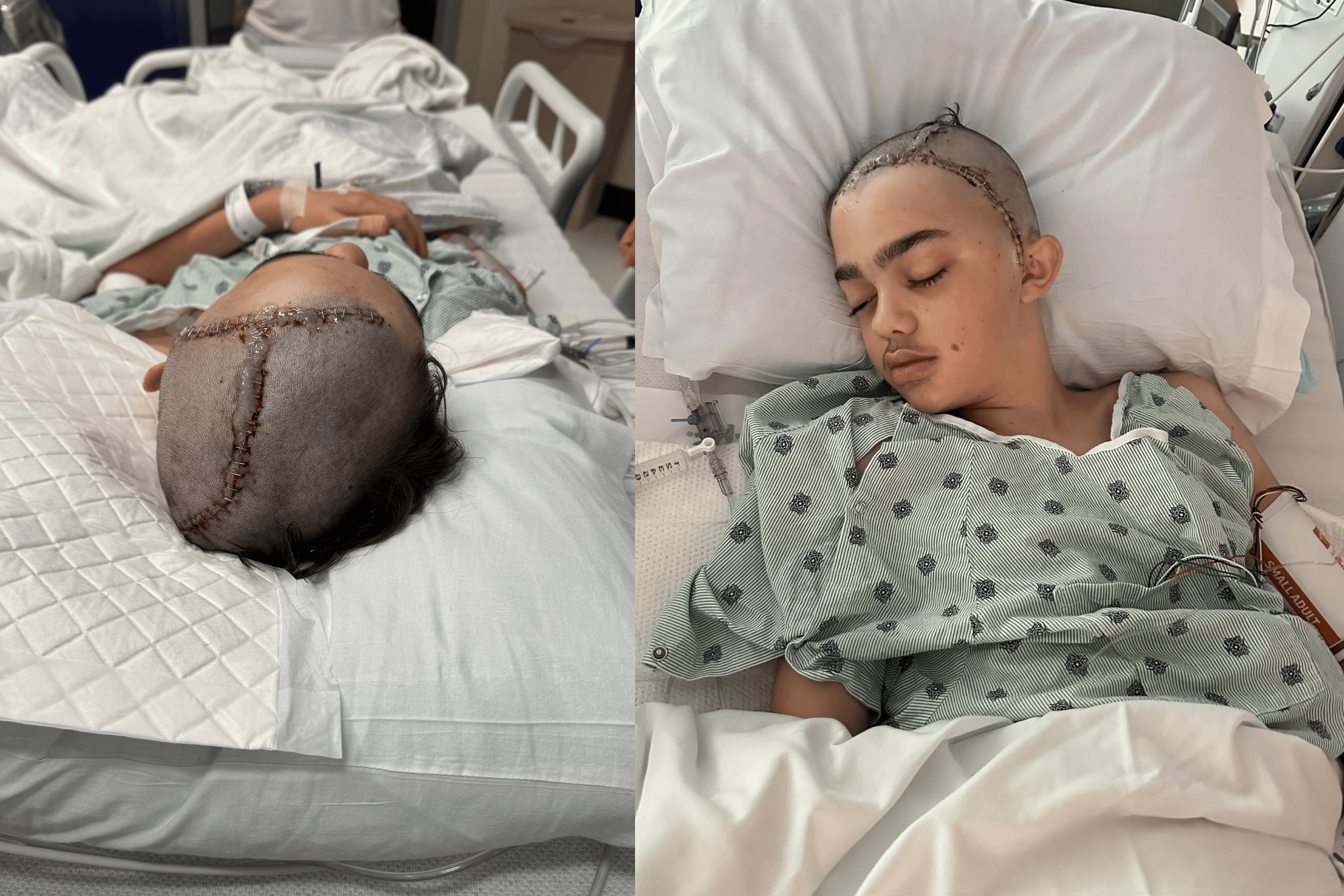
Fourteen-year-old Lukas Hardeman’s lighthearted remark spiraled into something no one could have predicted. Within moments, he was rushed to the hospital, facing surgeries and staples that would hold his life together.
His story is not only about one boy’s suffering—it is about the fragility hidden within everyday life. It reminds families and schools how quickly the ordinary can shift, and how urgent it is to nurture environments where children feel safe, valued, and protected.
The Moment Everything Changed
What began as a routine school day quickly shifted into crisis inside the cafeteria of a Kilgore middle school. In the swirl of voices and movement, a brief exchange between classmates took a violent turn. Witnesses say 14-year-old Lukas Hardeman was lifted and slammed onto a fixture, his head striking the hard edge of a stool.
The blow left Lukas with severe brain injuries, including multiple bleeds and dangerous swelling. Emergency responders rushed him to Children’s Medical Center in Dallas, where surgeons worked to relieve the pressure on his brain by removing two sections of his skull. More than 60 staples were placed to close his wounds, marking the beginning of a long and uncertain recovery.
For the community, the incident was a jarring reminder that safety can fracture in an instant. Kilgore ISD later called the event “unexpected and deeply troubling,” promising to review its safety practices, even as questions lingered about accountability and prevention.
A Family Holding on to Hope
Behind the medical updates lies the weight of a young boy’s healing journey and a family learning how to carry it. Lukas’ father, Michael Hardeman, shared the raw reality of what his son faces: “He’s embarrassed. He is hurt. He is struggling.” For a teenager once full of creativity and energy, the sudden shift has been overwhelming.
Yet even in this struggle, the family has found strength in community. After a school board meeting, Michael and Lukas’ stepmother spoke of the “so many calls, messages and donations” that reminded them they were not walking this road alone.

Their verified fundraiser reflects the practical side of recovery—covering travel, missed work, and continuing care. With contributions surpassing $42,000, the message is clear: healing requires not only doctors and time, but also the solidarity of those willing to stand with them.
Faith has also become a lifeline. Michael has said he believes Lukas is “only alive today because of Jesus,” describing the moment as if divine “hands around his heart” kept him here. In their home, hope is not just a word—it is a practice woven into every prayer, every message of support, and every step toward recovery.
Schools Under Scrutiny
When tragedy strikes on campus, the responsibility to restore safety falls heavily on the institution itself. Kilgore ISD moved quickly to issue a public statement after the incident, declaring, “No student should feel uncertain, afraid, or anxious about attending school,” and promising a thorough review of safety measures, communication practices, and security protocols.
Parents, however, wanted more than reassurances. At a special-called meeting, many raised concerns about repeated emergency calls to local campuses, pressing leaders not just for words but for immediate, visible changes. Their questions pointed to a deeper issue: how quickly can schools transform policies into protection when every delay risks another child’s wellbeing?
The district has pledged to “take every necessary step” to strengthen safety and rebuild trust. For families, the test will be whether those promises translate into transparent action—steps that make classrooms and cafeterias feel like the safe spaces they are meant to be.
Beyond One Incident: A National Challenge
What happened in Kilgore is heartbreaking, but it is not an isolated event. Across the United States, violence in schools continues to shape the lives of young people, even as surveys reveal some signs of progress.
The CDC’s Youth Risk Behavior Survey shows that bullying on school grounds dropped from 19.5% in 2019 to 15.0% in 2021. On paper, this looks like improvement, but it still means nearly one in six high school students reports being bullied where safety should be a given.
Physical confrontations, too, remain a concern. Data from the National Center for Education Statistics found that about 8% of students were involved in a physical fight on school property in 2019—a lower percentage than in previous decades, but still affecting thousands of classrooms nationwide.
Behind the numbers lies a growing mental health crisis. The CDC has tracked sharp increases in sadness, hopelessness, and stress among teenagers during the pandemic years, raising alarms about how emotional struggles can intensify the risk of violence.
This is why schools are shifting from punishment alone to prevention. On-campus counseling, trauma-informed teaching, and behavioral health programs are becoming essential tools in creating safe, supportive environments. Safety is no longer just about discipline—it is about healing the unseen wounds that often precede aggression.
When a Village Comes Together
In moments of crisis, the strength of a community often reveals itself. For Lukas and his family, the outpouring of support has transformed heartbreak into a reminder of collective care.
Online, a verified fundraiser has become a lifeline. With hundreds of donations—totaling over $42,000—it reflects more than financial help; it reflects the compassion of strangers who refuse to let one family carry the burden alone.

That generosity has spilled into the streets as well. In Longview, a local gym opened its doors for a special boot camp and Zumba session, raising nearly $1,000 in just one weekend. Each dollar carried with it a message: you are not forgotten, and your healing matters to us.
Milestones in Lukas’ recovery have also become moments of shared relief. When local news outlets reported his return home from Children’s Medical Center Dallas, neighbors and supporters alike celebrated quietly, knowing that even small steps forward are victories worth holding onto.
And as national platforms like People amplified the story, the circle of care widened far beyond East Texas—proof that compassion, once sparked, can ripple across borders and turn tragedy into a catalyst for solidarity.
Nurturing Safer Spaces for Children
Lukas’ story reminds us that safety is not guaranteed—it is something communities must actively cultivate. Families and schools both have the power to shape environments where conflict is less likely to escalate into harm. Here are steps supported by research and practice that can guide the way:

- Keep Conversations Open at Home
Children are more likely to share struggles when they feel listened to without judgment. Simple rituals like daily check-ins can uncover hidden stress before it grows into crisis. - Teach Calm Responses Early
Social-emotional learning in schools shows that children can be taught to pause, breathe, and choose nonviolent responses when emotions run high. These small skills can defuse potentially harmful situations. - Reinforce Safety in Shared Spaces
Cafeterias, hallways, and playgrounds often see the most conflicts. Ensuring consistent adult supervision and clear reporting systems can help prevent situations from spiraling. - Prioritize Mental Health Access
The CDC has linked poor adolescent mental health with increased risks of violence. School counselors, community therapists, and mental health education can make resilience part of daily life, not an afterthought. - Stay Informed About Online Trends
Viral challenges and online dares sometimes encourage dangerous behavior. Parents and teachers who stay aware of these trends are better positioned to talk openly with children about their real-world consequences. - Empower Students to Lead
Peer-led initiatives—whether anti-bullying campaigns or mentorship programs—can shift school culture. When students model kindness and accountability, the message becomes stronger than any rulebook.
These actions are not quick fixes. They are long-term investments in the health, safety, and confidence of the next generation.
Healing the Wounds We Cannot See
Hospitals can close wounds and stabilize bodies, but the soul’s healing is often a longer journey. For a teenager like Lukas, the challenge ahead is not just in recovering physically—it is in reclaiming his sense of self and spirit after trauma.
Psychologists remind us that scars, both visible and invisible, can shift how young people view themselves. Embarrassment, isolation, and fear may linger long after the stitches are removed. Studies in the Journal of Pediatric Psychology stress that a child’s return to confidence often depends on the acceptance and compassion of peers, teachers, and family members.
This is where community care transforms into something sacred. When schools provide counseling and safe spaces, when families listen without judgment, and when friends show up with kindness, these actions become more than support—they become healing rituals. Even the smallest gestures, like a classmate offering inclusion or a teacher affirming progress, carry the weight of grace.
Spiritual traditions often teach that true recovery is not only about mending the body, but about rediscovering connection—to self, to others, and to something greater. Setbacks may come, but when children are surrounded by love, faith, and belonging, they are reminded that they are more than their wounds. Healing then becomes a sacred act: the reweaving of spirit, strength, and hope.
A Call to Protect What Is Sacred
One cafeteria incident has become a mirror for families, schools, and communities across the nation. It shows how quickly the ordinary can fracture—and how vital it is to build spaces where children feel secure, seen, and supported.
Lukas’ journey is still unfolding, marked by surgeries, recovery, and the steady work of rebuilding his confidence. Yet his story carries a lesson larger than one boy’s struggle. Safety is not something to be assumed; it is a responsibility that belongs to us all. Every conversation, every safety measure, every act of kindness adds a layer of protection for the young lives entrusted to us.
There is also a spiritual truth here: the wellbeing of children is sacred. To care for them is to honor the most essential gift of life itself. When we stand together—families, educators, neighbors, and faith communities—we not only respond to tragedy, we prevent it. We become the guardians of futures still unfolding.
Lukas’ scars remind us that resilience is possible, but prevention is far better. Let his story move us to action, compassion, and vigilance—so that no ordinary day ever turns so fragile again.
Featured Image from Catom Morris-Hardeman and Autumn Crews on GoFundMe
