
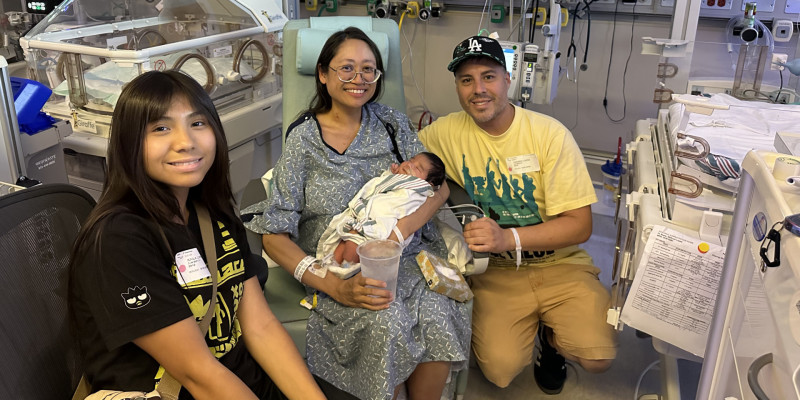
Suze Lopez walked into Cedars-Sinai Medical Center expecting answers about a tumor. She left with something no one could have predicted.
For years, a massive growth had been expanding inside her body. At 41 years old, the emergency room nurse from Bakersfield, California, had grown accustomed to the discomfort. She knew her periods were irregular. She accepted the abdominal pain as part of her daily life. And she had long ago made peace with the idea that her teenage daughter, Kaila, would be her only child.
After 17 years of trying for another baby, hope had faded. A 22-pound ovarian cyst occupied the space where dreams of a second child once lived. Surgery to remove it seemed like the logical next step, a chance to finally reclaim her body from the mass that had been growing for years.
But before any surgeon could make an incision, hospital protocol required something simple. Something routine. Something that would change everything. A pregnancy test.
An Impossible Result
Lopez stared at the results in disbelief. Positive. At 41, with a massive cyst dominating her abdomen, the word seemed almost cruel. Her mind raced through the possibilities. Could it be a false reading caused by the tumor? Was it a sign of something far more serious, perhaps even ovarian cancer?
She had spent nearly two decades praying for another child. She and her husband, Andrew, had tried everything. Nothing worked. And now, just as she prepared to have a giant growth removed from her body, a routine test suggested the impossible.
Three days passed before she could bring herself to share the news. She chose a special moment, a date night at a Dodgers baseball game in Los Angeles. Andrew’s reaction was everything she had hoped for. Joy. Shock. Pure elation. Together, they snapped a selfie, holding up a tiny Dodgers onesie as proof of their unexpected news. But their celebration was short-lived.
During the game, pain tore through Lopez’s abdomen. Sharp. Intense. Impossible to ignore. Andrew rushed her to Cedars-Sinai, where medical staff discovered her blood pressure had spiked to dangerous levels. What happened next would leave an entire hospital in awe.
A Discovery Beyond Belief

Medical teams moved quickly. They ordered blood work. An MRI. An ultrasound. As images appeared on screens, doctors gathered around, struggling to process what they were seeing. John Ozimek, medical director of Labor and Delivery at Cedars-Sinai, delivered news that defied medical textbooks.
“Suze was pregnant, but her uterus was empty, and a giant benign ovarian cyst weighing over 20 pounds was taking up so much space,” Ozimek explained. “We then discovered a nearly full-term baby boy in a small space in the abdomen, near the liver, with his butt resting on the uterus. A pregnancy this far outside the uterus that continues to develop is almost unheard of.”
Lopez had been carrying a baby for months without knowing it. Not in her uterus, where pregnancies normally develop, but in her abdomen. Near her liver. Behind the massive cyst that had masked his presence entirely.
As her baby grew, he pushed the tumor forward. Every bit of swelling, every increase in size that Lopez noticed, she had simply assumed meant her cyst was getting bigger. She never imagined a child was growing alongside it, hidden from view, surviving against all odds.
Understanding Abdominal Ectopic Pregnancy

Ectopic pregnancies occur when a fertilized egg implants somewhere other than the uterus. About 2% of all pregnancies fall into this category, and the vast majority happen in the fallopian tubes. Abdominal ectopic pregnancies, where the egg implants on organs or blood vessels inside the abdomen, account for only about 1% of ectopic cases.
Such pregnancies are considered life-threatening emergencies. Without a uterus to support growth, the placenta cannot develop safely. Catastrophic bleeding can occur at any moment. Fetal death is common. When infants do survive delivery, they often face severe medical problems.
For a baby to develop to full term in such conditions is extraordinarily rare. Medical literature contains only a handful of documented cases. Most physicians go their entire careers without seeing one.
Michael Manuel, a gynecological oncologist at Providence Cedars-Sinai Tarzana Medical Center, was called in to help remove the giant cyst. What he saw stopped him in his tracks.
“It was profound to see this full-term baby sitting behind a very large ovarian tumor, not in the uterus. In my entire career, I’ve never even heard of one making it this far into the pregnancy,” Manuel said.
Lopez’s case presented a puzzle that demanded immediate attention. A baby with its placenta and blood vessels attached inside her abdomen. A 22-pound ovarian mass that needed removal. A mother whose life hung in the balance. Medical staff had to figure out how to address all three challenges at once.
Thirty Experts Prepare for the Unthinkable

Cedars-Sinai holds a distinction as California’s only Level IV Maternal Care hospital. Such a designation means the facility can provide the most advanced care for mothers before, during, and after childbirth. For a case as extreme as Lopez’s, that designation would prove essential.
About 30 specialists assembled in a single operating room on August 18. Maternal-fetal medicine experts stood alongside gynecological oncologists. Nurses worked beside anesthesiologists. Surgical technicians filled nearly every available space. Each person had a role to play in what would become one of the most unusual deliveries any of them had ever witnessed.
Sarah J. Kilpatrick, chair of the Department of Obstetrics and Gynecology, noted that providing such highly trained, coordinated care for extremely high-risk patients can make all the difference for both mother and baby.
Manuel approached the massive dermoid cyst first, lifting it carefully out of the way. Ozimek and his team then moved quickly, delivering the baby boy and handing him off to Neonatal Intensive Care Unit staff within moments. But their work was far from finished.
Racing Against Time

As soon as the medical staff delivered the baby, Lopez began hemorrhaging badly. Blood loss accelerated at an alarming rate. Even a team of obstetric anesthesiologists who had prepared for exactly such a scenario found the intensity overwhelming.
Michael Sanchez, an anesthesiologist on the team, had anticipated trouble. Before surgery began, he powered up a special machine designed to deliver blood products at high speed. When Lopez started bleeding, every second mattered. Medical staff used 11 units of blood to stabilize her. For reference, a typical blood donation yields about one unit. Lopez needed more than ten times that amount just to survive the delivery.
Meanwhile, in the NICU, doctors focused on her newborn son. One serious concern dominated their thinking. Had his lungs developed properly? Would he be able to breathe on his own? Sara Dayanim, a neonatologist with Cedars-Sinai Guerin Children’s, had prepared for the worst. Her team stood ready to handle any respiratory problems the baby might face. But the little boy had other plans.
He came out of anesthesia quickly. He was feisty. He fought. Within a day, medical staff removed his breathing tube. Over the next two weeks, he reached every important benchmark for healthy survival. He defied every expectation doctors had set for him.
A Guardian Angel in Scrubs
Recovery demanded everything Lopez had. But she pushed herself, determined to spend time in the NICU with her new son, her husband, and her teenage daughter.
Throughout the ordeal, one person stood out. Carmen Chavez, assistant manager of the Maternal-Fetal Care Unit, stayed close to the family before and after the challenging delivery. She sat in on consultations with doctors, making sure Lopez and her family understood everything they faced. She even helped them tell Kaila about the pregnancy. Lopez, herself a nurse, recognized care that went beyond the call of duty. She still refers to Chavez as her guardian angel.
Chavez felt Lopez deserved every bit of support she could provide. Knowing the challenges mother and baby faced, she wanted to stay close. For nursing staff at Cedars-Sinai, it was all hands on deck. Planning every detail became essential for such an exceptionally high-risk case.
Eight Pounds of Miracle

Baby Ryu entered the world weighing eight pounds. He had a full head of hair. He had remarkably few health problems. And he had a name chosen with purpose.
Andrew and Suze selected “Jesse” as his middle name. It means “gift from God.” After 17 years of prayers, after countless disappointments, after a pregnancy that medical science says should not have been possible, the meaning felt appropriate.
Andrew was allowed in the operating room during the procedure. Watching his wife go through such an ordeal was difficult. Seeing his son delivered was amazing. Both experiences left him overwhelmed with gratitude. He called both Ryu and Suze his miracles. Many prayers, he said, had been answered.
For Suze, the experience reshaped how she sees every single day. Small moments matter now. Nothing goes unappreciated. Every breath her son takes represents something medical professionals call almost impossible.
“I appreciate every little thing. Everything. Every day is a gift and I’m never going to waste it,” Lopez said. “God gave me this baby so that he could be an example to the world that God exists—that miracles, modern-day miracles, do happen.”
Medicine Meets the Unexplainable

Ryu Jesse Lopez exists because of extraordinary medical care and circumstances that defy easy explanation. A routine pregnancy test caught what months of symptoms could not reveal. A team of 30 specialists executed a delivery that textbooks say should not have succeeded. A baby survived conditions that claim most lives long before reaching full term. His mother walked into a hospital expecting a tumor removal. She walked out with a son.
For the Lopez family, the holiday season carries new meaning now. Seventeen years of hoping produced something they had stopped believing could happen. An eight-pound baby boy with his mother’s fighting spirit now fills their home with sounds they once thought they would never hear again.
Medical professionals at Cedars-Sinai continue to marvel at what they witnessed. Cases like Ryu’s remind even the most experienced physicians that some things remain beyond prediction. Beyond statistics. Beyond what training prepares them to expect. Sometimes, against every odd, life finds a way.
