
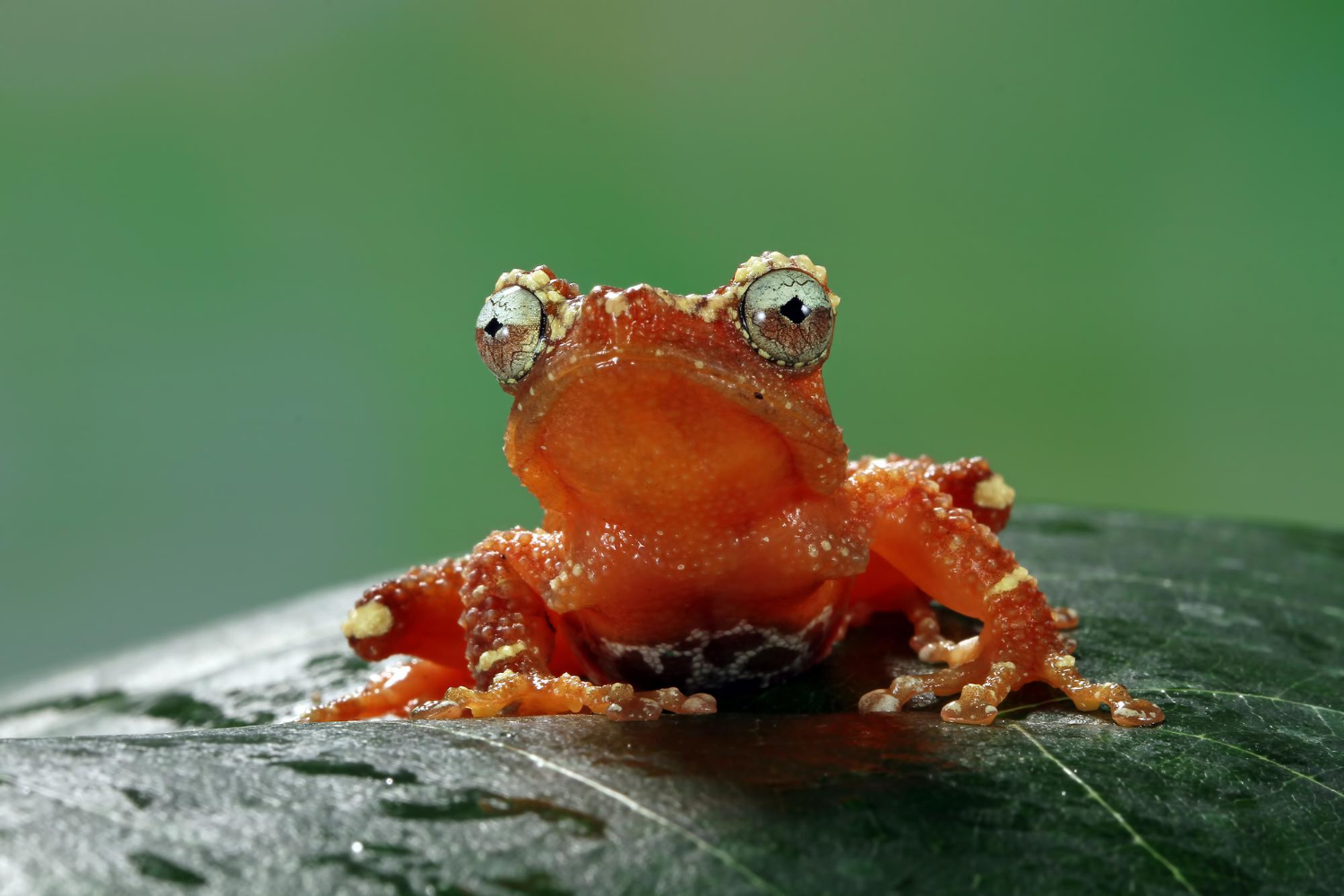
Deep within Brazil’s misty mountain forests, something small was making a lot of noise. Researchers hiking through the Serra do Quiriri range kept hearing a distinctive call echoing through the trees. Yet every time they tried to find its source, they came up empty-handed.
For years, these sounds puzzled scientists. Whatever was producing them seemed determined to stay hidden. And when researchers finally tracked down the culprit, they discovered something remarkable. Sitting in the damp leaf litter was a frog so small it could perch comfortably on a pencil tip. Its skin glowed bright orange, like a tiny ember flickering on the forest floor.
What they had found would soon become one of 2025’s most charming biological discoveries. But size was just one part of what made it special. Behind those miniature features lay a story about ancient forests, isolated mountaintops, and why protecting even the smallest creatures matters more than ever.
A Loud Voice Led Scientists to a Tiny Frog
Finding a frog by sight in a dense forest can feel impossible. Finding one smaller than your thumbnail? Even harder. So when a team of Brazilian biologists set out to study amphibians in Serra do Quiriri, they relied on their ears instead of their eyes.
Male frogs of many species produce calls to attract mates. Each species has its own acoustic signature, almost like a fingerprint made of sound. Researchers noticed that certain calls in Serra do Quiriri didn’t match any known species in the area. Something new was singing in these forests.
After painstaking searches through layers of fallen leaves and moss, scientists finally spotted the singers. Tiny orange frogs, barely visible against the brown leaf litter, were belting out surprisingly loud calls for their size. Males measured just 8.9 to 11.3 millimeters long. Females grew slightly larger at 11.7 to 13.4 millimeters.
To put that in perspective, a standard pencil measures about 7 millimeters across. An adult male of the new species could sit on that pencil tip with room to spare.
Confirmation required more than just observation. Researchers collected 32 individuals and brought them to the lab for a detailed study. Genetic sequencing revealed these frogs formed a distinct lineage. Physical measurements showed subtle but consistent differences from related species. And acoustic analysis confirmed their calls were unlike any previously recorded.
Each call consisted of two notes containing up to four pulses. Some calls included soft “attenuated notes” that built up before louder sounds, almost like a singer warming up before hitting the big notes. Scientists recorded 13 complete calls from different individuals, documenting a vocal pattern found nowhere else.
What Makes Pumpkin Toadlets So Special

Pumpkin toadlets belong to a group called Brachycephalus, and they rank among Earth’s smallest four-limbed animals. With 43 species now recognized, including the newly described frog, scientists have named 35 of them just since 2000. Advanced genetic tools keep revealing hidden diversity that earlier researchers missed.
But small size brings unusual challenges. When bodies shrink to extreme proportions, certain features must change or disappear entirely. Many pumpkin toadlets have lost toe bones, have shrunken skulls, and sport highly compacted frames. Some species lack a visible fifth toe. Others have simplified inner ear structures that affect their hearing.
Perhaps the strangest discovery involves communication. At least two related species, B. ephippium and B. pitanga, appear unable to hear their own calls. Scientists suspect these frogs may rely on body movements and bright colors rather than sound to get their message across.
Speaking of color, pumpkin toadlets earned their name honestly. Many species display intense oranges and yellows that make them look like tiny Halloween decorations scattered across the forest floor. Researchers believe these bold hues serve as warning signals. Bright skin often indicates toxins that predators learn to avoid after an unpleasant first encounter.
Beyond color, some species have bones that glow under ultraviolet light. Scientists still debate why. Possible explanations include predator deterrence, mate attraction, or simple biological accident. Whatever the reason, it adds another layer of strangeness to an already bizarre group.
One more unusual trait sets pumpkin toadlets apart. Most frogs go through a tadpole stage, wriggling through ponds before developing legs. Pumpkin toadlets skip that step entirely. Their eggs hatch directly into tiny froglets on land, never needing standing water. Scientists call it “direct development,” and it allows these frogs to thrive in habitats where puddles and streams are scarce.
Life in the Cloud Forests

https://journals.plos.org/plosone/article?id=10.1371/journal.pone.0334746
Serra do Quiriri rises along the border between Brazil’s Paraná and Santa Catarina states. Mist hangs over these peaks for much of the year, keeping humidity high and temperatures cool. Ecologists call such places “cloud forests” because clouds often wrap around the mountain slopes like a blanket.
At lower elevations, dense rainforest dominates. Higher up, trees grow shorter and vegetation shifts to highland grasslands. In between lies a transitional zone where cloud forest reigns. Moisture drips from branches. Moss carpets every surface. And the newly described pumpkin toadlet makes its home in the thick leaf litter covering the forest floor.
Unlike many frogs that emerge at night, these tiny amphibians stay active during daylight hours. Researchers noticed calling decreased during the hottest part of the day, roughly between 11 a.m. and 3 p.m. Otherwise, males sang throughout daylight hours, their voices carrying through the misty understory.
So far, scientists have confirmed the species at two locations about 6.3 kilometers apart. One site, Pico Garuva, gave up specimens at elevations between 635 and 990 meters. Another location, Monte Crista, produced frogs from 435 to 895 meters in elevation. Researchers believe populations likely exist in forested areas between these two points, though surveys haven’t confirmed it yet.
The total known range spans roughly 8 square kilometers. For a frog that cannot travel far, that tiny patch of forest represents its entire world.
Sky Islands and How New Species Form

Why would three closely related frog species live on the same mountain range yet remain genetically distinct? Scientists found an answer written in the landscape itself.
Mountaintop forests function like islands in the sky. Warm, dry lowlands separate one peak from another, creating barriers that ground-dwelling frogs cannot easily cross. Populations become isolated on their respective summits, cut off from relatives living just a few kilometers away.
But the real magic happens when climates shift. During drier periods in the past, forests retreated downslope and shrank to small patches. When wetter conditions returned, forests expanded back uphill. Yet they didn’t always reconnect. Sometimes forest patches grew separately, surrounded by grasslands, creating what scientists call “microrefugia.”
Frog populations trapped in these isolated forest patches had no way to reach neighboring groups. Over thousands of years, genetic differences accumulated. Eventually, separate species emerged from what had once been a single population.
On Serra do Quiriri, three sister species now occupy different patches of forest on the same mountain complex. B. lulai shares the range with B. auroguttatus and B. quiririensis. All three descended from a common ancestor, but geographic isolation pushed them down separate evolutionary paths.
Even today, forests continue advancing uphill into grassland areas. Researchers have documented frogs colonizing young forest patches less than 30 years old. Evolution keeps working, and new species may still be forming as landscapes shift.
Conservation Status and Future Protections

Despite its tiny range, the new species currently faces no obvious threats. Forests where it lives remain relatively intact. No development projects loom on the immediate horizon. Based on available evidence, researchers classified B. lulai as “Least Concern” on conservation assessments.
But that classification comes with caveats. As researchers noted in their study, “this status is based on the absence of observed ongoing decline and the apparent lack of plausible future threats. Nevertheless, it is essential to continue systematically monitoring this scenario.”
Small ranges make species vulnerable. A single fire, a road project, or unchecked cattle grazing could devastate populations before anyone noticed. Serra do Quiriri already faces pressure from regular grassland burning, livestock, invasive pine trees, mining operations, and hiking trails. None currently threatens the new frog directly, but any could expand upslope with little warning.
Researchers proposed a solution that wouldn’t require the government to purchase private land. “The new species is found close to other endemic and threatened anurans, justifying a proposition for the Refúgio de Vida Silvestre Serra do Quiriri, a specific type of Integral Protection Conservation Unit that would not necessitate expropriation of land by the government.”
A wildlife refuge would protect all three Brachycephalus species living on Serra do Quiriri, plus another endangered frog called Melanophryniscus biancae. Landowners could continue using their property under guidelines designed to preserve habitat. Controlled burning, sustainable grazing, and tourism management could balance human needs with wildlife protection.
Creating such a refuge wouldn’t just help frogs. Cloud forests and highland grasslands support entire communities of plants and animals found nowhere else. Protecting these habitats preserves evolutionary histories stretching back millions of years.
Why Naming Matters for Conservation

Scientists named the new species Brachycephalus lulai after Brazilian President Luiz Inácio Lula da Silva. Political tributes in species names generate attention and spark conversation. But as researchers acknowledged, naming alone guarantees nothing.
“Through this tribute, we seek to encourage the expansion of conservation initiatives focused on the Atlantic Forest as a whole, and on Brazil’s highly endemic miniaturized frogs in particular,” the team wrote in their study.
Brazil’s Atlantic Forest once stretched along much of the country’s eastern coast. Today, roughly one-fifth of that original forest survives, scattered across fragments separated by farms, cities, and roads. Species with small ranges face especially high risks when their tiny patches of habitat sit outside protected areas.
Every new species description adds to our understanding of how life diversifies when landscapes fragment. Pumpkin toadlets show that even microscopic patches of forest can harbor distinct lineages found nowhere else on Earth. Protecting these habitats doesn’t just save individual species. It preserves the evolutionary processes that created them.
A frog smaller than a pencil eraser might seem insignificant. But somewhere in Brazil’s misty mountains, a tiny orange amphibian is still singing. And for now, at least, someone is listening.
