
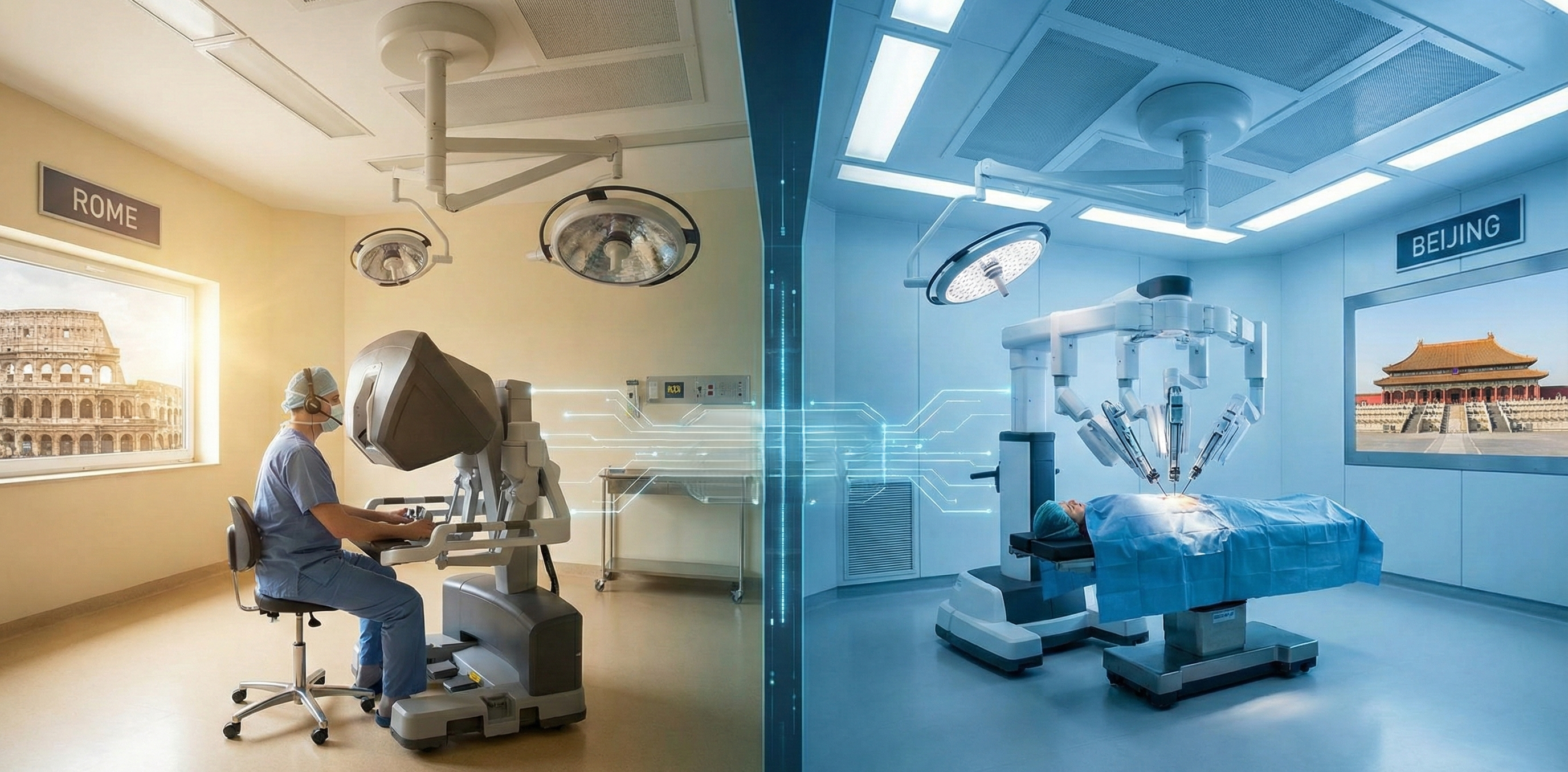
A surgeon in Rome sits at a console in a conference hall, while a man with prostate cancer lies on an operating table in Beijing, trusting instruments guided from 8,000 kilometers away. In another setting, a team in Lhasa connects to patients in Beijing through a satellite orbiting tens of thousands of kilometers above Earth. These are not trial runs on plastic models but real operations on real people, using robots, 5G, and satellite links to close the gap between where expertise lives and where patients are treated. The technology is impressive, but the real story is more human: what it takes to keep surgery safe when the lead surgeon is not in the room, how teams manage delay in a world where a fraction of a second matters, and what questions patients should ask before saying yes to this kind of care.
Inside of the World’s First Transcontinental Surgeries

In June 2024, urologist Professor Zhang Xu sat at a robotic console in Rome and removed the prostate of a man with cancer in Beijing, more than 8,000 kilometers away. Using a Chinese developed surgical robot, his hand and foot movements at the console in Italy controlled robotic arms beside the patient at the Third Medical Center of the PLA General Hospital. The link ran over high speed 5G and fiber networks. Engineers kept latency, the delay between command and response, around 135 milliseconds, comfortably below the 200 millisecond limit many teams consider safe for telesurgery. A full surgical team and a backup surgeon were physically present in Beijing, ready to take over if needed.
A separate project led by liver surgeon Professor Rong Liu pushed distance even further using satellite links. From an operating center in Lhasa, his team performed robotic liver surgery on two patients in Beijing through the Apstar-6D satellite, roughly 36,000 kilometers above Earth. They used predictive control algorithms, automatic switchover to a 5G backup link, and smart bandwidth management to keep the robotic instruments precise even when latency reached about 632 milliseconds. Each procedure lasted around two hours, with minimal blood loss and no major complications, and both patients were discharged within 24 hours, similar to typical minimally invasive liver surgery.
The Data Loop That Connects Surgeon, Robot, And Patient

At its core, remote robotic surgery is a feedback loop between a human and a machine, with a data link sitting in the middle. The surgeon never touches the patient directly. Instead, they sit at a console that provides a magnified, often three dimensional view of the surgical field. Hand controls and foot pedals translate each motion into digital commands.
On the patient’s side, robotic arms hold the instruments and the camera inside the body. Every command from the console travels through a high speed network to these arms, which then move in sync with the surgeon’s hands. At the same time, the live video feed travels back to the surgeon so they can continuously adjust what they are doing.

The critical factor is latency, the delay between the surgeon acting and seeing the response on screen. If that delay is small, movements feel natural and precise. Research and clinical experience suggest that staying under about 200 milliseconds keeps control safe. Once delay climbs toward 300 milliseconds or more, hand eye coordination can suffer.
To cope with higher latency, as in the satellite based surgeries, engineers add predictive algorithms that estimate where the surgeon intends to move next, safety modes that freeze or slow the robot if the link becomes unstable, and smart bandwidth management that prioritizes control signals and video quality. The goal is simple but demanding: keep the surgeon’s intent accurately aligned with the robot’s actions, even across thousands of kilometers.
From One-Off Experiments To Real-World Use

Remote surgery did not start with Rome and Beijing. It has been more than 20 years in the making.
In 2001, French surgeon Jacques Marescaux led the Lindbergh operation, removing a woman’s gallbladder in Strasbourg while he sat at a console in New York. That transatlantic case proved that distance surgery was technically possible, but it relied on dedicated fiber lines, custom hardware, and a highly controlled setup. It was closer to a sponsored demonstration than a service hospitals could scale.
For years after, most telesurgery projects looked similar. They were research trials with specialized telecom links and robots that almost no hospital could afford or maintain. Networks were slower, video quality was lower, and latency was harder to control. The idea was exciting, but the path to routine clinical use was not clear.
The Rome to Beijing prostate surgery and the Lhasa to Beijing liver surgeries signal a shift. They used 5G, commercial fiber networks, and satellites that are becoming part of broader digital infrastructure. They were built around actual patients, real hospital teams, and protocols for what to do if something failed. In other words, telesurgery is starting to move from proof of concept into cautious, real world practice.
Can You Trust A Surgeon Who Is Not In The Room

Remote surgery is not just a technical challenge. It is a trust challenge. A patient in Beijing allowed a surgeon in Rome to remove his prostate through cables and code. That decision rests on more than latency numbers.
On paper, the safeguards are clear. In the Rome to Beijing operation, a full team and a backup surgeon were in the operating room. Engineers watched the connection in real time. Protocols defined exactly what to do if the link slowed or failed. The Lhasa to Beijing liver cases added another layer: if the satellite link became unstable, the robot switched to 5G and its arms went into a safe hold.
But patients and local teams still have to believe that this digital chain will not break at the wrong moment. Professor Zhang has pointed out that communication and delay are his main concerns. In practice, that means everyone involved needs a shared mental model of who is responsible for what, and what happens if technology falters.
Presence also looks different here. The surgeon is not physically in the room, but their attention is. The local team provides the bedside touch, monitors anesthesia, and can convert to open surgery if needed. Remote robotic surgery does not remove humans from care. It stretches the concept of where the lead surgeon can sit while keeping the patient surrounded by a familiar clinical environment.
Distance Should Not Decide Who Gets Expert Care

Remote robotic surgery is still in its early chapters, but the direction is clear. When a surgeon in Rome can remove a prostate in Beijing, and a team in Lhasa can operate on livers in Beijing using a satellite link, geography starts to lose some of its power over who gets advanced care and who does not.
That possibility cuts both ways. It can widen access for people in remote or crisis settings, or it can deepen divides if only a few well funded centers control the technology. It can support local teams, or it can sideline them if systems are deployed without proper training and shared decision making.
Your role, whether you are a patient, clinician, or health communicator, is to keep the focus on outcomes and honesty, not hype. Ask how these tools will serve people outside big cities. Ask how safety is monitored and who remains accountable.
The technology is moving fast. Our responsibility is to make sure the ethics, consent processes, and communication keep up with it.
