
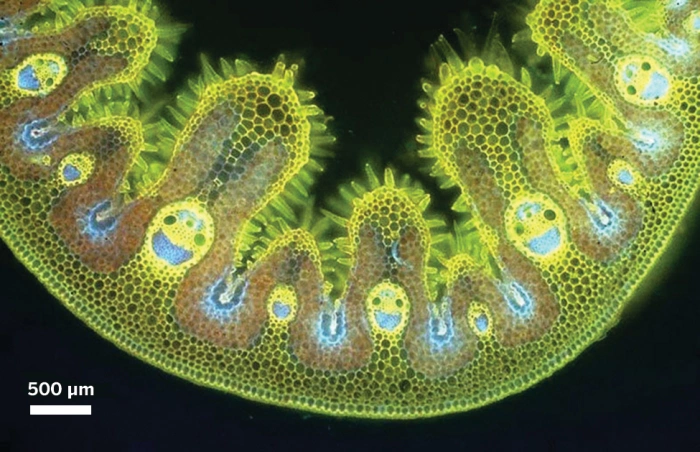
It started with a simple photo shared online showing a magnified image of a blade of grass that appeared to contain tiny smiling faces. Viewers around the world could not believe their eyes. Was nature really smiling back at us? The phenomenon, called “smiling grass,” quickly captured the internet’s imagination, blending the charm of optical illusion with the curiosity of backyard science.
But as with most viral wonders, the truth behind those miniature grins turns out to be both fascinating and completely natural.

What People Are Actually Seeing Under the Microscope
According to the detailed explanation shared on Foldscope’s official blog, what appears to be smiling faces inside blades of grass is actually a glimpse into the plant’s internal transport system. When a cross section of a grass stem is viewed under a microscope, what the viewer sees are not expressions but highly organized cellular structures called vascular bundles. These bundles are the life support channels of the plant, consisting of two main components: the xylem and the phloem. The xylem carries water and dissolved minerals from the roots upward, while the phloem distributes sugars and other nutrients produced during photosynthesis throughout the plant. Together they form a complex grid of microscopic tubes that maintain balance and growth in each blade of grass.

When illuminated from below under magnification, the circular ends of these vessels create patterns that resemble eyes, mouths, and even faces. The arrangement is a natural result of how the vascular tissue develops in tight clusters to strengthen the grass stem while still allowing flexibility in the wind. The illusion of a smile emerges from the geometry of these bundles and the contrast in color between the xylem and surrounding cells. Rather than representing emotion, the pattern showcases the elegant symmetry of plant anatomy, a design honed by evolution to transport resources efficiently while keeping the grass upright and resilient.
This microscopic view also highlights the precision of nature’s engineering. The vascular bundles appear almost artistic, demonstrating how function and form coexist seamlessly in even the simplest plant. What looks whimsical to the human eye is, in reality, a system of living architecture that sustains entire ecosystems one blade at a time.
How Scientists (and Hobbyists) Capture the Smiling Grass Effect
Capturing the delicate structures that produce the smiling grass illusion requires precision and a clear understanding of optical technique. According to a study, the process of observing these microscopic details depends on how samples are prepared, mounted, and illuminated.
Preparing grass samples for this level of observation demands delicacy and control. The blades must be sliced thin enough for light to pass through and for the vascular bundles to appear clearly. Users typically place the cross-section of grass on a slide coated with a transparent adhesive, such as clear nail polish or tape, then seal it under a cover slip. Once dry, the sample becomes stable enough for repeated viewing without distortion. Guides on Foldscope’s website and Foldscope 2.0 documentation emphasize that alignment and light control are crucial; even slight changes in the angle of illumination can dramatically alter what is visible.

The device achieves alignment through flexure mechanisms built into its folded structure, allowing precise positioning of both lens and sample without the need for mechanical calibration. This means that anyon can capture high-resolution images of plant microanatomy in the field or at home. Additional analyses, such as the Cleveland State University optical performance review, show that while the Foldscope may experience minor spherical aberrations compared to conventional lab microscopes, its clarity remains strong enough for identifying cellular arrangements and vascular patterns.
Once the sample is in place, focusing and illumination adjustments reveal the cross-sectional architecture of the grass. The visual effect that resembles smiling faces appears when the circular xylem and phloem vessels align symmetrically within the field of view. This is not simply an artistic coincidence but a result of consistent plant structure illuminated correctly under transmitted light. The experiment rewards patience and careful tuning of the Foldscope’s focus ramp, a process that transforms an ordinary lawn clipping into a visual representation of biological order.
By sharing their microscopy images through Foldscope’s Microcosmos platform and social media, users around the world contribute to a growing library of citizen science observations. Each image extends scientific participation beyond traditional laboratories, connecting people to the microscopic beauty that surrounds them. In this way, studying smiling grass is not only about identifying plant anatomy; it is a lesson in observation, creativity, and accessibility in modern science.
The Joy of Scientific Discovery at Home
The smiling grass phenomenon underscores the power of curiosity-driven learning. The project aims to make science accessible and enjoyable for everyone by turning ordinary spaces into laboratories of discovery. Its simplicity allows students, educators, and enthusiasts to explore the natural world with minimal equipment while gaining direct experience of how living systems work.
Foldscope encourages hands-on engagement instead of passive learning. Observers can examine a leaf vein, study a water droplet teeming with microorganisms, or look closely at everyday materials to understand the structures that shape them. Each observation connects science to lived experience, helping users recognize how the smallest details in nature reveal universal principles of life and design.

Educational organizations have adopted Foldscope globally to promote inquiry-based learning and STEM participation. Reports note that the tool has reached classrooms and communities in more than 150 countries. Its affordability and portability eliminate the barriers that often limit access to quality scientific tools, allowing learners from all backgrounds to share discoveries and exchange ideas.
This culture of shared exploration creates a worldwide community of citizen scientists. Through the Microcosmos platform, users post images, discuss observations, and celebrate the beauty of the microscopic world. Each contribution adds to a collective understanding that science belongs to everyone and can thrive anywhere curiosity exists.
Why We See Faces Everywhere
The illusion of smiling grass draws attention to one of the most intriguing quirks of human perception. Psychologists refer to this tendency as pareidolia, the brain’s automatic response to interpret vague or random patterns as meaningful images, often faces. Research explains that this phenomenon is deeply rooted in our evolutionary biology. Recognizing faces quickly was once a critical survival mechanism, helping early humans identify allies, threats, or emotional cues in an instant. Over time, this rapid recognition system became so sensitive that it began to detect faces where none actually exist.
In the case of grass viewed under a microscope, the arrangement of xylem and phloem vessels happens to mimic the spatial configuration our brains associate with eyes and a mouth. Once that familiar pattern emerges, the facial recognition circuitry in the fusiform gyrus activates, giving us the unmistakable sense that something is looking back. This response is not simply imagination but a predictable feature of neural processing—our minds prioritize patterns of symmetry, alignment, and contrast that resemble human features.

Modern studies also suggest that pareidolia is linked to emotion and creativity. Seeing faces in objects, clouds, or microscopic images may activate parts of the brain associated with empathy and imagination, allowing us to project emotion onto the inanimate. According to findings reported by the University of Sydney’s School of Psychology, this reaction is universal and even measurable, reflecting how humans naturally search for connection in their environment. In this sense, the smiling grass effect reveals more about human perception than it does about plant anatomy, it shows how our brains turn ordinary visual data into stories of recognition and meaning.
Beyond the Smile What the Discovery Teaches Us
The smiling grass discovery extends beyond fascination and novelty, serving as a lesson in awareness, perspective, and the depth of life hidden in plain sight. Each blade of grass functions as a microcosm of natural design, showing how structure and purpose converge at every level of existence. Examining it under magnification reveals not just plant anatomy but the principles of balance and interdependence that sustain all living systems. The vascular networks that appear as smiles are reminders of how intricately life organizes itself to adapt, thrive, and endure.
What makes this insight meaningful is how it reconnects people with observation as a mindful act. In an age of instant images and rapid information, the simple act of looking closer, literally and metaphorically, offers a way to slow down and appreciate complexity. Observing the world through a microscope fosters patience, curiosity, and humility. It reminds us that beauty is often a matter of attention, and that discovery begins when we take the time to look beneath the surface.
The Foldscope project reinforces this mindset by encouraging exploration for its own sake. Using accessible science tools to view the unseen not only enriches personal understanding but also cultivates environmental awareness. Seeing how even grass contains organized systems of transport and energy flow helps us appreciate how dependent larger ecosystems are on these minute and often ignored details. The smiling grass, in this sense, becomes both a scientific and philosophical metaphor: what we perceive as simple is often extraordinarily complex, and what seems ordinary can inspire renewed wonder.

A Tiny World with a Big Message
In the end, those little faces inside the grass remind us of something profound. Science and art are not separate. They meet in moments like these, when structure becomes story and curiosity turns into connection. The smiling grass may not truly grin, but the joy it inspires in those who discover it is every bit as real.
Featured Image from Phil Gates, Durham University
