
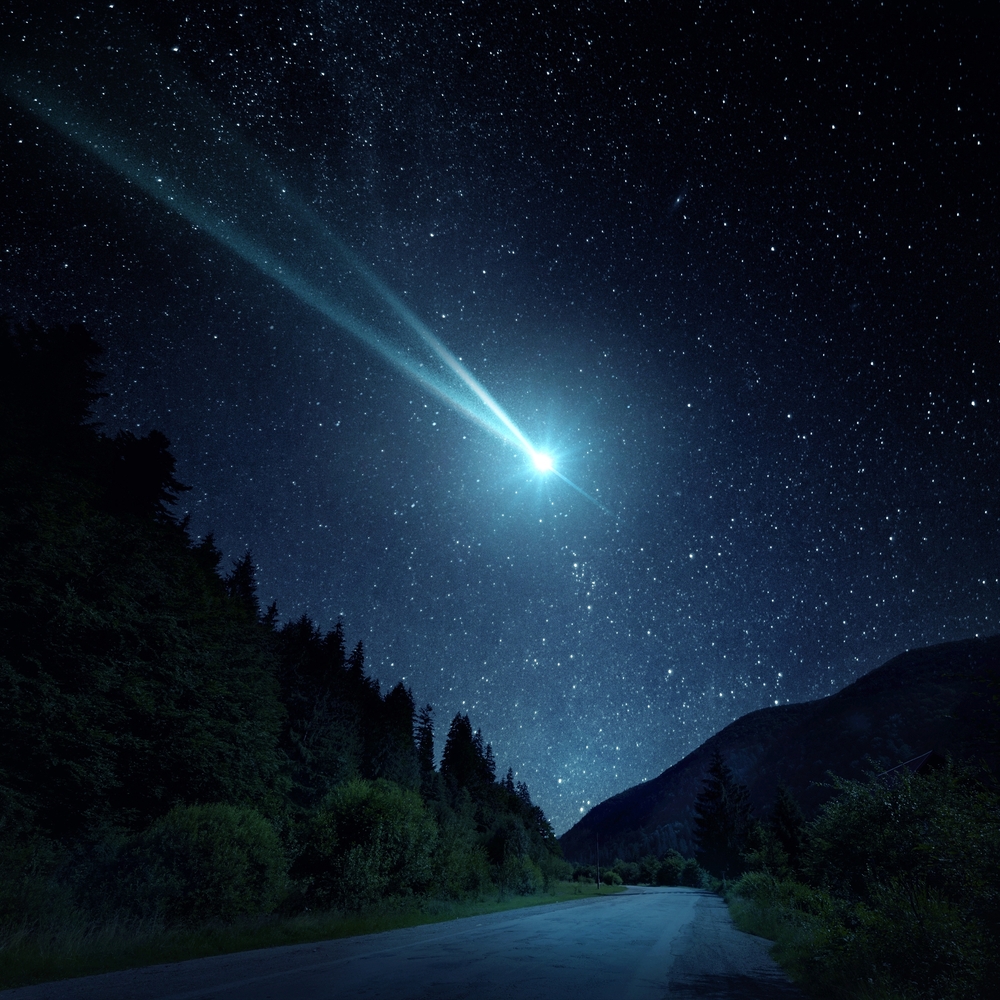
In the quiet darkness beyond the orbit of Mars, a frozen traveler is racing inward toward the blazing heart of our solar system. Astronomers have identified it as C/2026 A1 (MAPS), a newly discovered sungrazing comet that could soon become visible and bright in our skies. If current projections hold true and if it survives its perilous close encounter with the Sun, this icy fragment from deep time may light up early April in a way humanity has not seen for years.
In a universe governed by gravity and orbital mechanics, comets are still wild cards. Their brightness can surge unexpectedly. Their fragile nuclei can split apart without warning. They can transform from faint telescopic smudges into breathtaking spectacles that command the horizon at sunset. They can also dissolve into nothing. This unpredictability is part of their mystery. It is also part of their symbolism.
Astrology has long regarded comets as messengers of change. Ancient sky watchers described them as broom stars sweeping the heavens, clearing away stagnant energies and signaling transitions for kingdoms and civilizations. Today, while we understand their physical composition in greater detail, their deeper meaning remains open to contemplation. A comet that dives toward the Sun and possibly reemerges brighter than before speaks to a universal theme of transformation through fire.
The Astronomical Story Behind Comet A1 MAPS
Comet C/2026 A1 MAPS was discovered in January by a team of astronomers operating remote telescopes in Chile’s Atacama Desert. What immediately caught the attention of the astronomical community was how far from the Sun it was detected. Sungrazing comets are typically discovered only when they are already very close to the Sun. A1 MAPS was found more than two astronomical units away, suggesting that it may be a relatively substantial fragment.
It belongs to the Kreutz family of sungrazers, a lineage of comets believed to be fragments of a massive progenitor that broke apart more than two thousand years ago. Some of the brightest comets in recorded history have emerged from this family. The Great Comet of 1882 and C/1965 S1 (Ikeya-Seki) both dazzled observers in daylight. These comets passed extraordinarily close to the Sun and survived long enough to put on unforgettable displays.
A1 MAPS is predicted to pass within roughly 120,000 to 160,000 kilometers of the Sun’s surface. To put that in perspective, this distance is less than half the separation between Earth and the Moon. At such proximity, the comet will plunge into the Sun’s corona, a region of superheated plasma where temperatures soar into the millions of degrees.
Most comets do not survive such encounters. The intense solar radiation and tidal forces often tear them apart. The much publicized Comet ISON in 2013 disintegrated during its perihelion passage. Yet survival is not impossible. In 2011, a sungrazer astonished observers by emerging intact and brilliant after skimming the Sun.
If A1 MAPS survives its solar encounter, it could brighten dramatically in early April and possibly even become visible in broad daylight under the right conditions. Even if it does not survive, the joint NASA and ESA Solar and Heliospheric Observatory will capture its journey in remarkable detail.
Fragments of an Ancient Celestial Giant

The Kreutz sungrazers trace their origins back to a colossal comet that likely fragmented in antiquity. Historical records from the third and fourth centuries BCE describe astonishing daylight comets. Over time, the original body broke into progressively smaller pieces. Each return to the inner solar system led to further fragmentation.
This lineage includes the Great Comets of 1106 and 1138, events so dramatic that they were recorded across continents. The fragment that became Ikeya Seki in 1965 shone as brightly as the full Moon at its peak. These comets remind us that what we witness in a single lifetime is part of a much larger cosmic cycle unfolding over centuries.
When we observe A1 MAPS, we may be witnessing a sibling of these historic apparitions. It could be another fragment continuing a journey that began more than two millennia ago. There is something humbling about recognizing that this object has been orbiting the Sun on a timescale far exceeding any human lifespan.
Astrologically, this connects us to ancestral memory. A comet from the Kreutz family is not merely a new event. It is a returning echo from deep time, a messenger whose lineage has repeatedly coincided with periods of upheaval and renewal.
Fire and Ice: The Alchemy of Perihelion

As comets approach the Sun, they undergo a dramatic transformation. Their frozen ices sublimate into gas. Jets burst from their surfaces, releasing plumes of vapor and dust into space. These jets can alter a comet’s spin, change its structure, and even cause it to fragment.
A striking example of this dynamic behavior is 41P/Tuttle-Giacobini-Kresák. During its 2017 perihelion passage, this relatively small comet experienced a rapid slowdown in its rotation before apparently reversing its spin direction. Outgassing jets acted like thrusters, applying torque to the nucleus. Within weeks, its rotation rate changed dramatically. Scientists were astonished by the speed of this transformation.
Another fascinating case is 29P/Schwassmann–Wachmann, a centaur object that undergoes explosive outbursts far from the Sun. Astronomers have described its interior as a fizzy cocktail of volatile substances. When internal pressure builds, it erupts, blasting debris into space at astonishing speeds.
These examples illustrate that comets are not passive ice balls drifting silently through space. They are dynamic, evolving bodies. They respond to solar energy with bursts of activity, sometimes violently.
In alchemical symbolism, fire is the agent of purification and transformation. When A1 MAPS plunges into the solar corona, it undergoes a literal trial by fire. Whether it survives or disintegrates, the encounter represents a moment of maximum intensity.
Astrologically, the Sun symbolizes consciousness, identity, and vitality. A comet diving into the Sun invites us to contemplate our own relationship with illumination. What parts of us are ready to be exposed to greater light? What outdated patterns might be burned away?
The Astrological Meaning of a Sungrazer

Unlike predictable planetary alignments, comets arrive unexpectedly. Their sudden appearance disrupts the regular rhythm of the heavens. In ancient astrology, such disruptions were often interpreted as signs of major change.
A sungrazer is particularly potent symbolically. It does not merely pass near the Sun. It risks annihilation in order to complete its orbit. This evokes themes of sacrifice, courage, and rebirth.
If A1 MAPS reaches peak brightness in early April, it will do so in the sign of Pisces before moving outward again. Pisces is associated with dissolution, spiritual awakening, and the merging of boundaries. A comet blazing in this region of the sky can be viewed as amplifying themes of emotional release and intuitive insight.
The timing is also significant. Early April marks a seasonal transition in many parts of the world. In the northern hemisphere, spring unfolds. In the southern hemisphere, autumn deepens. Both transitions involve change, letting go, and preparation for a new phase.
A comet’s tail, streaming away from the Sun, resembles a cosmic brushstroke across the sky. In spiritual symbolism, it can be seen as clearing stagnant energy and inviting renewal. Whether one interprets this metaphorically or energetically, the visual impact of a bright comet can stir profound reflection.
Southern Skies and Collective Perspective

If A1 MAPS survives perihelion, it will likely be most visible from the southern hemisphere. This geographical emphasis is intriguing. For much of recorded history, many of the most dramatic comets have been best observed from southern latitudes.
From an astrological perspective, visibility matters. A celestial event that commands attention in one part of the world can influence the collective psyche differently than one hidden from view. In our interconnected era, images from observatories and spacecraft ensure that the whole planet can witness the event, even if it is not directly visible overhead.
The Solar and Heliospheric Observatory has discovered thousands of sungrazing comets since its launch in 1995. Most pass unnoticed by the naked eye. Only a few grow bright enough to capture public imagination. If A1 MAPS becomes visible in daylight, it will join a rare category of celestial phenomena capable of uniting global attention.
Shared sky events can serve as reminders of our planetary unity. Regardless of culture or belief system, we all orbit the same star. A comet diving toward that star and potentially emerging transformed is a story that transcends borders.
The Psychology of Waiting

Right now, astronomers and sky watchers are in a state of anticipation. Brightness predictions vary widely. The comet could peak at a modest level or surge to extraordinary brilliance. The uncertainty creates a sense of suspense.
There is a psychological parallel here. Transformation often involves waiting. We sense that something significant is approaching, yet the outcome remains unclear. A comet on a sungrazing trajectory embodies this tension between possibility and risk.
In spiritual practice, surrendering to uncertainty is a recurring theme. The comet cannot alter its path at the last moment. It must follow its orbit into the solar furnace. Likewise, there are times in life when we are called to move forward despite not knowing whether we will emerge intact or transformed.
Observing the comet’s journey can serve as a meditation on trust. Trust in cycles. Trust in resilience. Trust in the idea that even dissolution feeds future creation.
Ancient Omens and Modern Awareness

In ancient China, Europe, and the Middle East, bright comets were often recorded alongside political upheavals or natural disasters. While modern science does not support a causal link between comets and earthly events, the symbolic association with change persists.
Today, rather than fearing celestial omens, we can reinterpret them as invitations to awareness. A bright comet can inspire curiosity about our solar system, appreciation for cosmic beauty, and reflection on our place in the universe.
The Kreutz family’s history reminds us that fragmentation can produce beauty. A giant comet shattered long ago, yet its fragments have repeatedly graced our skies with awe inspiring displays. In personal terms, experiences that break us open can also reveal unexpected brilliance.
Beyond April: A Long Journey Outward

If A1 MAPS survives its encounter with the Sun, it will not linger. After its brief display, it will head outward toward the distant reaches of the solar system, traveling hundreds of astronomical units away over centuries.
This trajectory underscores the fleeting nature of visible splendor. A comet may blaze brilliantly for days or weeks, then fade into darkness for generations. The window of visibility is short compared to its orbital period.
There is a lesson here about presence. When the comet appears in the evening sky, even faintly, it invites us to look up. To pause. To witness. Not every celestial event becomes a Great Comet. Yet every comet carries the story of our solar system’s formation, preserved in primordial ice.
In that sense, whether A1 MAPS becomes a dazzling spectacle or a modest telescopic target, its approach is meaningful. It connects us to the early solar system, to cycles spanning millennia, and to the enduring dance between fire and ice.
A Moment of Collective Illumination
As early April approaches, telescopes and spacecraft will monitor the comet’s dive toward the Sun. Images will stream in. Predictions will be updated. Enthusiasts will scan the twilight sky near Venus, hoping for a glimpse.
From an astrological perspective, this is a moment of collective illumination. The Sun represents consciousness. A comet entering its domain can be seen as information from the outer reaches of experience entering awareness.
If the comet fragments, that too carries symbolism. Not all transformations preserve the original form. Sometimes brilliance arises precisely at the moment of breaking apart.
The cosmos does not promise certainty. It offers cycles, forces, and opportunities for reflection. A newly discovered comet racing toward the Sun reminds us that even in a clockwork universe, surprises abound.
Whether A1 MAPS becomes the next Great Comet or quietly dissolves in the solar blaze, its journey has already stirred imagination across the globe. It has prompted scientists to refine models, observers to ready their equipment, and countless individuals to look skyward with renewed curiosity.
In the end, perhaps that is the deeper gift of a sungrazing comet. It draws our gaze upward. It reminds us that we inhabit a dynamic solar system filled with fragile wanderers and powerful forces. It mirrors our own capacity for transformation through intensity.
Soon, we may witness a streak of light near the Sun at dusk, a luminous reminder that even objects forged in the coldest reaches of space can blaze with extraordinary brilliance when they dare to approach the fire.
