
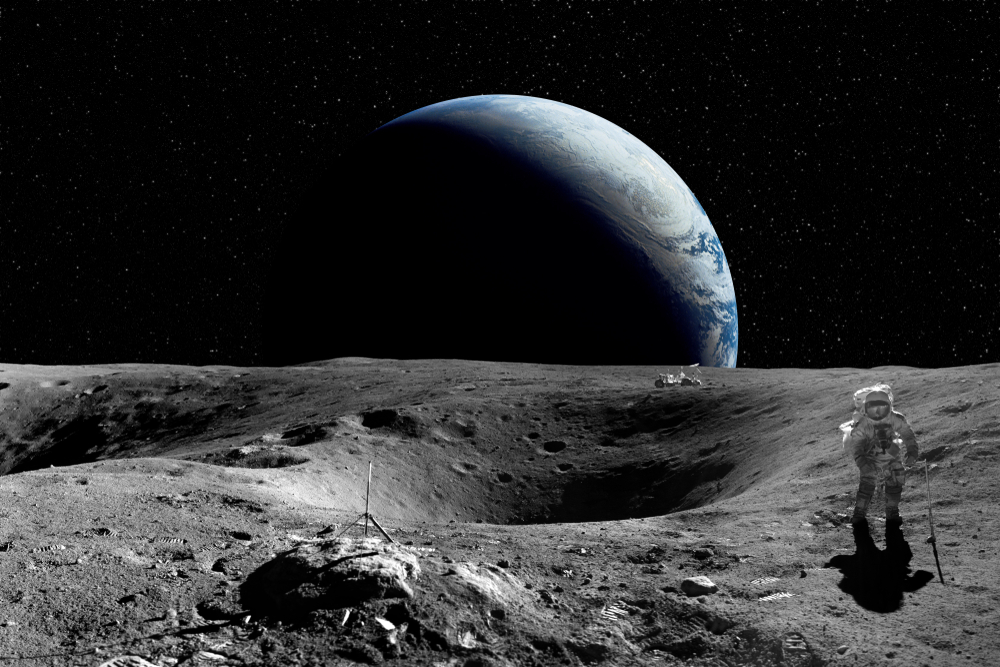
NASA’s latest lunar dream may soon turn the imagination of science fiction into the architecture of reality. The agency has unveiled plans to construct giant glass domes on the Moon, built entirely from lunar dust. These “lunar glass” habitats, made possible through a collaboration with California-based company Skyeports, represent a new vision of space living: one rooted not in fleeting missions, but in long-term sustainability. The domes would be made from melted lunar regolith, the gray powdery soil covering the Moon’s surface, and could even have the ability to self-heal small cracks caused by meteor strikes. It’s not just a vision of exploration, but of habitation: turning the Moon from a destination into a home.
What makes this announcement especially fascinating is how it mirrors our search for harmony between technology and nature. Humanity has always looked up at the Moon as a symbol of reflection, calm, and mystery. Now, the same celestial body could become a second cradle for human life. This lunar project isn’t only a step forward in space travel: it’s also a meditation on how we live, create, and adapt. As NASA’s lunar domes begin to take shape, they remind us that innovation, when grounded in natural materials and closed-loop ecosystems, might be the truest form of sustainability.

Turning Moon Dust into Habitat
The idea of transforming lunar dust into livable domes may sound otherworldly, but it’s based on solid science. The Moon’s surface is coated with lunar regolith, a mix of fine dust, rock, and minerals formed by billions of years of meteor impacts. Instead of importing construction materials from Earth, NASA’s engineers plan to use what’s already there. By feeding regolith into microwave furnaces, they can heat it to over 2,000 degrees Celsius: hot enough to melt it into glass. Once cooled, the molten material could be shaped into thick, transparent domes strong enough to protect inhabitants from radiation, temperature extremes, and micrometeorites.
Dr. Martin Bermudez, Skyeports’ CEO and the architect leading the project, says that lunar glass may even outperform steel in durability when properly reinforced with polymers. These polymers would give the glass an extraordinary property: self-healing. If a small crack forms, the material could seal itself automatically, maintaining the integrity of the structure in the Moon’s harsh environment. This innovation means that future lunar settlers could live safely inside these luminous bubbles, walking on soil that once seemed impossibly hostile.
Beyond protection, the domes would offer light and space: two things essential to human well-being. The transparent design would allow filtered sunlight to enter, supporting small gardens, hydroponic farms, and even patches of greenery that mimic the colors of Earth. It’s not just a feat of engineering; it’s a psychological experiment in preserving the essence of home while living far away from it.
BREAKING: NASA plans to build houses on the moon by 2040.
— Daily Loud (@DailyLoud) October 3, 2023
The homes will be for both astronauts and ordinary civilians according to NY TIMES. pic.twitter.com/SCohqmnWJA
Why Glass, Not Metal or Concrete?
For decades, space engineers envisioned lunar bases made of metal or concrete, but both options proved impractical. Metals corrode under radiation and temperature swings, and concrete requires water: an incredibly scarce resource on the Moon. Glass, however, offers a surprising alternative. It can be made entirely from the Moon’s own soil and requires no water to form. In a sense, the Moon itself becomes both the foundation and the building material.
This concept transforms how we think about architecture and resource use. Every material used on the Moon must serve multiple functions: insulation, protection, and sustainability. Glass meets these needs by being both strong and transparent, allowing light for plants and solar energy systems. It’s also recyclable. Any damaged parts can be melted and reshaped, creating a truly circular construction process.
Perhaps most fascinatingly, this use of glass aligns with the principles of biomimicry: design inspired by nature. Glass, like the shells of deep-sea creatures or the crystalline structures of minerals, is born of heat and pressure. By reimagining it as a living, adaptable skin for lunar habitats, NASA is applying an ancient material to the most futuristic frontier imaginable.
NEWS: NASA Reveals Plans to build houses on the Moon by 2040 pic.twitter.com/YbTJDoniAz
— Curiosity (@MAstronomers) November 2, 2023
What Lunar Life Can Teach Us About Earth
In trying to build homes on the Moon, NASA may also be teaching us how to better care for our own planet. Lunar habitats must be closed-loop ecosystems, where every drop of water is recycled, every breath of air is filtered, and every scrap of waste is reused. There’s no room for wastefulness in space: and perhaps there shouldn’t be on Earth either.
The lunar dome project highlights how sustainability is not just about technology, but about mindset. Astronauts living in glass domes will need to adapt to scarcity, to appreciate every molecule of oxygen, every sip of water, every green leaf. Their survival will depend on balance, harmony, and respect for resources all values that our modern civilization could relearn.
In this sense, the Moon becomes a laboratory for human ethics as much as for science. What we test there recycling systems, renewable energy, and efficient agriculture can directly translate into better, cleaner living on Earth. The lunar domes might someday serve as mirrors reflecting what’s possible when we blend ingenuity with ecological mindfulness.

The Emotional and Psychological Side of Space Living
Life inside a sealed glass habitat will challenge more than just our engineering skills: it will test our emotional endurance. Astronauts in long-duration missions often report feelings of isolation, confinement, and a loss of connection to nature. Psychologists call this “space fatigue”, a state where the absence of natural sensory input: wind, rain, trees, human touch: affects mood and mental health.
NASA has already studied how color, light, and sound affect astronauts’ well-being. Inside lunar domes, lighting may mimic the day-night cycle of Earth to maintain circadian rhythms. Artificial gardens could provide sensory stimulation and psychological comfort, functioning like therapy. Music, art, and communication with Earth would become essential for emotional survival.
Interestingly, this mirrors challenges we face here on Earth. Many urban dwellers already live in environments with limited exposure to sunlight, greenery, or silence. The same solutions being designed for space: natural light therapy, hydroponic gardens, mindful routines: could help improve life on our own planet. The Moon may simply magnify what’s already true: humans need nature, even if we must recreate it under glass.

Ayurveda’s Take: Living in Tune With the Moon
Ayurveda, the ancient science of life and balance, offers a fascinating lens through which to view this lunar endeavor. In Ayurvedic philosophy, the Moon represents the mind, emotions, and nourishment: the cooling, nurturing counterpart to the Sun’s heat and activity. Living on the Moon, in the literal sense, could become an exercise in maintaining inner balance when the outer world is stripped away.
Ayurveda teaches that balance is achieved through rhythm: of sleep, diet, and breath. For lunar settlers, replicating this rhythm will be vital. Without Earth’s 24-hour day or seasonal changes, their bodies could lose their natural cycles. Maintaining Ayurvedic practices such as daily routines, warm plant-based meals, meditation, and self-massage could help regulate body and mind even in space.
On Earth, these same principles are our grounding force. The Moon project, through this lens, isn’t about escaping our planet; it’s about rediscovering how to live harmoniously within any environment. Whether under a glass dome or beneath a blue sky, wellness will always depend on the same balance of nourishment, mindfulness, and rhythm.
What the Moon Teaches Us About Wellness and Innovation
NASA’s lunar domes are more than scientific experiments: they’re symbolic of how human wellness and environmental stewardship are deeply intertwined. As we prepare to live on the Moon, we’re reminded that survival anywhere depends on the same foundations: air, water, food, community, and mental peace. Technology can build the shelter, but only wisdom can make it a home.
The Moon project suggests that the future of health is adaptive wellness: the ability to stay balanced amid change. As humans evolve from Earth-dwellers to interplanetary beings, our understanding of well-being must expand to include environments that are silent, airless, and harsh. This expansion of wellness thinking could lead to breakthroughs in mental health, nutrition, and regenerative design, both on the Moon and back home.
So while glass bubbles may soon dot the lunar horizon, the real transformation will be internal: learning to live lightly, sustainably, and meaningfully wherever we go. The Moon, in all its quiet brilliance, may teach us what it truly means to create health that transcends boundaries: between body and environment, technology and nature, and one world and the next.
