
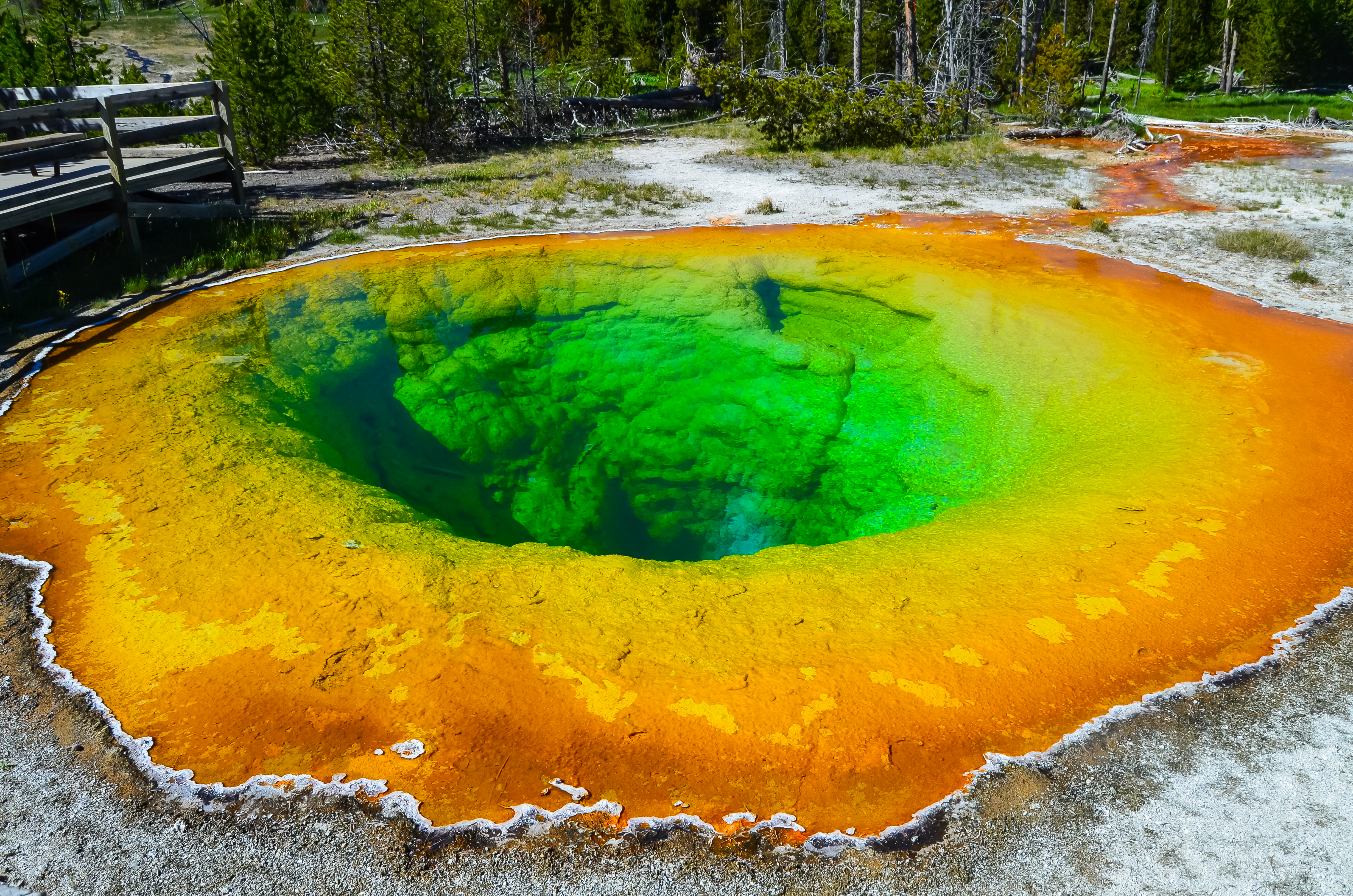
On June 7, 2016, 23-year-old Colin Nathaniel Scott, a recent college graduate with a passion for the natural world, died after falling into a thermal spring in Yellowstone National Park. The incident occurred in the Norris Geyser Basin, one of the hottest and most volatile areas of the park. Scott and his sister had left the safety of the designated boardwalk and walked more than 200 yards into a prohibited area. Their goal was to find a pool for “hot potting,” the illegal and dangerous practice of bathing in the park’s geothermal features. While his sister recorded on her phone, Scott knelt to check the water’s temperature, slipped on loose gravel, and fell into the boiling, acidic spring.
With no cell service in the remote basin, his sister ran for help. By the time park rangers arrived, a lightning storm was approaching, making immediate recovery impossible. They were forced to leave his body overnight. The next day, nothing remained. His body had been completely dissolved.
The Science of Dissolution: How a Body Disappears

To understand how a body can dissolve so quickly, think of it as a two-part process involving both boiling water and strong acid.
First, the heat. The water in the spring was about 212°F (100°C)—the boiling point. Anyone falling in would die instantly from the severe burns and shock to the body’s systems, not from drowning. This intense heat also acts like a chemical accelerator. It caused the water itself to aggressively break apart the body’s soft tissues, like muscle and fat, in a process that was less like slow decay and more like a rapid chemical dismantling.
Second, the acid. At the same time, the water was highly acidic. This acid is naturally created by tiny microorganisms in the spring that feed on volcanic gases from deep underground, producing sulfuric acid. While the acid alone might not have been extremely potent, the boiling temperature made it incredibly corrosive. This superheated acid was powerful enough to attack and dissolve bone, breaking down the hard minerals of the skeleton until it too was gone.

The combination of boiling heat and potent acid created an environment that could completely break down a human body in a matter of hours. As Deputy Chief Ranger Lorant Veress explained, “In a very short order, there was a significant amount of dissolving.” The process was so efficient that when crews returned the next day, the only things left were a wallet and a pair of flip-flops, made of materials that could survive the hot, acidic water.
A Pattern of Preventable Tragedies
Colin Scott’s death, while uniquely graphic, is part of a long and troubling history of fatalities in Yellowstone’s thermal areas. Since the late 1800s, thermal features have claimed more than 22 lives. These incidents are not random, unpredictable accidents; they almost always follow clear patterns of human error and a profound underestimation of the environment. The common thread is a failure to respect the park’s fundamental rules.
- Accidental Falls: In 1970, nine-year-old Andy Hecht was walking with his family at Old Faithful, a place synonymous with Yellowstone’s beauty. He tripped on the boardwalk—a seemingly minor stumble—and fell into the scalding Crested Pool. The incident happened so quickly that before his horrified family could react, he was gone. It serves as a stark example of how, even in the most visited areas, there is zero margin for error.
- Attempted Rescues: In 1981, 24-year-old David Allen Kirwin watched as a friend’s dog jumped into the 202°F Celestine Pool. In a fatal, instinctive act of love for the animal, he dove in headfirst to save it. He managed to pull himself out, but with third-degree burns covering 100% of his body, he had no chance of survival and died the next day. The dog also perished. This tragedy underscores the futility of such rescue attempts, which almost always claim two victims.

- Reckless Behavior: In August 2000, 20-year-old park concession employee Sara Hulphers and two friends were walking at night without flashlights, a clear violation of park safety advice. Familiarity with the area likely gave them a false sense of security. Attempting to jump what they believed was a small stream in the dark, all three plunged into the 10-foot-deep, boiling Cavern Spring. Hulphers died hours later, while her two companions survived, only to endure months of agonizing recovery from their severe burns.
These stories, spanning decades, reveal a persistent failure to grasp the unforgiving nature of the geothermal landscape. There is often a dangerous disconnect between the visual beauty of the springs and their lethal reality. As park geologist Hank Heasler once stated, “Geothermal attractions are one of the most dangerous natural features in Yellowstone, but I don’t sense that awareness in either visitors or employees.”
A Practical Guide to Staying Safe in Yellowstone

Yellowstone’s safety regulations are not arbitrary; they are lessons learned from tragic and preventable incidents. Following them is the only way to ensure a safe visit.
- Stay on the Boardwalks. The ground in thermal basins is an illusion. What appears solid is often a paper-thin mineral crust formed by deposits from the hot water. It is impossible to know where it is safe to step. Breaking through can cause severe, life-altering burns, an injury that happens to one or two visitors every single year.
- Never Touch the Water. The water is frequently at or above boiling temperature. Even brief contact can cause third-degree burns requiring specialized medical care. Beyond the heat, the water can be toxic. Arsenic concentrations in some springs can be thousands of times higher than the EPA standard for safe drinking water.
- Do Not “Hot Pot”. Bathing in thermal features is illegal for a reason. The underground geothermal plumbing that feeds these springs is constantly changing, causing water temperatures to fluctuate wildly and without warning. A pool that seems temperate can become a boiling trap in an instant. This was the activity that led directly to Colin Scott’s death.

- Keep Pets Secure and Away from Thermal Areas. Pets are not allowed on boardwalks or in thermal areas. They cannot perceive the danger and are instinctively drawn to water, regardless of temperature. The 1981 death of David Kirwin is a tragic example. In 2021, a woman suffered severe burns trying to rescue her dog from a spring; the dog did not survive. An attempt to save a pet will almost certainly result in two victims.
- Respect All Signs and Closures. Warning signs are placed by experts who understand dangers that are invisible to the average visitor, such as unstable ground, unpredictable eruptions, or the release of a toxic gas. Ignoring them has led to citations, fines, jail time, and, in the most tragic cases, preventable deaths.
Respect the Power of Nature

The events at Yellowstone serve as a clear reminder that wild environments are not theme parks. The rules exist not only to protect visitors but also to preserve the fragile and scientifically significant ecosystem. The same microbes that create the vibrant colors of the springs, called extremophiles, are scientifically priceless. It was from a Yellowstone hot spring that scientists isolated the microorganism Thermus aquaticus, whose heat-stable enzyme made possible the polymerase chain reaction (PCR)—a technique that has revolutionized medicine, genetics, and forensics.
Viewing such a place as a recreational backdrop ignores its inherent power and danger. The hot spring did not act with malice; it behaved according to the immutable laws of chemistry and geology. The tragedy occurred because those laws were not respected. True appreciation for a place like Yellowstone comes not from immersion, but from observation, humility, and a profound respect for its untamable forces.
