
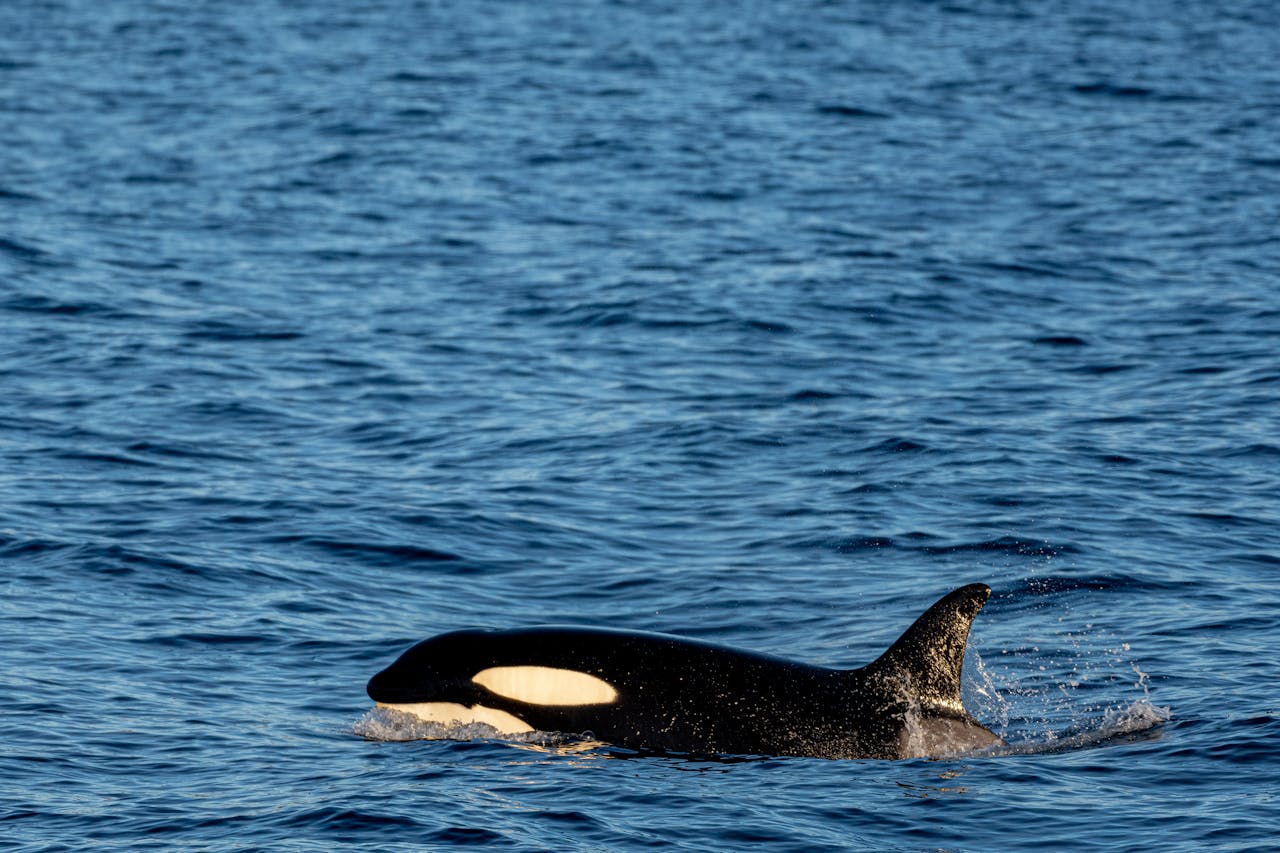
In 2018, the world watched in awe and sorrow as an orca named Tahlequah, known scientifically as J35, carried the lifeless body of her newborn calf for an astonishing 17 days and across more than 1,000 miles of the Pacific Ocean. The heartbreaking spectacle gripped millions, sparking questions about the depth of animal emotion, the fragility of marine ecosystems, and what such a powerful act of grief might reveal about the state of our oceans.
Now, years later, witnesses confirm that Tahlequah has once again carried a deceased calf, repeating this haunting ritual of mourning. Scientists and observers described the sight as both deeply moving and devastating, a mother unwilling to let go, her sorrow made visible on the vast expanse of open water.

The Unimaginable Scene: A Mother’s Oceanic Vigil
Eyewitnesses first spotted Tahlequah near the San Juan Islands, her black dorsal fin cutting through cold grey waves, and just below, the body of her calf. She was observed lifting and balancing the tiny body on her forehead, nudging it gently each time it slipped away.
For 17 days, she carried her calf through Washington’s coastal waters and into the Pacific, traveling over 1,000 miles. Observers described the display as a heartbreaking procession, a lone mother, her grief echoing across the sea.
Researchers who followed her noted moments of exhaustion and what seemed to be desperation. Yet, Tahlequah persisted, defying the currents, the hunger, and even the pod’s need to move on. Her determination became a symbol of unyielding love and the innate emotional bonds that exist in the natural world.
Do Orcas Really Grieve? Science Says Yes
For years, scientists debated whether non-human animals could experience grief the way humans do. Tahlequah’s actions have challenged that skepticism head-on.
Orcas, members of the dolphin family, possess large, complex brains, including areas linked to emotion, empathy, and memory. They form lifelong social bonds and often live in tightly knit family groups called pods. When a member dies, pods have been observed gathering around the body, sometimes for hours or days.
Marine experts say Tahlequah’s behavior wasn’t random. It was deliberate, emotional, and possibly ritualistic. Her mourning journey in 2018, and again in 2025, mirrors patterns seen in elephants, dolphins, and even magpies, species known to express mourning behaviors.
Recent studies suggest that orcas may even communicate distress sounds and altered vocal patterns during mourning, indicating emotional and social disruption within the pod. The evidence continues to grow that animal grief is not a human projection; it is a reality of life among intelligent and empathetic species.
The Deeper Cry Beneath the Waves
While Tahlequah’s act moved millions, her story also exposes an urgent truth: the Southern Resident orcas, to which she belongs, are fighting for survival.
This population, found mainly in the waters between Washington and British Columbia, numbers fewer than 75 individuals. Their primary food source, Chinook salmon, is in steep decline due to overfishing, habitat loss, and climate disruption.
Female orcas like Tahlequah are birthing fewer calves, and many do not survive. Experts say starvation, pollution, and boat noise all play devastating roles. Tahlequah’s tragic mourning may not just represent her personal loss; it symbolizes a population on the edge.
“Her grief is also the ocean’s grief,” said one researcher. “Every lost calf is a warning bell.”
The decline of Southern Resident orcas serves as a larger reflection of oceanic imbalance. When apex predators begin to vanish, it signals a cascade of ecological failures that can affect everything from plankton populations to global carbon cycles.

Image Credit: NOAA Fisheries
The Health of the Ocean: A Reflection of Our Own
From a health perspective, Tahlequah’s tragedy underscores how interconnected the fates of humans and marine life truly are. Declining salmon stocks are not just an orca problem; they’re a symptom of broader ecological imbalance.
Pollutants such as PCBs and heavy metals accumulate in the bodies of top predators like orcas, weakening their immune systems and disrupting hormones. Warmer ocean temperatures alter food chains and migration routes, leaving once-thriving populations malnourished.
Scientists warn that the same contaminants affecting orcas ultimately circle back to humans through seafood and water cycles. The ocean’s health mirrors our own; when one suffers, both do.
In recent years, environmental organizations have called for urgent reforms in coastal policy and stricter environmental protections to restore marine balance. The health of ocean ecosystems is inseparable from the quality of human life. Every pollutant dumped and every species lost eventually returns to us in one form or another.

What Can Be Done:
- Restoring salmon runs: Rehabilitating rivers, removing outdated dams, and improving spawning habitats can help rebuild food supplies.
- Reducing noise pollution: Quieter vessels and restricted traffic zones near key feeding areas can ease stress on orcas.
- Cutting pollutants: Limiting industrial runoff and banning harmful chemicals can reduce toxic buildup in marine food webs.
- Climate action: Reducing emissions helps stabilize ocean temperatures and preserve critical ecosystems.
Echoes of Empathy: How Human Emotion Mirrors the Wild
Tahlequah’s story reminds us that the capacity to mourn is not uniquely human. Grief, in its raw, unfiltered form, connects us across species lines. It’s a universal language of love and loss.
Researchers studying empathy in animals believe that behaviors like Tahlequah’s reflect a deep-rooted biological drive to maintain social bonds. Just as humans create rituals around death to process emotion, animals like orcas may do the same in their own way through touch, sound, and lingering presence.
Understanding this connection can help shift how we approach conservation. Protecting species isn’t just about numbers or biodiversity; it’s about safeguarding beings capable of deep emotional life. Recognizing animal empathy may be one of the most profound steps toward a more compassionate planet.

Lessons from a Mother’s Love and Loss
Tahlequah’s journey wasn’t just a display of grief; it was an act of endurance, love, and perhaps hope. Her refusal to abandon her calf forced humanity to look harder at the oceans we’ve wounded and the creatures trying to survive within them.
She showed us that empathy crosses species lines. Her mourning was a mirror, one that reflected not only her sorrow but ours: for the animals we lose, the environments we neglect, and the slow unraveling of the natural world.
In 2018, Tahlequah’s story awakened global compassion. In 2025, it returns as a reminder that our oceans are crying out too. Their health, like hers, depends on whether we choose to listen.
As humanity continues to explore the mysteries of emotion and ecology, perhaps the most powerful message from Tahlequah is that love, even in its most painful form, is a force that transcends boundaries and invites reflection on how we coexist with life around us.

The Legacy of a Mother’s Journey
The next time you stand at the shore, remember the mother who carried her baby for days through waves and storms, because love, even in the ocean, refuses to let go.
Tahlequah’s story is not only about grief but also about resilience and connection. Her determination to carry her calf reminds us of the emotional intelligence and strength that thrive within nature’s most extraordinary beings. Her act of love has sparked global discussions about conservation, empathy, and our shared responsibility toward marine life.
When we look out over the ocean, we should see more than water and waves; we should see the heartbeat of a planet that sustains us. Every act of protection we take, no matter how small, echoes across these waters.
If Tahlequah’s grief teaches us anything, it’s this: when we protect life in the sea, we protect a part of ourselves, our shared future, and the very soul of the Earth.
