
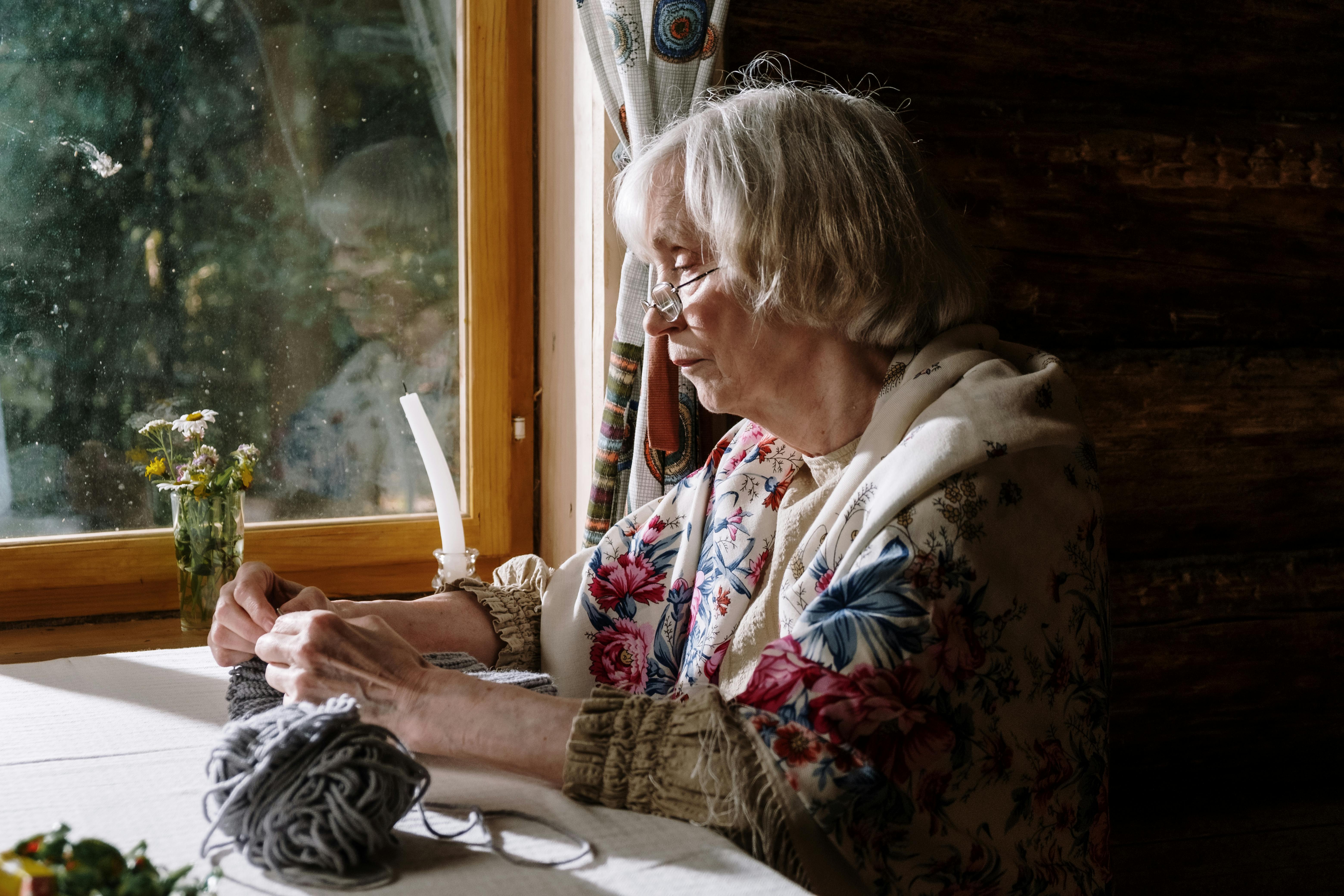
Lillian Weber was 99 years old when she began a project that grew far beyond her quiet farmhouse in Iowa: sewing one thousand unique dresses for children in Africa before her 100th birthday. To most people, that would sound like an impossible challenge, but for Lillian, it became the rhythm that shaped her final years. Each day, she sat at her sewing machine and created one special dress for a child she would never meet a simple, steadfast act that rippled across continents.
Her mission was far more than an act of charity; it was a living example of how purpose can sustain both body and spirit. Through her daily discipline, she showed that meaning and vitality are intertwined that having something to look forward to, something worth doing, can nourish health, sharpen the mind, and preserve dignity at any age. Lillian’s hands gave children beauty and belonging, but in return, her work gave her something just as vital: a reason to rise each morning and continue giving shape to kindness itself.
How Daily Purpose Becomes a Health Strategy

Lillian Weber’s disciplined daily routine beginning a new dress each morning and finishing it by the afternoon was more than a testament to her commitment; it was a living example of how purpose can be medicine. Her quiet ritual perfectly illustrates what decades of research have confirmed: volunteering functions as a powerful health intervention for older adults. Studies consistently show that sustained, meaningful activity like Lillian’s is linked to lower mortality rates, better cardiovascular health, and a slower decline in physical ability. One major analysis from Columbia University even found that older adults who volunteer regularly experience a 43 percent reduction in the odds of depression.
The connection between giving and thriving runs deeper than habit it’s biological. Acts of generosity activate the brain’s reward system, releasing neurotransmitters such as dopamine and serotonin. These “feel-good” chemicals create what scientists call the helper’s high a natural lift in mood that counteracts stress and strengthens emotional resilience. Over time, this mental boost translates into measurable physical benefits: lower chronic stress, reduced inflammation, and a decreased risk of diseases linked to aging.
In essence, Lillian’s sewing table wasn’t just a workspace it was a health practice. Every stitch she made wasn’t only helping a child far away; it was quietly extending her own vitality, proof that purpose doesn’t just give life meaning it gives life strength.
Lillian Weber’s devotion to her mission perfectly illustrated the three essential benefits of sustained purpose in later life meaning, cognitive engagement, and connection all of which fed her vitality right up to her final days.
Sense of Meaning: Purpose is the antidote to decline, and Lillian lived that truth. Volunteering gave her a clear, daily reason to stay active after retirement. She often said her mission “kept her out of a nursing home,” and it wasn’t hyperbole. Setting a concrete goal 1,000 dresses by her 100th birthday gave her life structure, direction, and a reason to get up every morning. Purpose gave her time texture and her days momentum.
Cognitive Engagement: Sewing is more than craft it’s cognition in motion. Choosing fabrics, planning unique patterns, and focusing on precision required Lillian to problem-solve, concentrate, and stay mentally agile. Unlike passive leisure activities, this hands-on, detail-oriented work continually exercised her brain. Each stitch was a small act of mindfulness, preserving her mental sharpness as much as her spirit.
Social Connection: Though she often sewed alone in her farmhouse, Lillian was far from isolated. Her work linked her to a local sewing circle and to children and volunteers across the globe. That web of connection protected her from the loneliness that can erode emotional and physical health. Social integration like this is no small thing it’s one of the most powerful predictors of longevity and resilience.
Her story captures a beautiful reciprocity: as her dresses restored dignity to children living in poverty, the act of giving restored vitality to her own life. The rhythm of her generosity one dress, one day, one act of care became a kind of quiet exchange between continents, proof that giving and thriving are intertwined forces in the human experience.
A Garment of Dignity: Unlocking Education and Opportunity

What Lillian Weber was truly creating went far beyond clothing she was crafting self-worth, one stitch at a time. While the charity encouraged quick, simple pillowcase patterns to make participation easy, Lillian quietly refused to take shortcuts. For her, quality was nonnegotiable. She chose sturdier fabrics, ensured proper fits, and prioritized both durability and comfort. But what set her work apart was her insistence that every dress be utterly unique. She spent extra time adding lace trims, floral accents, or small patches little details that turned necessity into beauty. Her daughter, Linda Purcell, summed it up perfectly: “It’s not like good enough that she makes the dresses, she has to put something on the front to make it look special, to give it her touch.”
Each one-of-a-kind dress carried a message that transcended fabric: You matter. You are worth the effort. For a child living with almost nothing, receiving something new and made just for her was not just a gift but a declaration of dignity. It was a tangible antidote to the invisibility that poverty so often imposes.
This mattered profoundly in places like Malawi, where Lillian’s dresses often arrived. There, childhood is shaped by hardship half a million children orphaned by HIV/AIDS, communities battered by climate-related food shortages, and families struggling against chronic insecurity. In those conditions, even a simple dress takes on new meaning. It becomes both protection and affirmation a reminder that somewhere, someone believed that their life was worth the care of human hands.
Through her thread and fabric, Lillian wove something far stronger than cotton: she wove belonging, beauty, and the radical message that even in scarcity, every child deserves to feel seen.

The data from Malawi is stark: nearly 60.5% of children aged 0–17 are multi-dimensionally impoverished, meaning they lack access to essentials like clean water, healthcare, education, and clothing. Even more devastating, 37% of children suffer from stunting, a condition that limits both physical and cognitive development. In such conditions, a dress becomes far more than an article of clothing it is a survival tool and a statement of worth.
In this environment, Lillian Weber’s dresses functioned as strategic interventions for a child’s success. For many families, even a simple school uniform is an unattainable luxury. Without proper clothing, children often face humiliation, discrimination, and are frequently kept home from school. A new dress, especially one lovingly crafted and built to last, removes that barrier. It restores confidence and dignity, making it possible for a child to walk into a classroom feeling seen and accepted.
Research from Kenya underscores just how transformative this can be: providing school uniforms led to a 37% reduction in absenteeism. Something as basic as a clean, properly fitting dress can literally open the door to education unlocking opportunities that might otherwise remain closed.
But the impact extends even further. In regions where child trafficking remains a constant threat, appearance can carry life-saving weight. Founder Rachel O’Neill has observed that a child who looks cared for who wears a clean, well-made dress is less likely to be targeted by predators. The garment becomes an invisible shield, a symbol that someone, somewhere, is watching out for that child.
Each of Lillian’s hand-decorated dresses, with its lace, bright fabric, or small flourish, carried a deeper message: You are seen. You are cared for. You are worthy. It fulfilled the heart of Little Dresses for Africa’s mission to plant in the hearts of little girls the unshakable belief that they matter. In a country where survival often eclipses self-worth, that belief is as vital as food or shelter.
Little Dresses for Africa’s Holistic Model
Lillian Weber’s disciplined daily sewing was the visible edge of something far larger a global strategy of empowerment built by Little Dresses for Africa (LDFA). Founded in 2008 by Rachel O’Neill, the organization began with a modest goal of 1,000 dresses but quickly evolved into a decentralized, worldwide network of volunteers and community builders. By 2014, when Lillian’s story captured international attention, LDFA had already distributed 2.5 million dresses. Today, that number has soared to over 11 million garments, including dresses and shorts, reaching children across 97 countries.
These garments function as little ambassadors, soft entries into communities where trust and connection must come before transformation. What begins as the gift of a simple dress becomes the foundation for deeper, systemic development. LDFA uses this goodwill to implement long-term solutions in three critical areas:
Clean Water:
LDFA funds the digging and installation of community wells, bringing clean water directly to villages that previously relied on distant, often contaminated sources. The impact is immediate and profound rates of waterborne illness drop, and young girls, traditionally responsible for hauling water over long distances, are freed to attend school. Access to water isn’t just a public health victory; it’s an act of liberation that expands opportunity.
Education:
The charity has built and supported primary schools throughout Africa, recognizing that true change takes root in learning. The dresses serve as the bridge an invitation that gets children to school who might otherwise stay home from shame or lack of proper clothing. Once they’re through the door, education becomes the engine of transformation, offering the skills and confidence to break cycles of generational poverty.
Community Health and Female Empowerment:
LDFA’s programs extend beyond clothing and classrooms to address health and dignity. Its Dignity Program provides washable, reusable sanitary pads for adolescent girls a crucial, often overlooked intervention. Without them, girls can miss up to a quarter of the school year, risking permanent dropout. The organization also runs workshops on sanitation, nutrition, and basic health, strengthening local knowledge and resilience. Recognizing that dignity belongs to all children, LDFA also supports the Britches for Boys program, ensuring boys receive proper clothing as well.
Through this model, LDFA has built a development framework anchored not in charity but in partnership where compassion becomes infrastructure. Lillian Weber’s sewing machine was one small but vital gear in this enormous system of hope. Each dress she made was both a gift and a doorway a way to reach children, families, and entire communities, proving that something as simple as thread and cloth can help weave the fabric of a better future.
A Hundred Years of Stitches, A Million Smiles

On May 6, 2015, Lillian Weber turned 100 years old and with that milestone came the completion of her one-thousandth dress. In fact, she had surpassed her goal, producing 1,051 garments by that day. At a community celebration in her honor, Little Dresses for Africa presented her with a plaque recognizing her extraordinary dedication and generosity, marking her as one of the organization’s most inspiring contributors. Yet for Lillian, the honor itself was secondary. What truly mattered to her was the image she carried in her mind the vision of little girls, far across the ocean, smiling in dresses she had sewn with her own hands. That thought, more than any award, was her deepest reward.
Her story spread rapidly, capturing the hearts of people across the United States and beyond. She became affectionately known as a “sewing celebrity,” a symbol of resilience, compassion, and the quiet power of purpose. News outlets, television networks, and social media platforms celebrated her example, showing the world how ordinary acts, when done consistently and with love, can create extraordinary change.
Yet through all the attention, Lillian remained profoundly humble. She never saw herself as a hero only as a woman doing what she could, one dress at a time, to make a small corner of the world gentler.

Even after reaching her ambitious goal, Lillian Weber refused to slow down. “If I’m still able to do it, I’ll continue all the way through,” she said a simple promise that perfectly captured her unwavering spirit. And she kept that promise. Each morning, she returned to her sewing table, continuing to create dresses with the same steady rhythm and care that had defined her mission from the beginning.
On May 5, 2016, just one day shy of her 101st birthday, Lillian passed away peacefully at her farmhouse, surrounded by her daughters. By then, her story had circled the globe, touching lives far beyond Iowa. She had inspired countless people young and old alike to take up small, consistent acts of kindness in their own communities.
She left behind not just 1,051 dresses, but a legacy measured in compassion, not numbers. Her stitches became symbols threads connecting strangers across continents, weaving a lasting reminder that the quiet persistence of one person’s kindness can ripple endlessly through the world.
The True Measure of a Gift

Lillian Weber showed that the true measure of giving isn’t found in how much we give, but in the care, time, and intention we pour into the act itself. Her handmade dresses stand as quiet proof that generosity rooted in attention and effort carries a weight that mass production never could. In a world overflowing with fast, disposable things, her work was a slow, deliberate act of defiance a reminder that when we create something with quality and love, we give dignity both to ourselves and to those who receive it. That is what turns a simple act of service into something transformative.
Still, generosity doesn’t exist in a vacuum. Even the purest intentions live within a complex global landscape. Free goods, for example, can sometimes undercut local economies or small businesses struggling to survive. Lillian’s legacy invites us to think critically about how we give to combine compassion with strategy. The most meaningful charity doesn’t stop at relief; it builds resilience.
The real continuation of Lillian’s work lies in that mindset: giving that uplifts rather than replaces, that pairs immediate care with long-term empowerment. Supporting efforts that educate children, build clean water systems, and strengthen local infrastructure transforms a gift from a momentary comfort into a lasting foundation. That’s how a single stitch of kindness carefully placed, thoughtfully chosen can become part of a much larger tapestry of enduring change.
