
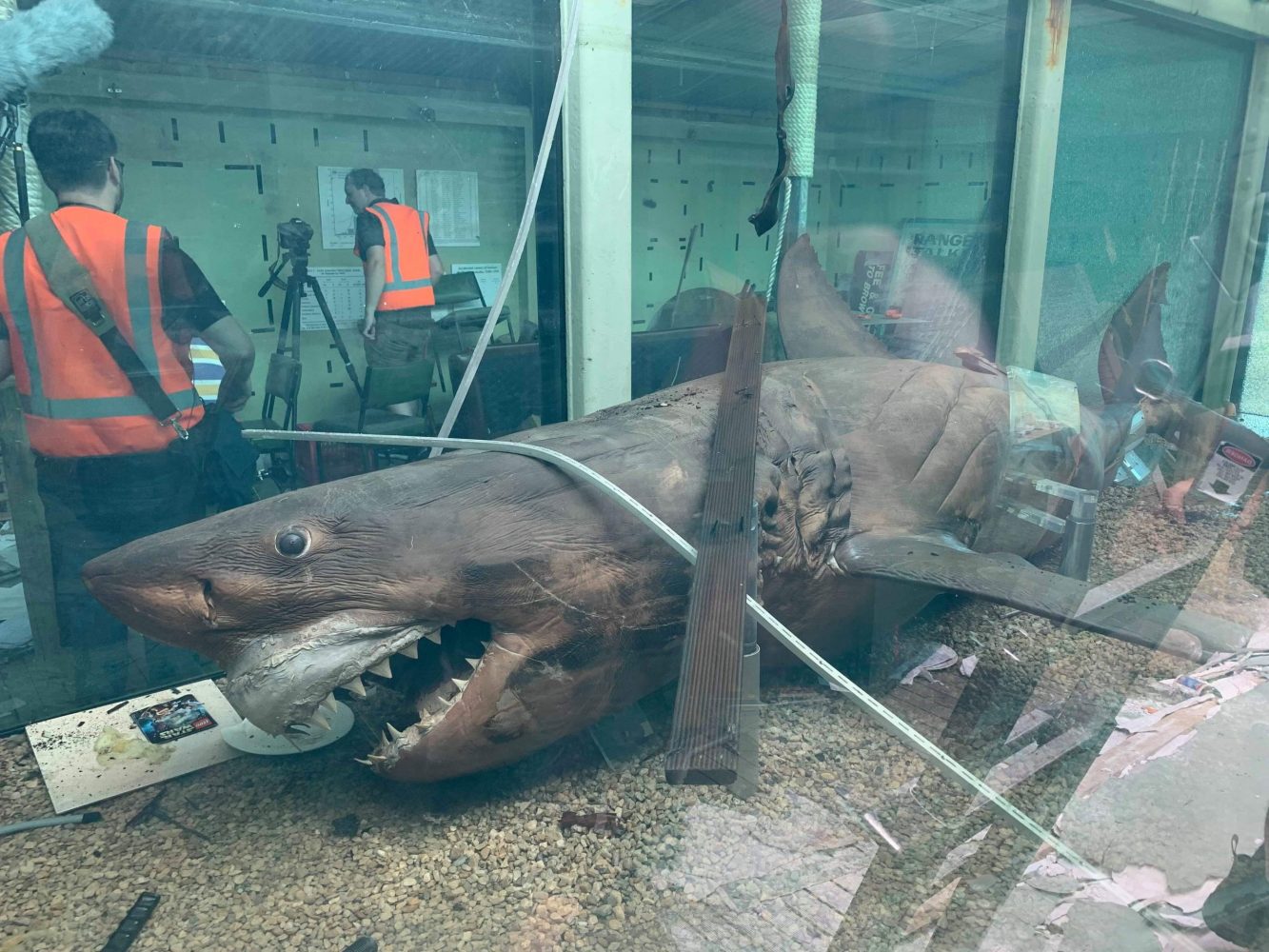
When urban explorers stepped into a derelict wildlife park armed with flashlights and cameras, they expected crumbling buildings and rusted enclosures. What they found instead would captivate millions and spark an unlikely rescue mission that continues to draw visitors from across the globe. Deep inside a dark, half-ruined building sat something extraordinary: a 16-foot great white shark suspended in cloudy green liquid, its massive silhouette drifting behind cracked glass like something from a fever dream.
Years after the discovery sent shockwaves across social media, Rosie the shark remains on display in 2025, but her story has taken several unexpected turns since that eerie footage first went viral.
When a Dead Shark Became an Internet Sensation
YouTuber Luke McPherson had no idea what he was about to stumble upon when he ventured through the abandoned Wildlife Wonderland park in Bass, Victoria, in 2018. Armed with a torch and camera, he navigated through collapsed structures and decaying exhibits until his light caught something strange. A pale mass floated in green-tinged liquid, and as his beam sharpened the outline, the unmistakable form of a great white shark emerged from the murk.
McPherson’s footage showed the pumps still circulating highly toxic formaldehyde through the deteriorating tank, surrounded by debris from the collapsed building. When backlit by torches, the tank emitted an otherworldly green glow, creating an atmosphere so surreal it seemed almost staged. His video exploded online, racking up more than 17 million views and transforming Rosie from a forgotten specimen into a global phenomenon practically overnight.
People around the world became obsessed with the abandoned shark, sharing theories about how she ended up there and why she had been left behind. Comments flooded in from viewers who found the footage both haunting and mesmerizing. What started as one explorer’s curious discovery quickly morphed into something far more dangerous.
Rosie’s Journey from Ocean to Captivity

Before becoming an internet curiosity, Rosie swam freely off the coast of South Australia. Her story took a tragic turn in 1997 when she became entangled in tuna fishing nets. Despite attempts to free her, the young shark thrashed so violently that her blood began to boil from stress. Fishermen faced an impossible choice, and rather than allow prolonged suffering, they decided to humanely euthanize her with a single shot.
Her body was immediately placed in a freezer, with the fishing company planning to sell her for educational purposes. Institutions across Australia expressed interest in acquiring such a rare and well-preserved specimen. Great white sharks rarely end up intact and available for study, making Rosie particularly valuable to researchers and educators.
Wildlife Wonderland won the bid, reportedly paying around AU $500,000 to secure her. What followed was a 900-mile journey that took an unexpected detour. During transport, authorities intercepted the refrigerated truck to perform an autopsy. Concerns had arisen that Rosie might have consumed remains of a woman who had gone missing off the South Australian coast. Examiners found no trace of human remains inside her, and the journey continued.
Once she arrived at Wildlife Wonderland in 1998, workers placed her into a massive custom-built tank filled with formaldehyde. For several years, she remained one of the park’s most popular attractions, drawing visitors curious to see an apex predator frozen in time.
Abandoned and Forgotten After Park Closure

Everything changed in 2012 when authorities discovered Wildlife Wonderland was operating without proper licenses. Animal welfare concerns prompted immediate action. Officials seized more than 130 living animals and relocated them to appropriate facilities, evicted the operators, and shut down the park permanently.
Rosie, however, was not included in the relocation efforts. As a preserved specimen rather than a living creature, she fell outside the scope of animal rescue operations. With staff gone and the property abandoned, her sealed tank remained inside a dark outbuilding while the surrounding structures gradually collapsed from neglect and weather damage.
For six years, Rosie floated in complete darkness. Pumps continued circulating the toxic preservative through automated systems, but no one maintained the tank or checked on her condition. Rust crept across the metal frame, fractures spread through the glass, and the building itself began to crumble around her. Unless you knew exactly where to look and were willing to trespass on private property, you would never know she existed.
Vandals Turned Viral Fame into Destruction

McPherson’s viral video changed everything. Suddenly, thousands of people knew exactly where to find Rosie, and many decided they wanted to see her in person, regardless of the private property barriers and no trespassing signs. What followed was a wave of destruction that threatened both the specimen and anyone foolish enough to break in.
Thrill seekers forced their way into the crumbling shed, smashing sections of glass and throwing debris into the chemical-filled liquid. Some climbed onto the tank’s structure and pried open the top hatch, exposing the highly toxic formaldehyde fumes. Others reached inside once the tank was breached, attempting to snap off Rosie’s teeth as souvenirs using anything they could find, including hedge trimmers.
Someone even hurled a discarded television straight into the tank, letting it sink into the cloudy preservative. People threw rocks at the glass, creating a network of dangerous cracks that threatened to rupture the entire structure. Had the glass shattered completely, anyone nearby would have been doused in carcinogenic formaldehyde, likely resulting in serious injury or death.
As damage mounted and the situation grew increasingly hazardous, the landowner faced a grim decision. To prevent further break-ins and protect trespassers from their own recklessness, plans were made to destroy Rosie entirely.
Tom Kapitany’s Unexpected Rescue Mission

When Tom Kapitany heard about the planned destruction, he immediately intervened. But his connection to Rosie actually began years earlier, long before the viral video made her famous. Back in 2012, Kapitany had toured the abandoned Wildlife Wonderland property while considering purchasing it for his business ventures. During that walk-through, he discovered Rosie floating in what he would later describe as a green slimy tank.
Although the property sale never materialized, the image of that preserved shark stayed with him. When he learned she faced destruction in 2019, he didn’t hesitate. Kapitany arranged for the entire tank to be carefully craned out of the collapsing shed, a delicate operation given the contaminated and unstable formaldehyde inside.
Moving Rosie made national headlines, which created its own problems. Kapitany was forced to hire 24-hour security throughout the extraction process to protect both the workers and the specimen from curious onlookers and potential vandals. Getting her safely to his Crystal World Exhibition Centre in Devon Meadows required careful planning, specialized equipment, and considerable expense.
Rosie’s New Life at Crystal World Exhibition Centre

Once Rosie arrived at her new home, Kapitany set about restoring her properly. He disposed of the contaminated formaldehyde and replaced it with glycerol, a much safer and more stable preservation fluid that prevents decay without releasing harmful vapors. Workers cleaned and repaired the tank, removing years of grime and damage.
Currently, Rosie rests in approximately 5,000 liters of glycerol in the Crystal World car park. While her outdoor location might seem unconventional, it allows easy access for the roughly 50,000 visitors who come to see her each year. People have traveled from Brazil, India, Canada, and countries across Europe specifically to view this remarkable specimen.
Rosie the Shark’s Facebook page has amassed 52,000 followers who share stories, photos, and discussions about her history and significance. Some individuals who stole items from her old exhibit have even anonymously returned them to Kapitany, who plans to include these artifacts in a future purpose-built viewing gallery alongside shark fossils and other relics.
Kapitany awaits permits to construct a dedicated educational space designed specifically for school groups and organized visits, though Rosie remains carefully maintained and monitored in her current setup.
Educational Mission Over Profit

What drives someone to spend thousands of dollars rescuing and maintaining a dead shark? For Kapitany, the answer is simple: “We don’t charge people to see Rosie. It was never about making money out of her. If anything she’s cost me a significant amount of money.”
His motivation stems from childhood experiences growing up in the Australian bush, where his father encouraged curiosity about the natural world. As a kid, Kapitany collected unusual specimens and even experimented with preserving snakes. That early fascination with nature and preservation never left him, eventually leading to careers in geology, botany, and entrepreneurship.
When asked about his unconventional pet, Kapitany describes himself with characteristic humor: “I’m just a crazy old guy who likes rocks and dead sharks.” But beneath the self-deprecating joke lies genuine passion for natural history and conservation. He firmly believes that destroying Rosie “would be sacrilegious if she had been buried in landfill.”
Great white sharks are protected and endangered, making specimens like Rosie increasingly rare and scientifically valuable. Her near-perfect preservation offers researchers and the public alike a chance to study and appreciate these apex predators up close. For Kapitany, keeping her on display serves a larger purpose about respecting ocean life and understanding our impact on marine ecosystems.
Why One Man Spent Thousands on a Dead Shark
Kapitany hopes Rosie’s story will “help people understand that these are beautiful creatures which have lives and we shouldn’t destroy their home.” His message resonates with visitors who come expecting a novelty attraction but leave with a deeper appreciation for marine conservation.
Rosie’s journey from ocean dweller to frozen specimen, from forgotten relic to viral sensation, and finally to carefully maintained educational exhibit reflects something larger about how we value and preserve natural history. Her story could have ended in a landfill or with toxic chemicals spilling across an abandoned building. Instead, she continues teaching people about great white sharks and the importance of protecting ocean habitats.
Standing before her tank today, visitors see more than just a preserved predator. They encounter a creature that once ruled the waters off Australia’s coast, whose accidental death led to decades of unlikely preservation, abandonment, and eventual rescue by someone who simply refused to let her story end in destruction.
Rosie the shark remains suspended in her glycerol tank, maintained with care, visited by thousands, and no longer forgotten.
