
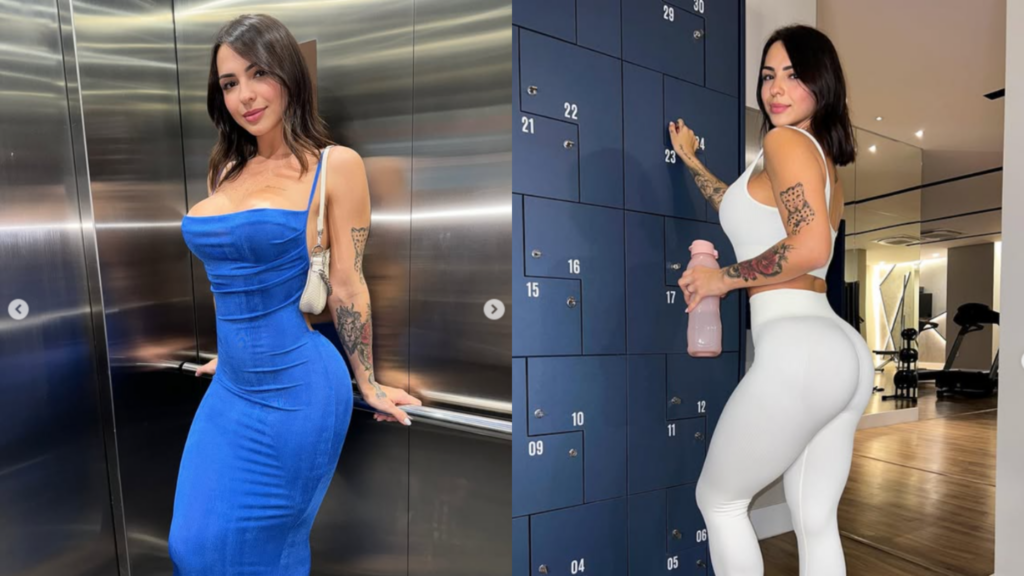
What if technology could define perfection? This intriguing concept became a reality when artificial intelligence crowned Brazilian fitness influencer Karol Rosalin as “the perfect 10.” Praised for her symmetry, proportion, and overall bodily harmony, Karol’s recognition has captivated the fitness world and sparked widespread curiosity.
But what does it mean to have the “perfect body” according to AI, and how does this standard align—or conflict—with real-world perceptions of beauty and health? As the lines between technology and societal ideals blur, Karol’s story offers a fascinating glimpse into the evolving landscape of fitness, beauty, and human potential.
Karol Rosalin’s Journey to Recognition
Karol Rosalin, a 25-year-old fitness influencer from São Paulo, Brazil, has captivated the fitness community with her dedication and transformation. Her journey began eight years ago when she embarked on strength training, initially without a clear direction. Reflecting on her early days, Karol admitted, “In the beginning, I didn’t know how to train properly. I went through periods when I was thinner or more muscular.” Through perseverance and self-discovery, she eventually found the right balance for her body, leading to her current regimen of weight training five days a week, complemented by daily aerobic classes.
Her commitment extends beyond the gym. Karol maintains a disciplined diet. She often shares her culinary creations, such as baked sweet potato chips and vegetable frittatas, with her audience.
Karol’s dedication and balanced lifestyle have garnered significant attention, culminating in her being recognized by Playboy Australia as having “the perfect body in terms of definition” and being “ideal in the fitness world.” This acknowledgment was based on an AI analysis that evaluated her well-being, health, strength, symmetry, proportion, and overall harmony. Reacting to this accolade, she expressed, “Seeing the results in the mirror is already a victory. Being recognized as the ‘Perfect Fitness Woman’ is incredible!”
Her journey underscores the importance of consistency, self-awareness, and a balanced approach to fitness and nutrition. It also highlights the evolving standards of beauty and health in the digital age, where technology and personal dedication intersect to redefine what it means to achieve physical “perfection.”
What Makes Her Body “Perfect” According to AI

Artificial intelligence has recently recognized Brazilian fitness influencer Karol Rosalin as possessing “the perfect female body,” evaluating her physique based on criteria such as symmetry, proportion, and overall bodily harmony.
Symmetry and proportion are fundamental aspects of human aesthetics, often associated with perceptions of beauty and health. Studies in anthropometry—the measurement and analysis of the human body—have long emphasized the significance of these factors. For instance, research on automatic estimation of anthropometric measurements highlights the importance of accurate body dimension assessments in various applications, including ergonomics and garment manufacturing.
In Karol’s case, the AI model analyzed her physical attributes, considering factors such as the balance between her upper and lower body, the evenness of muscle distribution, and the alignment of body parts. This comprehensive evaluation led to her being described as having “the perfect body in terms of definition” and being “ideal in the fitness world.”
It’s important to note that while AI can assess physical attributes based on data and predefined criteria, the concept of a “perfect body” remains subjective and culturally influenced. Fitness expert Ben Lucas emphasizes that “genetics and lifestyle play a huge role in determining body shape and type,” and that “there are many ‘perfect’ body types.”
The Fitness Routine Behind the Look
Karol Rosalin’s recognition as having “the perfect female body” is a testament to her disciplined fitness regimen and nutritional habits. Her journey into strength training began eight years ago, and she currently engages in weight training five days a week, complemented by daily aerobic classes.
Her diet is meticulously planned to support her fitness goals, emphasizing natural and unprocessed foods. She regularly consumes fruits, vegetables, oats, and lean proteins such as chicken. A typical breakfast might include two scrambled eggs, cassava, papaya, pineapple, oats with cinnamon, and coffee. She also enjoys preparing meals like baked sweet potato chips and vegetable frittatas, showcasing her commitment to a wholesome diet.
Karol’s approach to fitness and nutrition reflects a balanced lifestyle aimed at maintaining health and well-being. She emphasizes that her dietary choices are part of a plan to keep her health up to date, stating, “I don’t do anything crazy; everything I eat is part of a plan to keep my health up to date.”
It’s important to recognize that while Karol’s routine has been effective for her, individual results can vary based on factors such as genetics and lifestyle. Fitness expert Ben Lucas notes, “Genetics and lifestyle play a huge role in determining body shape and type, and I want to stress that there are many ‘perfect’ body types.”

AI’s Impact on Beauty Standards
This technological intervention raises significant ethical and psychological concerns. A study titled “AI in Beauty Content: A Theoretical Study of Ethical and Psychological Considerations” highlights that AI-generated beauty standards can perpetuate unrealistic ideals, adversely affecting self-esteem and body image, particularly among impressionable demographics.
Moreover, the datasets used to train AI models often reflect existing societal biases. Research indicates that AI-generated images frequently depict a narrow and homogenized view of beauty, predominantly featuring light-skinned individuals with specific facial and body features. This lack of diversity can marginalize those who do not conform to these constructed ideals, reinforcing exclusionary standards.
The fashion and media industries are also experiencing shifts due to AI’s role in content creation. The emergence of AI-generated influencers and virtual models presents challenges to traditional representations of beauty, potentially displacing human models and altering consumer perceptions. This evolution necessitates a reevaluation of authenticity and representation in media.
Expert Opinions: Is There Really Such a Thing as a “Perfect Body”?
The concept of a “perfect body” has long been debated among fitness professionals, sociologists, and ethicists. The recent designation of “perfect female body” by artificial intelligence has reignited discussions about the validity and implications of such labels.
Fitness expert Sammy Robinson emphasizes that “No two individuals are the same, and striving for someone else’s ideal often overlooks the unique strengths and attributes we each possess.” This perspective is echoed in sociocultural theories, which propose that different societies have varying conceptions of the ideal body shape. Within contemporary Westernized cultures, media and social networks promote particular assumptions about what constitutes the ‘ideal’ body, exerting strong social pressure to achieve such a body shape. Dr. Deborah Giles notes, “The ‘perfect body’ changes depending on cultural and historical contexts. What was celebrated a century ago is not the same as today’s beauty standards.”
The reliance on AI to define beauty standards raises additional ethical concerns. Dr. Nitzan Kenig, co-author of a study on AI’s influence, warns, “AI models rely on datasets for learning. If these datasets contain societal biases or promote unrealistic standards, the AI may inadvertently perpetuate those views, making it difficult to guide future generations toward a balanced and healthy perspective on body image and beauty.” Supporting this, Andrew Foote, an AI researcher, explains, “AI’s perception is a mirror of societal values. If we want better outcomes, we need to feed it diverse, unbiased datasets.”
Furthermore, studies on the psychological impact of unattainable beauty standards reveal significant risks. “Unrealistic beauty ideals can lead to severe self-esteem issues and a distorted view of one’s own body,” notes Dr. Johanna Weston, a psychologist specializing in body image. She continues, “Promoting diversity in representation is essential to combat these negative effects and foster a healthier self-image among all individuals.”
A Balanced Perspective on Beauty and Health
Karol Rosalin’s journey to being crowned “the perfect 10” by artificial intelligence reflects more than just physical attributes; it embodies discipline, dedication, and a pursuit of personal health and balance. While AI’s analysis provides an intriguing lens through which to view symmetry, proportion, and harmony, it also underscores the subjective and culturally influenced nature of beauty.
The increasing role of technology in defining societal standards offers both opportunities and challenges. On one hand, AI can serve as a tool to promote health-focused ideals, but on the other, it risks perpetuating unrealistic expectations and reinforcing biases inherent in the datasets it relies upon.
Ultimately, the idea of perfection should not be confined to a single model or algorithm. Beauty, as experts emphasize, is deeply personal and varies widely across cultures, genetics, and individual perspectives. By celebrating diversity and fostering a holistic approach to health and self-care, society can move beyond narrow standards and embrace the many ways in which individuals can thrive.
Featured Image Source: Karol Rosalin @karolrosalin on Instagram
