
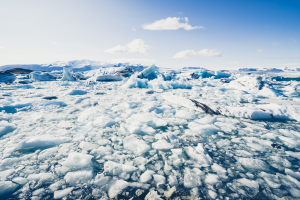
Cities across the world, from London to Miami, could be underwater within the next few centuries. New research warns that more than half of Antarctica’s ice shelves could collapse by 2300, triggering an irreversible sea level rise of up to 32 feet. While the year 2300 might sound distant, scientists caution that the tipping point for catastrophic change could arrive far sooner, within the next few generations.
A Future Submerged Beneath the Waves
The idea of entire cities drowning beneath the sea once belonged to the realm of science fiction. But according to scientists from Sorbonne University in Paris, this could be humanity’s reality if greenhouse gas emissions continue to soar. Their study, published in Nature, predicts that up to 59 percent of Antarctica’s ice shelves could collapse by 2300, leading to a 10-meter rise in global sea levels.
This kind of sea level rise would redraw the world map. In the United Kingdom, cities like Hull, Glasgow, Bristol, and parts of London could disappear beneath the water. Across Europe, the coasts of France, Denmark, Spain, and Italy would suffer similar fates.
In the United States, millions of people in Houston, Miami, and New Orleans could be displaced, forced to move inland as the ocean reclaims the land. Even Asia’s great coastal metropolises, including Shanghai, Bangkok, and Dhaka, could be submerged.
For low-lying island nations like the Maldives, Kiribati, and Tuvalu, such a rise would mean complete erasure. The cultural loss would extend beyond land it would mean the disappearance of languages, traditions, and entire ways of life tied to the sea.
The Ice Shelves: Antarctica’s Fragile Barrier

Antarctica is ringed by vast floating platforms of ice known as ice shelves. These structures act as barriers, holding back the continent’s massive glaciers from sliding into the ocean. Scientists often describe them as the planet’s safety bands. When these shelves thin or collapse, the grounded ice behind them accelerates into the sea, causing sea levels to rise dramatically.
Dr. Clara Burgard, who led the Sorbonne University study, explains that these ice shelves are crucial to maintaining balance in the global climate system. Once they weaken, the process of ice loss becomes unstoppable. Their simulations examined the fate of 64 Antarctic ice shelves under different emission scenarios, offering both hope and warning.
Under a low-emission pathway where global warming is limited to below two degrees Celsius by 2300, only one ice shelf becomes unstable. But under a high-emission scenario, where global temperatures rise by as much as twelve degrees Celsius, 38 of the 64 shelves could collapse entirely. That single difference in our emission choices would determine whether the world faces a manageable challenge or a global catastrophe.
The collapse of these shelves would not be uniform. Scientists predict that some, particularly those already vulnerable to warm water intrusion, could disintegrate much sooner than 2300. The Thwaites and Pine Island Glaciers in West Antarctica, already thinning rapidly, are often cited as the most precarious. Their combined collapse could raise sea levels by over three meters alone.
The Science Behind the Meltdown

Antarctica holds around 58 meters of potential sea level rise in its ice sheet. While scientists stress that a total melt is unlikely within the next few centuries, even a small fraction of that loss could transform coastlines across the planet.
Traditionally, researchers have focused on West Antarctica, where glaciers such as Thwaites and Getz are already showing signs of instability. These ice shelves are melting year-round due to the constant inflow of warm Circumpolar Deep Water from the Southern Ocean. The collapse of just the Thwaites Glacier, sometimes called the “Doomsday Glacier,” could alone raise sea levels by three meters.
However, new research suggests East Antarctica is not as stable as previously believed. A study by the ARC Australian Centre for Excellence in Antarctic Science and UNSW Sydney found that East Antarctica experiences intense seasonal melting in summer. When sea ice retreats during the warmer months, warm ocean water flows beneath the ice shelves, causing basal melting from below. These processes are often overlooked by climate models, meaning current sea level rise projections could be underestimating future changes.
Dr. Fabio Boeira Dias, lead author of the East Antarctica study, warns that these dynamics must be incorporated into global climate models to ensure accurate predictions. Without understanding how ocean currents and seasonal temperature shifts interact with the ice shelves, projections may paint too optimistic a picture. His team used a high-resolution ocean model to simulate these interactions, revealing that East Antarctic shelves such as Totten could melt rapidly during summer and refreeze in winter. Yet, as the climate warms, even this seasonal pattern could break down.
The Interconnected Crisis

The Antarctic system is not only about ice and water; it is deeply tied to global climate stability. Recent research led by Dr. Nerilie Abram from the Australian National University warns that Antarctica is undergoing rapid and interconnected transformations that may soon become irreversible.
The loss of sea ice does more than open new stretches of ocean. It amplifies warming by reducing the Earth’s reflectivity, allowing more solar energy to be absorbed. It also exposes the fragile ice shelves to wave-driven collapse and disrupts ocean circulation. These feedback loops are accelerating change faster than many climate models had predicted.
One particularly alarming risk is the potential collapse of the Antarctic overturning circulation. This deep ocean process helps transport heat, carbon, and nutrients around the globe. If it weakens, nutrients could remain trapped on the ocean floor, depriving marine ecosystems of life-sustaining material. Professor Matthew England, a co-author of the study, emphasizes that this slowdown could make the Southern Ocean less effective at absorbing carbon dioxide, further intensifying global warming.
Antarctica’s ecological web is also at stake. Emperor penguins, krill, seals, and phytoplankton all depend on stable sea ice. Early sea ice breakups have already led to multiple breeding failures among penguin colonies. As warming accelerates, these species may face extinction, signaling the unraveling of one of Earth’s last great wildernesses.
A Timeline for Disaster

While the year 2300 may feel distant, the path toward that future is already unfolding. The Sorbonne team notes that between 2085 and 2170, Antarctica could experience the highest rate of ice shelf collapse. In climate terms, that is just around the corner.
This century will therefore be decisive. If emissions continue along their current trajectory, global temperatures could rise well beyond the two-degree threshold set by the Paris Agreement. Each fraction of a degree compounds the stress on the Antarctic system. As Dr. Abram warns, rapid change has already been detected across Antarctica’s ice, oceans, and ecosystems, and this is set to worsen with every fraction of a degree of global warming.
Moreover, the researchers caution that their 32-foot projection may actually be conservative. Ice shelf collapse is not a gradual process. Once weakened, ice shelves can fracture suddenly through processes like rifting, hydrofracturing, or calving. These events can lead to the swift disintegration of vast sections of ice, as seen in the dramatic collapse of the Larsen B Ice Shelf in 2002. What took thousands of years to form can vanish in weeks.
Global Consequences: The Human Cost

A sea level rise of even a few meters would reshape the geography of human civilization. A ten-meter rise, however, would submerge entire countries and displace hundreds of millions of people.
In the UK, low-lying regions such as Portsmouth, Southend-on-Sea, Cardiff, and Hull would be lost. Much of London along the Thames would be underwater, including Westminster and Greenwich. In Europe, Venice, Lisbon, and Seville would struggle to survive. Across the Atlantic, vast swaths of Florida and the Gulf Coast would disappear, taking with them cities like Miami and New Orleans.
The implications go beyond flooded streets. Rising seas contaminate freshwater supplies, destroy cropland, and erode cultural heritage sites. Economies that depend on tourism, shipping, or agriculture would face upheaval. Insurance systems would collapse under the strain of endless coastal damage. And beyond the physical losses, the social and political consequences of mass displacement could be profound.
Bangladesh, for example, already faces chronic flooding, and even a modest rise in sea level could render large portions of the country uninhabitable. Island nations such as the Maldives and Tuvalu would vanish entirely, forcing their populations to become climate refugees. The question of where these millions will go remains unanswered.
The financial cost of inaction would also be astronomical. According to the World Bank, global coastal flooding could cost more than one trillion dollars annually by 2100 under high-emission scenarios. Yet those economic figures pale in comparison to the humanitarian toll.
The Urgent Need for Action

Scientists are clear that the fate of Antarctica and of global coastlines depends on choices made today. Every ton of carbon dioxide emitted pushes the system closer to an irreversible tipping point. The difference between a two-degree and a twelve-degree future lies in global policy, innovation, and collective will.
Dr. Adele Morrison from the Australian National University emphasizes that integrating these new Antarctic processes into climate models is crucial for informed policymaking. If policymakers underestimate future sea level rise, infrastructure planning, disaster management, and adaptation efforts will all fall short.
The world has already seen record-low Antarctic sea ice coverage in recent years, coupled with marine heatwaves and disrupted ocean patterns. These are early warnings of what lies ahead. Professor England calls this moment critical, insisting that the only way to prevent catastrophic change is through rapid reduction of greenhouse gas emissions.
Beyond emission cuts, scientists also call for expanded monitoring and research. The Antarctic Treaty System offers important protections for ecosystems, but it cannot address climate-driven threats alone. New international cooperation will be necessary to understand and mitigate the evolving risks.
A Narrow Window of Hope
Despite the grim projections, scientists emphasize that there is still a window of opportunity. If emissions are drastically reduced, much of Antarctica’s ice can remain stable. Limiting warming below two degrees could mean losing only one major ice shelf rather than dozens.
This is not merely a scientific challenge but a moral and political one. The choices made in this century will determine whether future generations inherit a world of sinking cities and vanishing coastlines or one that remains largely intact.
Antarctica may feel remote, but it is not disconnected from human life. The continent’s icy heart regulates ocean currents, climate patterns, and sea levels that sustain billions. As scientists have warned repeatedly, the meltdown of this frozen world would be irreversible. Humanity stands at the edge of a precipice, armed with both knowledge and responsibility.
The question is whether we act swiftly enough to step back before the ice gives way.
