
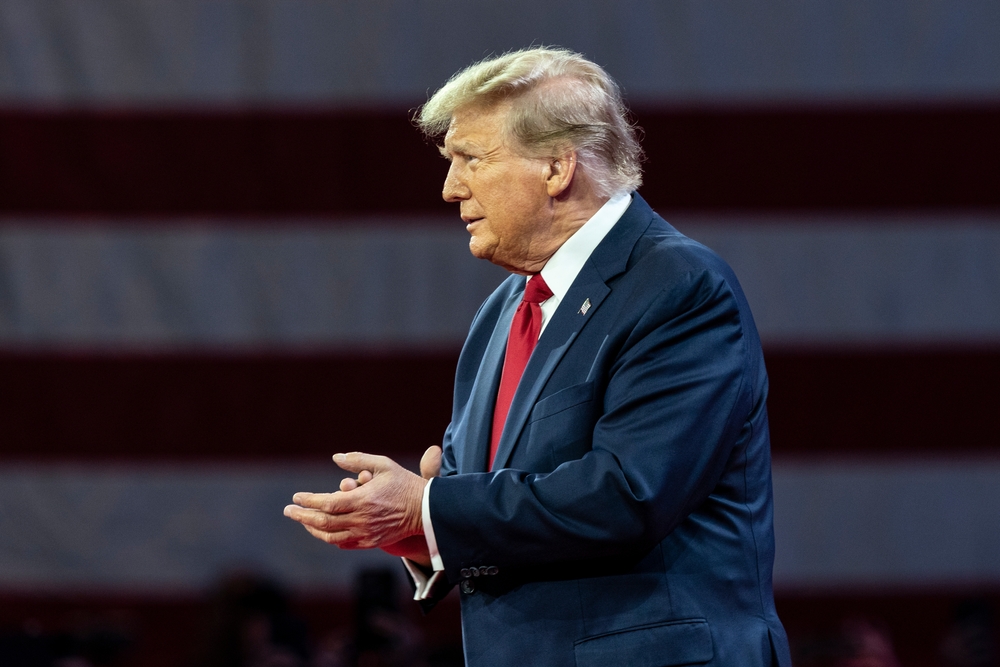
Donald Trump has long stood out for his extravagant lifestyle, unfiltered persona, and penchant for excess yet one of his most defining personal traits is his claim to total abstinence from alcohol. The man famous for gilded towers, high-stakes deals, and political showmanship insists he has never touched a drop of alcohol in his life. In a world where power and indulgence often go hand in hand, this commitment feels almost paradoxical. For Trump, however, it isn’t simply a matter of preference. It is, by his own account, a deeply personal decision rooted in tragedy a lesson learned from the life and death of his older brother, Fred Trump Jr., who struggled with alcoholism and died young.
The former president has repeated this story countless times over the years, across interviews, rallies, and podcasts. The version rarely changes: Fred was charming, talented, and full of potential, but his addiction consumed him. Watching his brother’s decline, Trump says, left an indelible mark. He decided early in life never to drink, fearing that he might inherit the same weakness. That simple vow, he claims, shaped the rest of his life not only his health habits but also his worldview, his approach to control, and even his political image. Yet, as with many aspects of Trump’s persona, his teetotal story exists in a curious space between personal truth and public mythology. It reveals as much about how leaders craft their identities as it does about Trump himself.
A Family Tragedy That Defined a Life
Trump’s decision to avoid alcohol traces back to his brother Fred, whose battle with addiction has been described by both family members and biographers as one of the most painful chapters in the Trump family history. Fred Trump Jr., known affectionately as Freddy, was the second of five children and, by many accounts, the most likable and free-spirited. He pursued a career as a pilot, defying his father’s wishes to join the family’s real estate business. This independence became a point of tension with their father, Fred Sr., who prized discipline and ambition above all else. Over time, the combination of family pressure, unfulfilled dreams, and a growing dependence on alcohol took its toll.
Fred Jr. died in 1981 at the age of forty-two from a heart attack linked to his alcoholism. Donald Trump, then in his mid-thirties, later described his brother as both an inspiration and a cautionary tale. Speaking in various interviews including one with podcaster Theo Von in 2024 Trump recounted how Fred had repeatedly warned him: “Don’t drink. Don’t smoke. Don’t do drugs.”

Those words became a lifelong commandment. Trump has often said that he believes he might have had an addictive personality himself, and that by abstaining entirely, he avoided a path that could have led to ruin.
In this sense, his sobriety is not simply a health choice but an act of self-preservation. It represents a moral and emotional boundary drawn from trauma. For Trump, who rarely reveals vulnerability, the story of his brother’s death is one of the few personal losses he speaks of openly. It functions as a kind of emotional anchor a private sorrow transformed into public moral. While Trump is often associated with bravado and dominance, this part of his story shows a man deeply influenced by fear of weakness and loss.
The Making of a Public Persona

From a political and cultural standpoint, Trump’s abstinence narrative fits neatly into his larger image-making. In interviews dating back decades, he has linked his sobriety to discipline, control, and clarity qualities he portrays as essential to success in both business and governance. “It’s one of my only good traits,” he once joked during a press conference in 2018. The humor aside, the message was consistent: while others might falter under the influence of temptation, Trump stays sharp, sober, and always ready to win.
The image of the non-drinking mogul amid the excess of Manhattan nightlife became a subtle but powerful piece of branding. In the 1980s and 1990s, when Trump’s celebrity status was first solidifying, his name was synonymous with wealth and extravagance the man of gold-plated jets and beauty pageants. Yet within that persona was an undercurrent of moral discipline: the idea that Trump could indulge in every other form of luxury but not vice. This paradox reinforced the myth of Trump as a man who understood indulgence without succumbing to it.
As he entered politics, that self-portrait gained new resonance. Sobriety, especially in American political culture, carries symbolic weight. It evokes notions of control, trustworthiness, and moral authority. George W. Bush famously credited his decision to quit drinking at forty with transforming his life. Jimmy Carter’s abstinence was tied to his devout faith. Trump’s teetotal identity, though less religiously framed, tapped into a similar cultural vein. It allowed him to project discipline amid chaos to claim, despite his reputation for volatility, that he possessed an inner restraint others lacked.
Conflicting Accounts and the Question of Myth

Of course, as with many aspects of Trump’s public image, the story of lifelong abstinence has faced scrutiny. Reports from former nightlife acquaintances, bartenders, and club insiders have occasionally surfaced over the years, suggesting that Trump may have consumed alcohol on rare occasions in his younger days. One bartender, known as Laraby, told Vice in 2019 that she served Trump light beers in New York clubs during the 1990s, while others claimed to have seen him with champagne or vodka at events. Whether these accounts are reliable is unclear. Memory is fallible, and Trump’s presence at alcohol-heavy gatherings may have led some to assume he drank when he did not.
Regardless of the factual accuracy, the controversy underscores an important aspect of modern political storytelling: perception often outweighs proof. Trump’s claim of absolute abstinence, repeated for decades, functions as a myth a simplified, emotionally charged narrative designed for easy transmission. In an age of constant media repetition, consistency can matter more than factual nuance. Trump’s repetition of phrases like “I’ve never had a drink in my life” or “My brother taught me a lesson” has given the story a kind of ritualistic authority.
Even potential contradictions enhance the mythology. To supporters, skepticism about his sobriety reads as media nitpicking. To critics, it becomes one more example of Trump’s tendency to blur fact and fiction. Either way, the narrative stays alive. It becomes a conversation piece a window into how personal anecdotes evolve into symbols of character. The question of whether he ever truly drank matters less than what the claim reveals about how he wants to be seen: as a man of control, forged in tragedy, immune to weakness.
Sobriety as Political Symbolism

In political communication, sobriety serves as more than a lifestyle detail it becomes a metaphor. A teetotal leader projects steadiness and moral clarity, traits deeply embedded in the American imagination. The country’s history includes presidents who struggled with alcohol, like Franklin Pierce and Ulysses S. Grant, and others who swore off drinking entirely. Trump’s story fits within this lineage, but with a twist: his is not a tale of redemption, like Bush’s, but one of perpetual self-control. He didn’t have to quit; he never began.
That distinction adds to his political appeal among supporters who value strength and discipline. By framing his abstinence as a triumph of willpower, Trump aligns with conservative ideals of personal responsibility. It becomes a parable about resisting temptation, about standing apart from the crowd. Even his fondness for Diet Coke a habit well documented by aides and journalists plays into this imagery: a small, almost comedic symbol of indulgence under control.
Yet the narrative also reflects a deeper cultural desire for purity in leadership. Voters often respond to simple moral frameworks: the hard worker, the family man, the reformer. Trump’s sobriety fits that mold while simultaneously contrasting with his more flamboyant traits. It paints him as paradoxical a man who craves excess but governs by restraint. This duality fuels both fascination and skepticism, ensuring the story remains politically potent.
However, the risk of equating sobriety with virtue lies in oversimplification. History offers ample evidence that abstinence does not guarantee good judgment. Political competence depends on far more than personal habits. Trump’s story, viewed analytically, functions best as a case study in image construction how private loss can be repurposed into a public symbol, how discipline can be marketed as destiny.
The Public Health Perspective

Beyond politics, Trump’s stance on alcohol touches on broader public health themes. His core message “Don’t start” echoes standard addiction prevention advice. Research consistently shows that early avoidance of alcohol reduces the risk of dependence later in life. Organizations like the World Health Organization and the Centers for Disease Control and Prevention emphasize that no amount of alcohol is completely safe, with even moderate consumption linked to increased risks of cancer and cardiovascular disease. In this respect, Trump’s story aligns with scientific consensus.
Still, his framing of the issue tends to emphasize willpower over empathy. By presenting his brother’s addiction as a moral warning, Trump underscores the value of self-control but sidesteps the complexities of addiction as a medical condition. Public health experts increasingly stress that addiction is shaped by genetics, trauma, and environment, not merely individual weakness. While Trump’s message of prevention may resonate with some audiences, it risks reinforcing stigma against those who struggle with substance use disorders.
Nevertheless, the emotional authenticity of his account the pain of losing a brother has power. It offers a rare glimpse of vulnerability in a public figure otherwise defined by confidence. When he tells the story, there is little of his usual bravado; instead, there is a sense of lingering grief. That sincerity may explain why the tale endures. It speaks to something universal: the desire to learn from loss, to transform tragedy into strength. Even stripped of political context, the message carries a moral resonance that many Americans find relatable.
Myth, Memory, and Legacy

In the end, Donald Trump’s story about never drinking is less about alcohol itself and more about the nature of narrative in modern politics. Every leader crafts a personal mythology a story that encapsulates their values and shapes how they are remembered. For Trump, the teetotal narrative performs several functions simultaneously: it signals discipline, honors family loyalty, and reinforces his brand as a man who thrives where others fall.
That story has proven remarkably durable, surviving decades of public life, scandal, and scrutiny. Whether or not it is perfectly true may be impossible to determine, but its persistence reveals the mechanics of mythmaking in the age of mass media. The repetition of a simple personal anecdote can achieve what no policy speech can: it humanizes a figure often seen as larger than life. It turns the chaos of political identity into something legible a clear moral cause and effect.
If Trump’s political career has taught observers anything, it is that narrative control can be as powerful as legislative action. His tale of abstinence exemplifies this principle. It is a story of discipline and tragedy, of power restrained by memory. For supporters, it affirms strength; for skeptics, it exposes performance. Either way, it endures, a reminder that in politics, the most intoxicating force is not alcohol but the power of a well-told story.
The Moral of the Myth
Donald Trump’s lifelong abstinence, as he presents it, offers a window into how private trauma becomes public symbol. His brother’s death shaped not only his personal habits but also his public image transforming grief into discipline, vulnerability into narrative strength. Whether his claim of total sobriety is strictly factual is almost secondary. What matters is how it functions: as a parable of control in a culture that prizes self-mastery.
The story’s durability reflects a broader truth about American politics. Voters gravitate toward clean, emotionally resonant stories tales that make complexity manageable. Trump’s narrative of abstinence fits that need perfectly: simple, moral, and endlessly retold. It reminds us that in politics, personal stories are not just background details; they are instruments of persuasion and identity. And in Trump’s case, the myth of sobriety has become one of his most enduring signatures proof that sometimes, the strongest political drink is the story itself.
