
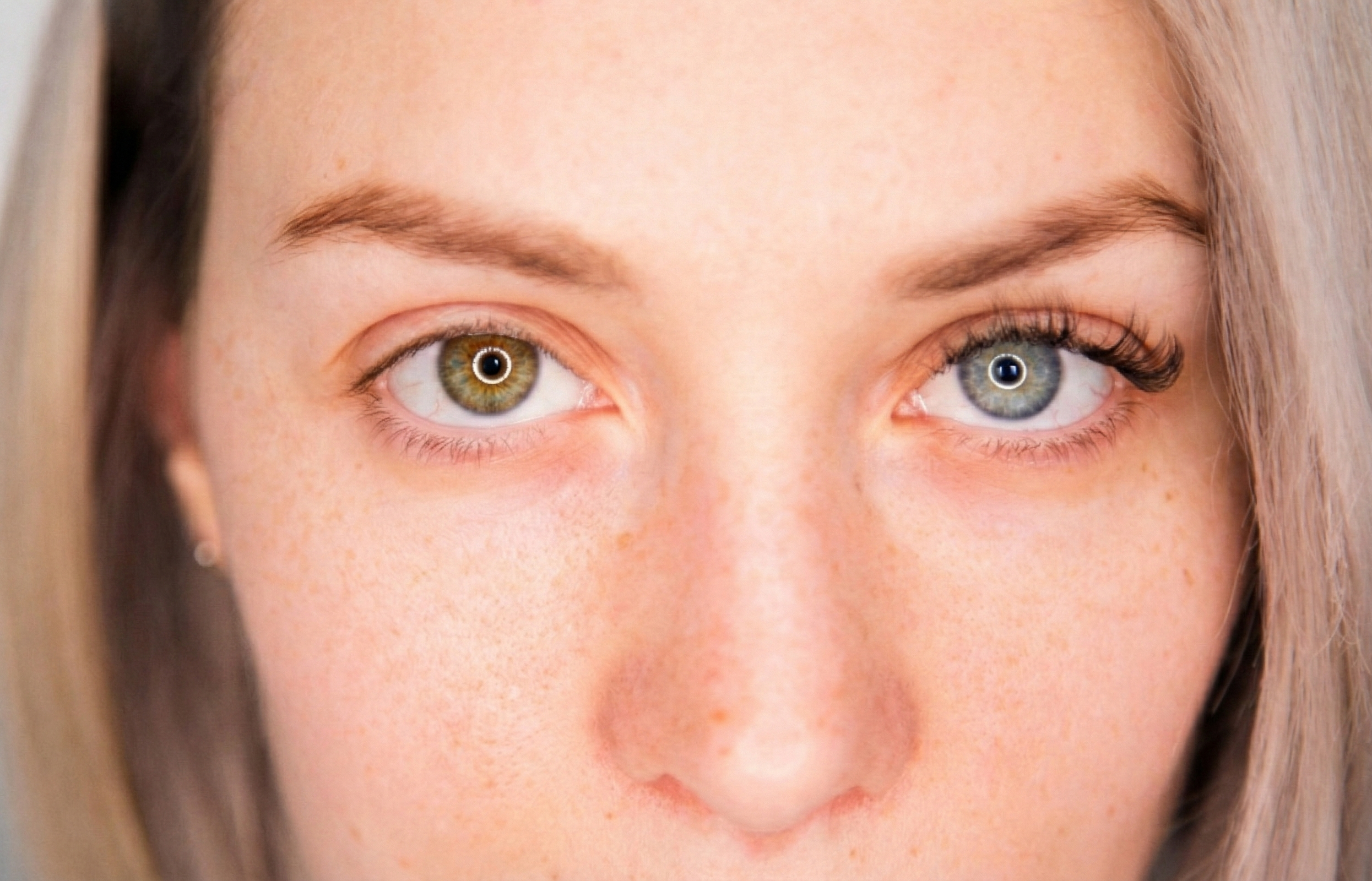
Twins share a unique bond, but for Taylor Muhl, that connection is woven into her very DNA in a way few medical professionals have ever seen.
For years, doctors dismissed the straight line dividing the pigmentation on her torso as a simple birthmark, ignoring the potential link to her chronic health issues. It wasn’t until adulthood that she discovered the startling truth behind her physical duality: she didn’t just have a sister; she absorbed her in the womb, becoming her own twin.
How One Person Can Have Two Sets of DNA

Taylor Muhl presents a fascinating medical reality because she technically exists as her own twin. During the earliest stages of fetal development, she absorbed her fraternal twin in the womb. This rare genetic condition is known as chimerism. Muhl specifically has tetragametic chimerism, a phenomenon that occurs when two separate eggs are fertilized by two separate sperm. Instead of developing into two distinct siblings, the zygotes fuse together to form a single human being.
This biological merger results in one person carrying two distinct genetic codes. Dr. Brocha Tarshish, a clinical geneticist at Nicklaus Children’s Hospital, explains that this fusion happens very early in embryonic development. Consequently, the individual retains two different cell lines. In Muhl’s case, she possesses her own DNA as well as the genetic makeup of her unborn sister.
While fraternal twins usually grow side by side, a chimera integrates the genetic material of the other. This means Muhl essentially functions with two separate immune systems and two bloodstreams within one body. Her body contains cells that match her own profile and cells that match her twin’s profile. This condition is often difficult to detect without specific biomedical tests, and many people live their entire lives without ever knowing they carry a second set of DNA. However, in cases like Muhl’s, the physical and internal manifestations are undeniable.
A Body of Two Halves
The most striking evidence of Muhl’s condition is a distinct coloration division on her torso. A straight line runs down the center of her stomach, separating two different skin pigmentations. The darker side manifests her twin sister’s genetic makeup. For most of her life, doctors dismissed this unique feature as a large birthmark. Muhl told People magazine, “I felt freedom [after the diagnosis] because for the first time in my life I knew why my stomach looks the way it does.”
This pigmentation is not static; the second color can become more or less prominent depending on her body temperature. Beyond the skin, the fusion created other physical asymmetries. Muhl possesses a double tooth on the left side of her mouth, and her body is slightly larger on the left side compared to the right.
While Muhl’s physical traits are pronounced, not all chimeras display such obvious external signs. Dr. Tarshish notes that without these visual cues, the condition is nearly impossible to detect without genetic testing. However, when physical traits do appear in others, they can include patches of different colored hair or distinct differences in eye color. Distinguishing these traits from standard birthmarks or heterochromia is often the first step toward a correct diagnosis.
Autoimmune Challenges and Sensitivities

While the physical traits of chimerism are intriguing, the internal implications can be physically taxing. Having two sets of DNA means possessing two distinct immune systems and bloodstreams. For Muhl, this results in a constant biological conflict. Her dominant immune system identifies her twin’s DNA as foreign matter and launches attacks against it. This perpetual internal defense mechanism compromises her overall immunity, leading to a host of autoimmune issues.
This cellular warfare manifests as severe allergies and sensitivities. Muhl’s body reacts aggressively to various stimuli, including specific foods, medications, and supplements. Testing revealed she was allergic to the vast majority of 150 different allergens, with shellfish causing life-threatening reactions.
The duality of her genetics even influences how her body handles external irritants. She reports that insect bites trigger different reactions on the left side of her body compared to the right. Similarly, her skin sensitivity varies by location; she can wear certain metals on the side dominated by her twin’s genetics that would cause a reaction on her own side. This condition requires constant vigilance, as her immune system remains in a suppressed state similar to patients undergoing treatment for serious illnesses, leaving her susceptible to illness and fatigue.
From Secrecy to Body Positivity
For years, the medical challenges of chimerism were compounded by the pressure to hide the condition. Working in the entertainment industry as a model and singer, Muhl feared that revealing her diagnosis would end her career. In a business driven by reliability and appearance, she worried that producers and investors would view her compromised immune system as a financial liability. Long shoots often requiring 14-hour days demand stamina, and she believed revealing her health struggles would lead to lost opportunities.
To protect her professional image, Muhl went to great lengths to conceal her physical traits. As a child, her mother ensured her torso was covered in public to prevent stares or questions. As an adult in the spotlight, this secrecy continued, forcing her to pretend her stomach looked like everyone else’s and that her health was perfect. The stress of maintaining this façade eventually became heavier than the risk of rejection.
Deciding to go public with her condition was a calculated risk that shifted her perspective. Muhl states that “coming out” as a chimera was liberating, removing the need to hide everyday struggles, such as why she wears hair extensions due to hair thinning from autoimmune issues. While the disclosure invited some negative commentary and judgment, it also connected her with a community of people who felt empowered by her body positivity. The decision transformed her condition from a closely guarded secret into a platform for awareness.
The Power of Owning Your Story
Going public didn’t just bring relief; it invited immediate scrutiny. After appearing on The Doctors, Muhl faced accusations that she was “faking” her condition simply because she appeared poised and comfortable on stage. Critics questioned how someone in the high-energy entertainment industry could truly suffer from a compromised immune system. This reaction highlights a pervasive stigma surrounding invisible illnesses: the assumption that if you look healthy or successful, you cannot possibly be sick.
Muhl also had to address misconceptions regarding her lineage. While her grandfather was a production VP at Universal Studios, rumors swirled that her career—and perhaps her medical care—was cushioned by family money. Muhl clarified that she received no financial handouts and built her career from the ground up. This distinction is vital to her message: illness does not discriminate based on background, and assuming otherwise invalidates the patient’s reality.
Muhl’s transparency serves a purpose larger than medical education. By exposing the physical traits she hid for decades, she challenges the rigid standards of perfection often found in media. Her torso, once a source of shame, is now a tool for advocacy. She reports receiving messages from people who say her confidence helps them feel beautiful in their own skin. Her experience offers a concrete takeaway for anyone hiding a part of themselves: the most powerful response to judgment is authentic self-acceptance. As Muhl proves, sharing your story doesn’t just free you—it gives others permission to do the same.
