
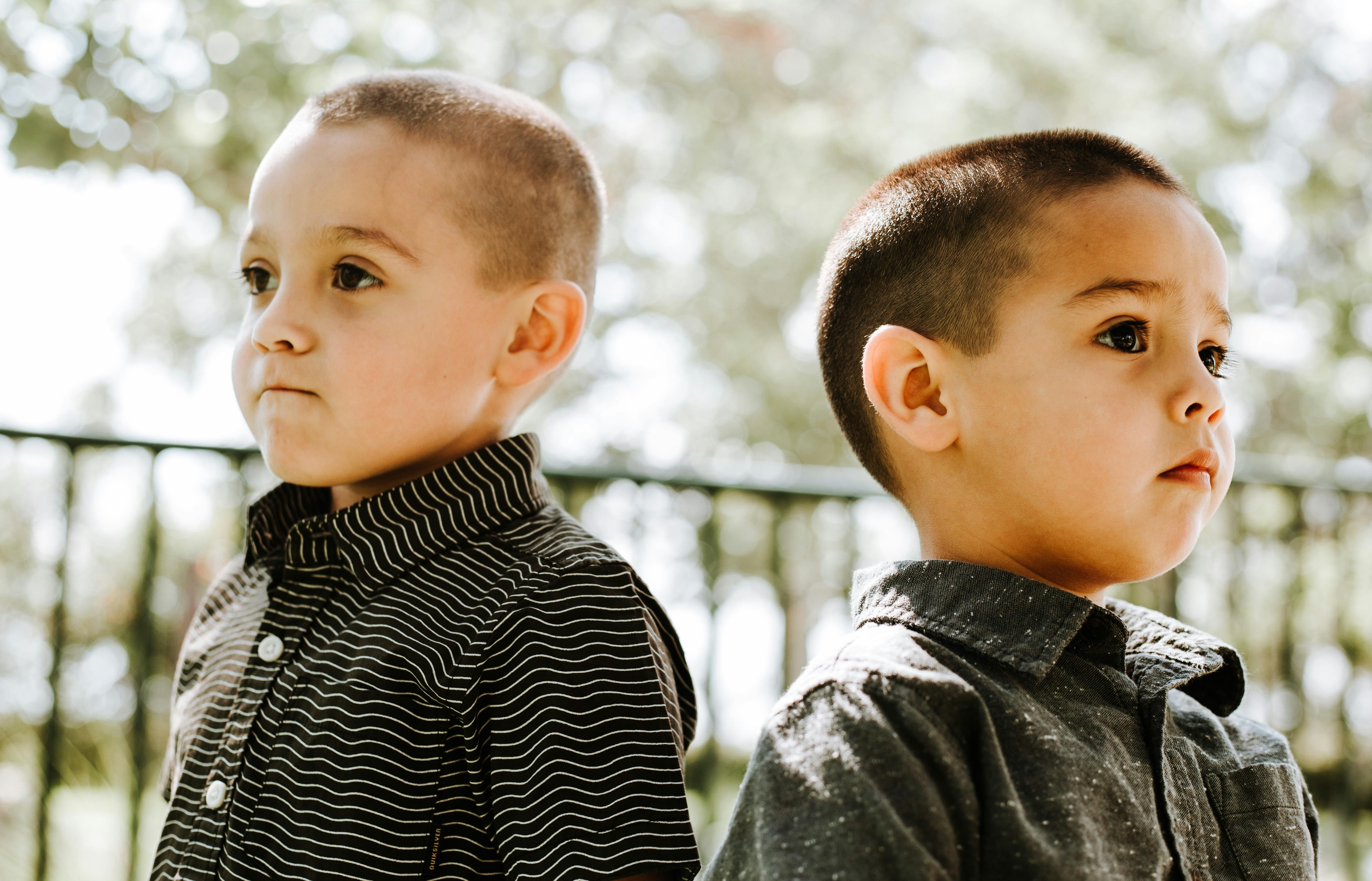
It is a common puzzle. At a family dinner, siblings recall a major childhood event. One remembers joy and security. The other remembers the exact same event as a time of anxiety and tension. This baffling divergence in memory and life outcomes is one of the most familiar paradoxes of human development.
We assume the “family environment” is a single force that should produce similar results. The evidence, however, overwhelmingly concludes that no two siblings ever experience the same childhood. The differences are not a matter of faulty memory; they are the predictable outcome of a complex developmental process.
Why No Two Siblings Have the Same Childhood

The foundational error is the premise of the “same house.” Clinicians and trauma experts are often the most direct in dismantling this assumption.
Dr. Gabor Maté, a physician and expert on trauma, states this clearly: “No siblings grow up in the same house. No siblings have the same parents. No siblings have the same family. No siblings have the same childhood.”
This is not an exaggeration. The physical house is a superficial variable. The true “environment” is the matrix of emotional, psychological, and relational experiences, which is unique to each child. Dr. Joan K. Peters, reflecting on her own life, came to the same conclusion, suggesting that “perhaps all siblings have different parents.”
The real question is not, “Why do siblings turn out differently?” The correct, science-based question is, “What forces create fundamentally different environments for each child within the same family?”
The “Different Parent” and “Different Child” Effect

The parent-child relationship is not a static monologue where a parent imprints the same nurture onto each child. It is a dynamic, responsive dialogue that changes for two main reasons: the parents are never the same, and the child is never the same.
Parents as a Variable, Not a Constant A person can change dramatically over the time it takes to raise a family. A child’s experience is a snapshot of their parents’ lives at a specific moment.
- Life Stage: A marriage, as Dr. Maté explains, has “ebbs and flows.” A child born during a “peak” of harmony and financial stability will have a different experience of their parents than a sibling born during a “valley” of conflict or uncertainty.
- Financial Status: This is a powerful, non-shared variable. Dr. Keneisha Sinclair-McBride, a clinical psychologist, notes, “Significant changes in family financial status can impact differences in extracurricular activities, schooling, vacations, and other material aspects of childhood between siblings.”
- Birth Order: Parents are, by definition, different for each child. “There is no way for a parent to relate to their first child the way they do their second,” Dr. Maté explains. The first child receives novice, anxious parents. The second receives experienced, but more divided, parents.
How Each Child Evokes a Different Response

A child is an active agent in their own development. It is impossible for a parent to “treat all their kids the same,” because they are not parenting the same child.
From birth, children display distinct personalities. Dr. Peters notes that parents “relate to different children differently… based on that child’s nature,” such as whether they are “fussy or calm, smiley or serious.” A fussy infant may evoke stress from a parent, while a calm infant may evoke feelings of competence and joy.
This is not about preferential love. As Dr. Maté says, “It’s not that I loved… any one of them more than the other, but we responded to them differently.”
The Science of the “Non-Shared Environment”

For decades, behavioral genetics has been grappling with this paradox. For most of the 20th century, it was assumed that the “shared environment”—parenting style, socioeconomic status, the neighborhood—was the force that made siblings similar.
The data failed to support this. Adoption studies, the clearest test, found that genetically unrelated siblings who share 100% of their family environment have almost no similarity. Researchers found that “for most psychological characteristics, correlations for adoptive ‘siblings’ hover near zero.”
This led to a paradigm shift. In 1987, researchers Robert Plomin and Denise Daniels published a foundational paper arguing that the environmental forces that actually shape personality are the ones that are not shared by siblings.
The “nurture” that matters is not doled out “family-by-family,” but “child-by-child.” This non-shared environment consists of the “unique experiences, interactions, and circumstances” that work to make siblings different. The research concludes that these forces “make two children in the same family as different from one another as are pairs of children selected randomly from the population.”
Key Forces That Create Different Childhoods

These non-shared environmental factors are delivered to each child through several key pathways.
- Differential Parental Treatment: Research by developmental psychologist Judy Dunn confirmed that parents show different levels of warmth, control, and affection to each child. More importantly, the perception of this differential treatment is what matters. A child’s environment is experienced relative to the treatment they see their sibling receiving.
- The Sibling Relationship: Dr. Dunn’s work identified the sibling relationship as “the first society.” In this separate world, children learn to “protect their territory, justify their actions, and negotiate deals.” This relationship, with its unique blend of conflict, envy, and support, is a powerful developmental force in itself.
- External Influences: As soon as a child leaves the home, their non-shared environment expands. This includes “differing friendships, personal experiences at school,” a “unique relationship with a specific teacher,” or encountering a bully.
- Chance Events and Perception: A single major event—a death, divorce, or illness—can split the family timeline. Dr. Joan K. Peters provides a powerful case study of her father’s death. Her older brother, who was seven, experienced his grieving parents as “overwhelming” and “leaning on” him. He needed to disconnect to survive. Dr. Peters, a toddler, experienced her parents as “elusive” and “vanishing.” She felt a “galactic loneliness” and needed to connect. They lived through the same event but in opposite emotional universes.
Reconciling Different Pasts
When siblings’ memories clash, the conflict is often not just about a simple disagreement; it can be a source of deep, lasting conflict. Each sibling fights to validate their own “truth.” This can feel invalidating to the other, as if their own reality is being questioned. The argument is often not just about “what happened,” but about “what was real.”
The research shows that all these truths can be real. The sibling who remembers a warm, supportive parent and the sibling who remembers a cold, distant parent are both describing a valid psychological reality. They simply experienced that parent at a different time, or with different needs, or through the lens of a different personality.

Understanding this is the key to reconciliation. It’s not about arguing over a single, objective “truth” that erases the other’s experience. It is about accepting the validity of each other’s subjective, non-shared experience. Dr. Peters found that true understanding with her brother only became possible “once the author and her brother accepted the differences between his parents and hers.” They had to accept that they literally had different parents, in every way that mattered psychologically. This act of acceptance was the key that unlocked a “more nuanced picture of their past.”
A Path Forward: One Question to Ask
The research points to a single, actionable principle: to understand your family, you must replace the myth of the “shared” experience with the reality of the “non-shared” one.
Instead of arguing about “what really happened,” the goal is to understand the experience of the event. The research provides a simple tool for this, articulated by Dr. Peters. The single most important question to ask is not, “Don’t you remember?”
The question is: “What were our parents like for you?”
This question validates the non-shared environment, honors the other person’s unique reality, and opens the door for compassionate exploration.
