
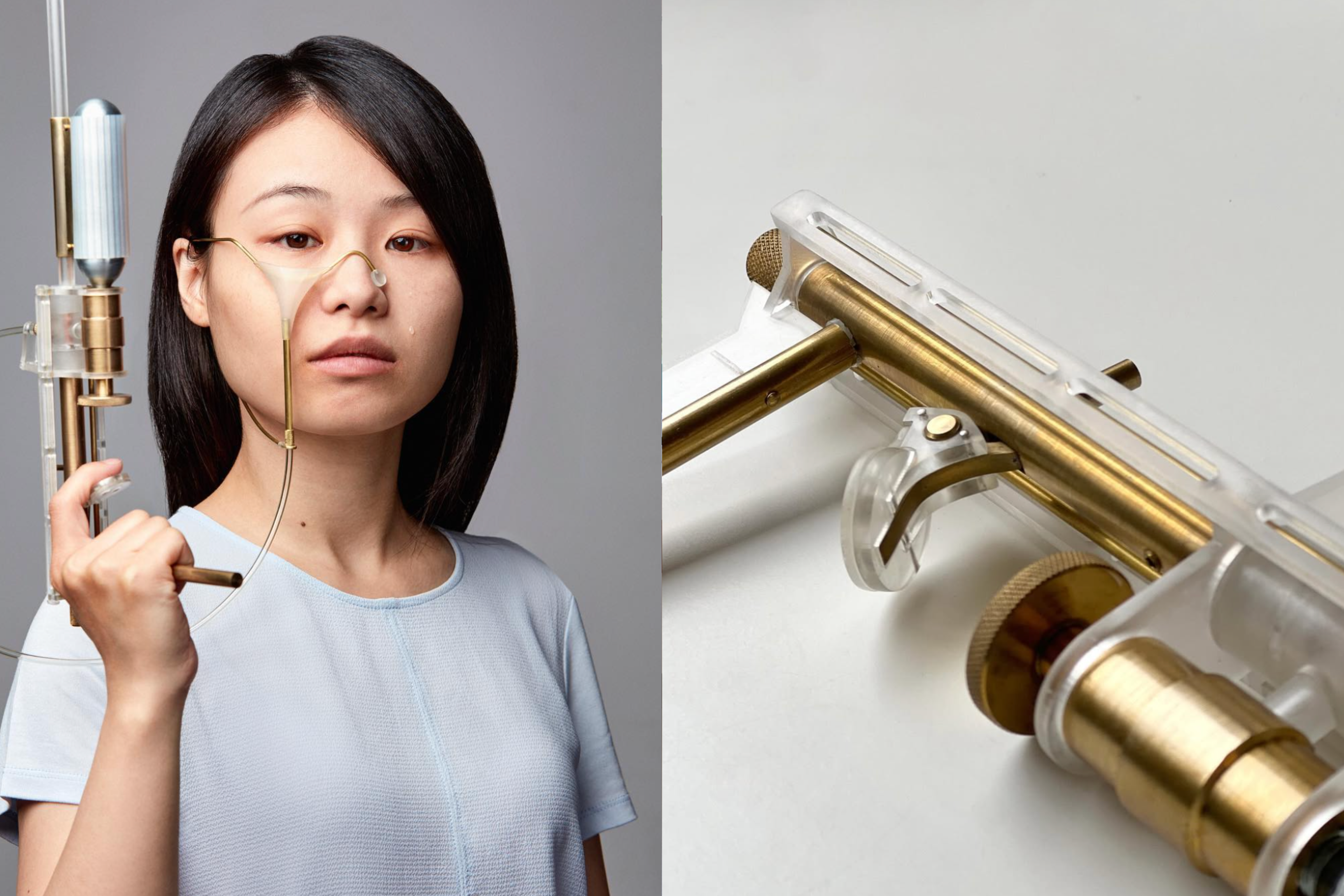
There are moments when emotions take over, and all the self-control we’ve learned seems to disappear. Crying is one of the body’s most natural responses to stress, frustration, or pain. For Yi-Fei Chen, a Taiwanese artist and designer, that emotional response became the starting point of an unusual creative experiment.

In 2016, during her time at the Design Academy Eindhoven in the Netherlands, Chen turned a difficult emotional experience into a tangible project she called the Tear Gun. The device collects her tears, freezes them, and allows them to be released as small frozen pellets. What began as an instinctive reaction to emotional distress soon evolved into a study of how people express and process difficult feelings which is an exploration of emotional release through art and design.
When Emotion Becomes Innovation
Strong emotions often push people toward self-reflection or change, but for Yi-Fei Chen, they led to invention. In an interview with AsiaOne, Chen shared that the idea for her creation began during her studies at the Design Academy Eindhoven in the Netherlands. After a disagreement with her mentor about a project, she felt herself losing composure and unexpectedly started to cry. “I felt very frustrated and angry, and I just burst into tears in front of my mentor,” she recalled.
Raised in Taiwan, Chen grew up in an environment where questioning authority was considered disrespectful. Like many students taught under traditional systems, she learned to suppress disagreement and maintain politeness, even when she felt misunderstood. “Even though I was crying, I still felt I couldn’t just leave during the conversation,” she said. The tension between wanting to speak up and needing to stay silent left her searching for another outlet.
What followed was not an act of rebellion but a process of understanding. Instead of dismissing her feelings, Chen decided to study them through her work. She began to imagine how emotions could be expressed in a physical form, leading to the concept of the Tear Gun. The device, designed to collect and freeze tears before releasing them as small projectiles, became her way of exploring emotional control and expression.
Developing the project helped Chen transform emotional distress into a creative process. She described the experience as a shift from reaction to reflection, turning frustration into focus. The result was more than a piece of conceptual art; it was a lesson in how emotional awareness can be a tool for clarity and purpose. For anyone navigating their own emotional responses, Chen’s story offers a reminder that understanding an emotion is often the first step toward mastering it.
The Design of Emotional Release
Understanding emotion often begins with learning how it moves through the body and mind. For Yi-Fei Chen, that understanding took shape through the Tear Gun, a device she created to transform her emotional experience into something observable and controlled. While it may sound complex, the mechanism itself follows a simple process. The device collects her tears and freezes them in about twenty seconds using carbon dioxide from a high-pressure bottle. Once frozen into small pellets, they can be released through a spring mechanism that propels them outward.
According to Chen, the project took three months to bring from concept to working prototype. The time and precision required reflected more than technical effort. It mirrored the gradual process of emotional regulation, where awareness and patience turn intense feelings into clarity. What began as a graduation project evolved into a practical expression of how emotion can be acknowledged rather than suppressed. In her AsiaOne interview, Chen shared her mentor’s unexpected reaction, saying, “He was quite happy with the result even though it was something [created] against him.”
Her mentor’s willingness to engage with the work became part of the lesson. During a live demonstration, he stood before Chen wearing protective gear as she symbolically released the frozen tears toward him in front of a classroom audience. The act was not about retaliation but about communication. It turned a moment of vulnerability into an open exchange between teacher and student.
This collaboration highlighted a key principle often seen in both art therapy and emotional healing: expression can lead to understanding. By externalizing her emotion through design, Chen found a way to process frustration without judgment. Her experiment illustrated that emotional health is not about control in the strict sense but about giving emotion space to move, whether through art, dialogue, or mindful observation.
The Psychology of Crying: What Science Says About Emotional Release
Crying is often viewed as a sign of weakness or loss of control, but research shows that it is one of the body’s most natural methods of emotional regulation. Scientists have long studied why humans cry and how tears influence both mood and physiology. Unlike reflex tears, which protect the eyes, emotional tears contain higher concentrations of stress hormones such as cortisol. Releasing these tears may help the body reset its internal balance after a period of heightened emotion.
Studies published in journals like Frontiers in Psychology and Cognition and Emotion suggest that crying can activate the parasympathetic nervous system, which supports relaxation and recovery. This helps explain why many people report feeling lighter or calmer after allowing themselves to cry. From a psychological perspective, crying can serve as a mechanism for self-soothing, communication, and emotional clarity. It allows difficult emotions to move through the body rather than remain unexpressed, reducing the risk of chronic stress or emotional fatigue.

In this context, Yi-Fei Chen’s creation, the Tear Gun, can be seen as an artistic reflection of what science already understands about emotional release. By giving her tears physical form, she turned an instinctive reaction into a study of self-regulation. Her project reminds us that expressing emotion is not a sign of instability but a step toward restoring equilibrium.
Modern psychology continues to emphasize the importance of emotional awareness in maintaining overall well-being. Allowing space for emotion, whether through crying, conversation, or creativity, can support both mental and physical health. Chen’s work illustrates this principle in a tangible way, encouraging people to acknowledge their feelings rather than suppress them. Emotional release, in any mindful form, is one of the body’s most accessible and effective forms of healing.
When Art Becomes a Global Dialogue on Emotion
When creativity is rooted in emotion, it often finds an audience beyond its original purpose. The Tear Gun, first developed by Yi-Fei Chen as a student project, soon captured the attention of the global design community. Its ability to merge psychology, art, and technology made it a point of discussion among designers and wellness thinkers alike. The project was exhibited at several major events, including Dutch Design Week 2016, 100 Years of Dutch Design at the Taiwan Design Museum, and the Temporary Art Centre Eindhoven in 2017.
For Chen, each exhibition was more than a professional milestone. It represented the evolution of an idea that began with emotion and matured through understanding. Over the following years, she continued refining the device to better represent that transformation. During the pandemic, she developed a third version of the Tear Gun that was larger and technically more advanced, with two carbon dioxide bottles that improved stability and freezing capacity.

While its appearance could suggest aggression, Chen has consistently clarified that her work was never about revenge or confrontation. In an Instagram Reel shared on October 9, she explained, “The tears are kind of a metaphor of yourself. You find a different angle, a different method to make yourself stronger or powerful. But in a way that keeps you who you are.” Her statement helped shift public perception, framing the device as an exploration of emotional awareness and personal strength rather than conflict.
By presenting the Tear Gun to audiences around the world, Chen opened a conversation about how emotion can fuel innovation. Her work demonstrates that emotional energy, when understood and directed with intention, can become a source of creativity and empowerment. It is a reminder that emotional expression, whether through art, dialogue, or self-reflection, plays a vital role in both personal growth and mental well-being.
The Power of Feeling Fully
Emotional strength is not measured by how well we suppress our feelings but by how consciously we face them. Yi-Fei Chen’s work reminds us that expression, when guided by awareness, can transform distress into understanding. Her creation, the Tear Gun, may appear unconventional, yet it symbolizes something deeply human: the need to give emotion a safe and honest outlet.

Science continues to show that holding back emotion can heighten stress and disrupt the body’s natural balance. Expression, on the other hand, allows the nervous system to recalibrate. Whether through crying, creativity, or conversation, the act of release brings clarity and calm. Chen’s story demonstrates that processing emotion is not only a personal act but also a biological one.
True well-being begins when we stop treating emotion as an interruption and start recognizing it as part of the body’s communication system. Every feeling carries information about what we need, what we value, and what requires care. Learning to acknowledge emotion with curiosity rather than judgment is not indulgence. It is healing.
Featured Image from @fei_studio_ on Instagram
