
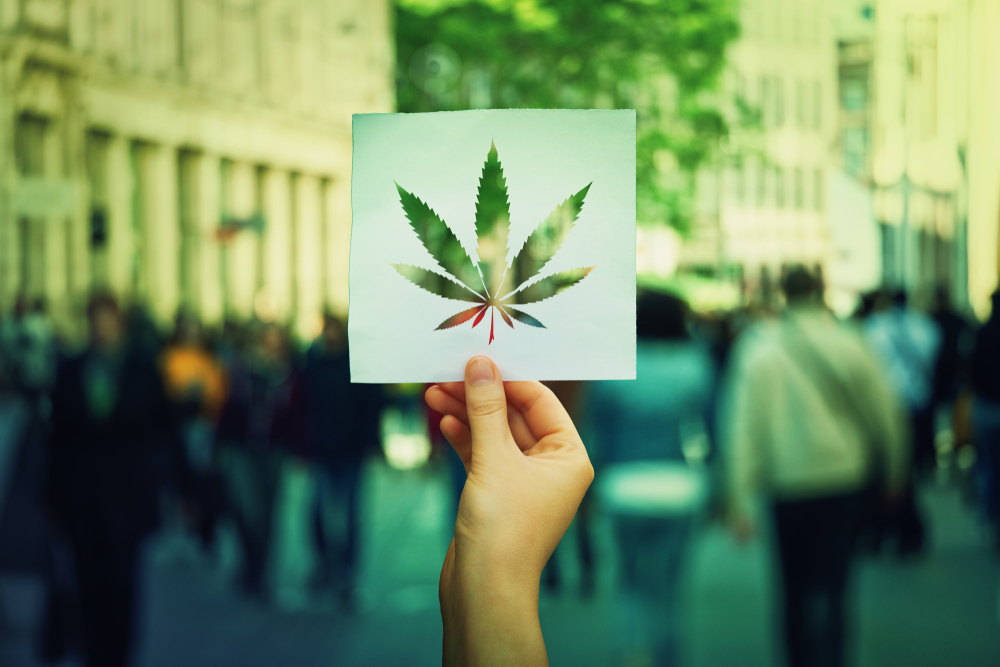
It’s been more than half a century since marijuana was locked into the same legal category as heroin condemned as dangerous, devoid of medical value, and banished from legitimate science. And yet, across much of America, cannabis dispensaries now stand on busy street corners, their neon signs glowing like coffee shops, serving customers with state-issued licenses and government-approved taxes.
Two countries, one border. In one, cannabis is an outlaw. In the other, it’s a booming industry worth billions.
Now, President Donald Trump says he’s “looking at” changing marijuana’s federal classification a move that could spark the biggest shift in U.S. drug policy in fifty years. The stakes are enormous. Nearly 70% of Americans support legalization, more than 64 million people have used marijuana in the past year, and forty states already allow it for medical purposes. Yet under federal law, those same businesses and patients are still branded as criminals.
So what happens if the federal government finally takes a step toward reconciling these two realities? And what would that mean for law, for business, and for the millions of Americans caught in the gap?
The Crossroads of Cannabis in America
America’s relationship with marijuana has always been a tale of contradictions. On one side, it’s a thriving, multi-billion-dollar industry employing hundreds of thousands, generating tax revenue for schools and infrastructure, and drawing tourists to cities from Denver to Las Vegas. On the other, it remains branded by federal law as a dangerous drug with “no accepted medical use,” a label unchanged since 1970.
This split reality has created a national patchwork: in some states, a cancer patient can walk into a licensed dispensary and buy cannabis products recommended by a doctor; in others, the same act could lead to arrest. Crossing a single state line can transform a legal purchase into a federal offense.
President Trump’s recent remarks have thrown this divide into sharper focus. His suggestion that the federal government might reclassify marijuana from Schedule I to a less restrictive category signals more than a policy tweak it’s a challenge to decades of entrenched thinking. It’s also a recognition that public sentiment has shifted dramatically: polls now show that nearly 7 in 10 Americans support legalization in some form.
The nation stands at a junction where science, economics, and cultural attitudes have outpaced federal policy. The question is no longer whether the country has changed, but whether its laws are willing or able to catch up.
The Federal Law as It Stands

Under U.S. federal law, marijuana sits in the most restrictive category of the Controlled Substances Act: Schedule I. This isn’t just a label it’s a legal barrier that carries real weight. Schedule I drugs are deemed to have a high potential for abuse, no accepted medical use, and no safe use under medical supervision. Alongside marijuana in this category are heroin, LSD, and MDMA.
The penalties are severe. Simple possession can result in fines and prison time. Selling or cultivating marijuana is considered a more serious offense, with sentences ranging from five years to life depending on the quantity. Even in states where cannabis is legal, these federal laws technically apply creating a constant undercurrent of legal risk.
For businesses, the consequences are even more tangled. Under Section 280E of the federal tax code, companies involved in “trafficking” Schedule I or II substances cannot deduct ordinary business expenses like rent, payroll, or marketing. Some cannabis operators end up with effective tax rates above 70%, making expansion and reinvestment far more difficult. Most banks avoid working with marijuana businesses altogether, fearing federal penalties, which forces many operators into risky, cash-only transactions.
Research faces its own obstacles. Studying a Schedule I drug requires special federal approval, a process so slow and restrictive that large-scale, definitive clinical trials on cannabis remain rare even after decades of widespread use. This has kept scientific understanding of marijuana’s full risks and benefits in a frustrating state of limbo.
The result is a nation living under two overlapping legal systems: one shaped by state reforms, where cannabis is regulated like alcohol, and another dictated by federal prohibition, where the same plant is treated as contraband. President Trump’s interest in reclassification is a signal that this legal tension between lawbooks and lived reality may finally be up for debate.
What Reclassification Could Mean (Schedule I → Schedule III)

Reclassifying marijuana from Schedule I to Schedule III would be the most significant shift in federal cannabis policy in over fifty years. It would not make recreational marijuana legal nationwide but it would formally acknowledge that cannabis has accepted medical uses and a lower potential for abuse than substances like heroin or LSD.
Medical Recognition
Under Schedule III, doctors could prescribe cannabis for approved medical uses, and licensed pharmacies could dispense it under regulated conditions. This change would give cannabis a place in the same legal framework as medications like ketamine or certain anabolic steroids. Patients in restrictive states might see expanded, safer access to cannabis-based treatments, backed by quality controls and medical oversight.
Tax Relief for Businesses
Cannabis companies would no longer be subject to Section 280E’s punishing tax rules. They could deduct normal business expenses from rent and payroll to marketing just like any other legal industry. This would free up substantial capital, potentially fueling expansion, job creation, and innovation.
Expanded Research Opportunities
Schedule I classification has long been a roadblock for cannabis research, making federally approved clinical trials cumbersome and rare. Moving to Schedule III would open doors for large-scale studies into the plant’s therapeutic potential, side effects, and safety profile giving doctors, patients, and policymakers better data to work with.
Potential Shifts in Banking and Investment
While a change in scheduling alone may not automatically remove all banking restrictions, federal recognition of cannabis as a legitimate medicine could encourage more financial institutions to offer services. This could ease the cash-heavy nature of the cannabis business, improve security, and attract institutional investors who have so far stayed away due to legal risks.
The Limits
Reclassification is not legalization. Recreational use would remain illegal under federal law, interstate cannabis commerce would still be prohibited, and the Drug Enforcement Administration would continue to oversee strict registration and reporting much like how pharmacies handle controlled medications. International treaties, such as the 1961 Single Convention on Narcotic Drugs, could also limit how far the U.S. can go without broader reform.
Economic, Social, and Political Ripple Effects

The effects of moving marijuana to Schedule III would ripple far beyond courtrooms and government agencies touching wallets, communities, and political strategies across the country.
The immediate financial winners would be cannabis businesses. Free from Section 280E’s tax stranglehold, companies could reinvest in growth, hire more employees, and upgrade operations. Analysts estimate that removing this tax burden could release hundreds of millions of dollars back into the legal cannabis market. For small dispensaries barely breaking even, that difference could mean survival instead of closure.
Banking access could improve as well. While not guaranteed, the perception shift from “illicit drug” to “regulated medicine” might entice more banks and credit unions to open their doors to cannabis clients. This could reduce risky cash-only transactions, attract mainstream investors, and fuel mergers or expansions.
Reclassification would send a clear message: the federal government recognizes marijuana’s medical value. This could encourage more physicians to consider cannabis as part of treatment plans, especially in states with restrictive laws. Patients might gain safer, more consistent access to tested products instead of relying on unregulated sources.
On the justice front, while the change wouldn’t automatically erase criminal penalties for recreational use, it could undermine the rationale for harsh enforcement possibly influencing future reforms or clemency decisions. Advocates also see potential for improved public education and harm reduction, as cannabis enters a more regulated and medically guided space.
For President Trump, publicly considering reclassification positions him in a politically strategic middle ground. He can acknowledge broad public support nearly 70% of Americans favor legalization in some form without endorsing full recreational legalization that some conservative voters oppose.
This move also intersects with state-versus-federal tensions. States with established cannabis markets could see federal reclassification as validation of their policies, while others might use the continued federal prohibition of recreational use as justification for stricter control. In Congress, the shift could reinvigorate debates on broader reform bills, from safe banking measures to outright legalization.
Public Opinion and State-Level Momentum

While Washington debates reclassification, much of the country has already moved on. Forty states and the District of Columbia now allow medical marijuana use, and 24 states plus D.C. permit recreational use for adults. In these places, cannabis has become a normalized part of daily life regulated, taxed, and integrated into local economies.
The past decade has seen a rapid wave of legalization, but not without setbacks. Ballot measures to legalize recreational marijuana failed in Florida, North Dakota, and South Dakota in recent years. In Florida’s case, a majority of voters supported legalization, yet the measure fell short of the 60% threshold needed for a constitutional amendment. Idaho lawmakers have even proposed a constitutional change that would prevent citizen-led marijuana legalization efforts, leaving such decisions solely to the legislature.
Despite these hurdles, public sentiment remains firmly in favor of change. Gallup polling shows support for marijuana legalization has risen from 36% in 2005 to 68% in 2024. A Pew Research Center study found that nearly 9 in 10 Americans believe marijuana should be legal for either medical or recreational use. Data from the Substance Abuse and Mental Health Services Administration indicates that more than 64 million Americans aged 12 and older used marijuana in the past year up from 19% of the population in 2021 to 22.3% in 2024. Adults aged 26 and older drove much of that increase, though young adults between 18 and 25 remain the most likely users.
A Turning Point in Policy and Perspective
Marijuana’s federal status has never just been about the plant itself. It’s been about who we trust to define truth, how we weigh risk against freedom, and whether our laws can evolve alongside our understanding. For over fifty years, the Schedule I label has stood like a locked door, keeping science, commerce, and even compassion on the other side.
Reclassification to Schedule III wouldn’t fling that door wide open. Recreational use would still be illegal at the federal level. State markets would remain fragmented. Many of the banking, justice, and regulatory hurdles would endure. But the symbolism would be powerful: a formal acknowledgment that marijuana has medical value, that research should not be shackled by outdated assumptions, and that policy should reflect reality, not resist it.
This is about more than cannabis it’s about how a nation chooses to grow. Public opinion has moved, states have acted, and science is ready to step forward. Now the question is whether federal law will take even a single step to catch up.
We often measure progress in grand gestures, but sometimes it starts with a single reclassification a signal that change is not only possible, but already underway. And in that shift lies a deeper choice for America: to cling to the comfort of the past, or to build laws that reflect the world as it is and the future we want to create.
