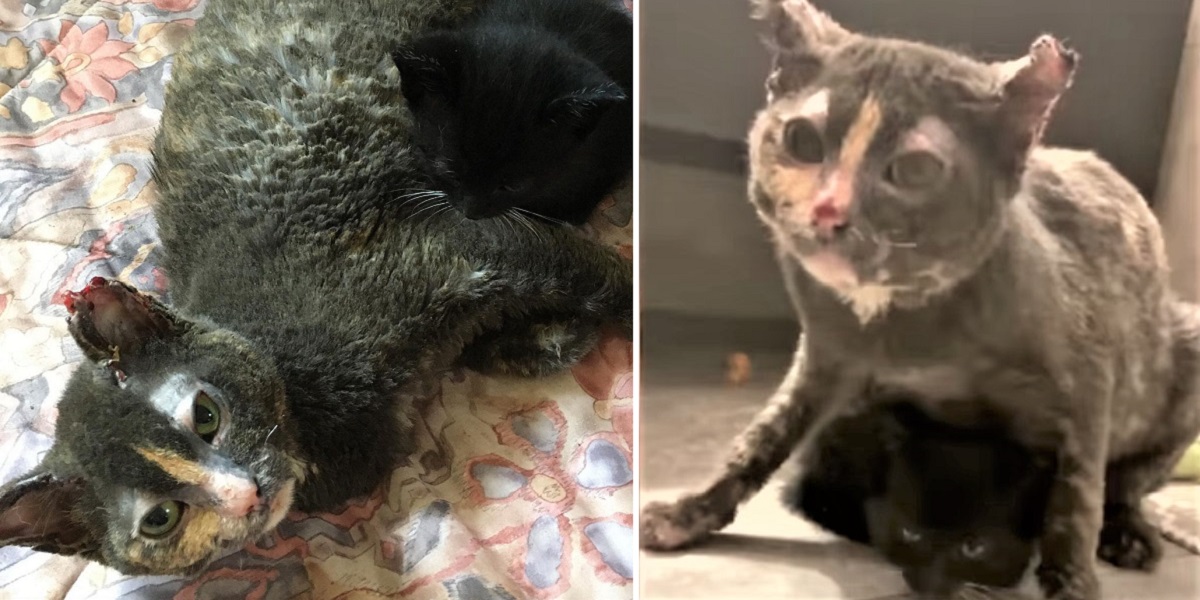
In 1996, a small apartment building in Brooklyn, New York, caught fire. Among the chaos, smoke, and sirens, a stray cat named Scarlett did something that would leave the world speechless. As the flames raged, she ran into the burning building not once, but five separate times, each time carrying one of her tiny kittens out to safety. Witnesses later described her as severely burned, her fur singed and eyes swollen shut, but her focus never wavered. She gently touched each kitten with her nose, one by one, to ensure they were all alive. Only then did she collapse from exhaustion.
Scarlett’s act of courage soon spread around the world, inspiring countless people and reminding humanity of the depth of love that exists even among animals. Firefighters and shelter workers who found her were deeply moved by her determination. Despite her own life being in danger, Scarlett’s instinct to protect her kittens was stronger than fear or pain. Her story has since been shared in books, documentaries, and animal welfare campaigns as a symbol of motherly devotion and bravery.
This moment of self-sacrifice defied logic and survival instinct, showing a kind of emotional awareness that many once believed only humans could possess. Scarlett’s actions made people question just how far an animal’s maternal bond can go. Her story remains one of the most powerful examples of maternal love in the animal world.

The Unimaginable Pain and the Price of Courage
Scarlett’s injuries were extensive. Her ears were badly burned, her eyes swollen shut, and her paws scorched. Much of her fur was singed, and the heat had caused severe damage to her skin. Yet, even while enduring unimaginable pain, her first concern remained her kittens. Firefighters described how she continued to nuzzle and count them despite barely being able to stand. All five kittens survived, though one later passed away from complications related to the smoke.
After her rescue, Scarlett and her kittens were taken to the North Shore Animal League, where veterinarians worked tirelessly to treat their burns and infections. Over time, Scarlett recovered, though her scars remained visible for life. Her story spread across the globe, and she became a symbol of love, courage, and resilience. Thousands of people wrote letters and sent donations, expressing gratitude for her bravery and concern for her well-being.
Scarlett’s recovery was a long and painful process, but she ultimately found a forever home where she lived peacefully for the rest of her life. Her kittens were adopted into loving families as well. Her story became a testament to how compassion transcends species and circumstances. It is a reminder that love, pure, protective, and selfless, is one of nature’s most powerful forces.
Why Animals Risk Everything for Their Young
The biological basis of Scarlett’s behavior lies in maternal instinct, a deeply ingrained drive shared across the animal kingdom. This instinct ensures the survival of offspring and, by extension, the species itself. When a mother senses her young are in danger, the body triggers a surge of stress hormones such as adrenaline and cortisol, which heighten alertness and override fear. In mammals, this is often coupled with the release of oxytocin, a hormone associated with bonding and caregiving, which strengthens the emotional attachment between mother and offspring.
Researchers have found that mother animals often exhibit extraordinary bravery when their offspring are threatened. For instance, elephant mothers form protective circles around their calves when predators approach, dolphins will physically lift injured young to the surface to breathe, and birds risk their lives to lure predators away from their nests. These behaviors are not calculated decisions but instinctual reactions rooted in both biology and emotion.
In Scarlett’s case, her repeated runs into the fire were likely driven by a mix of hormonal cues and the deep emotional attachment she felt toward her kittens. While science can explain the mechanisms behind this behavior, it cannot fully capture the emotional dimension that humans perceive in such acts. What Scarlett demonstrated was not just instinct but empathy, a profound awareness that her babies needed her help, no matter the cost.
This story also highlights how maternal instincts can blur the boundary between emotion and survival, showing that love is one of the most powerful motivators in all of nature. Her behavior stands as a reflection of both biological design and emotional depth, uniting science and sentiment in a single, extraordinary act.

Maternal Behavior Across Species
The courage seen in Scarlett is mirrored in many other species. In the animal world, motherhood often requires acts of extraordinary bravery. Penguins endure freezing temperatures and weeks of fasting to incubate their eggs. Wolves form tight-knit packs where mothers rely on communal care, with other females helping to feed and protect pups. Even insects show versions of maternal sacrifice, some species of spiders allow their offspring to feed on their own bodies to ensure survival.
Among mammals, maternal behavior varies greatly but always serves the same purpose, protecting and nurturing the next generation. Primates, for example, exhibit a level of emotional bonding similar to humans. Studies of chimpanzees and bonobos have shown that mothers will grieve the loss of their infants and carry them for days after death. In human terms, this mirrors the grief and attachment that mothers feel across cultures.
Such patterns suggest that the capacity for maternal care is not just a learned behavior but an evolutionary constant. From cats and dogs to humans and whales, the instinct to protect one’s young is hardwired into the brain. This universality of maternal love connects all living creatures through a shared biological and emotional thread, the desire to nurture and protect life.
Research in evolutionary biology further supports this idea by showing how maternal behaviors evolve to fit specific environments and survival needs. For instance, kangaroos keep their underdeveloped joeys safe in pouches until they are ready to face the world, while polar bears rely on months of fasting to nurture their cubs through harsh winters. Across all these examples, the same underlying drive remains constant, illustrating that the instinct to safeguard the next generation is one of nature’s most enduring truths.
The Hormones of Love and Sacrifice
Behind these heartwarming acts of protection are powerful hormonal and neurological mechanisms. Oxytocin, often called the love hormone, plays a central role in mother-infant bonding. It is released during childbirth and breastfeeding, helping mothers form a strong emotional connection with their offspring. This same hormone has been linked to increased empathy, reduced fear, and heightened trust, factors that encourage selfless behavior in moments of crisis.
In addition, the hypothalamus and amygdala, two regions of the brain responsible for emotional processing and decision-making, are highly active in mothers during caregiving situations. These areas help regulate responses to danger, prioritizing the safety of offspring even over self-preservation. Scientists believe this is why many mothers, human or animal, can act with astonishing courage when their young are in peril.

In Scarlett’s case, her brain and body were likely flooded with these powerful biological signals. While humans may interpret her behavior as heroic, to her it was a natural extension of love and duty, a biological imperative guided by deep emotional connection. Her instinctual drive also demonstrates how closely intertwined emotion and biology can be, blurring the lines between science and the heart. It shows that even in the animal kingdom, the chemistry of care can create actions that mirror the deepest forms of human love.
How This Story Reflects the Healing Power of Connection
Scarlett’s story touches people not only because it is rare, but because it mirrors something universal within us. The same instincts that drive a mother cat to risk her life for her kittens also shape human compassion and empathy. Studies in psychology have shown that witnessing acts of altruism or sacrifice can trigger emotional responses in the brain that encourage kindness and prosocial behavior. Scarlett’s bravery therefore not only saved her kittens but also ignited compassion in millions who heard her story.
This connection between human and animal emotions highlights how deeply intertwined we are with nature. Our capacity to feel empathy toward animals is rooted in shared biological pathways and emotional expressions. When we see love and sacrifice in another species, it resonates because it reflects our own humanity back to us.
Beyond the emotional response, Scarlett’s story also underscores the healing power of love and attachment. Her determination and the public’s reaction remind us that caring deeply for others, whether human or animal, is a vital part of well-being. It shows that empathy can bridge the gap between species and inspire people to act with greater compassion in their own lives.

A Lesson from the Heart
Scarlett’s act of courage continues to be remembered decades later because it represents something timeless, the instinct to protect, nurture, and love. Her story teaches us that heroism is not limited to humans, and that compassion is a universal language understood by all living beings. When she pressed her burned face against each kitten to make sure they were alive, she embodied the purest form of love, one that transcends fear, pain, and even species.
In a world where compassion sometimes feels scarce, Scarlett’s story reminds us that love is the most powerful force of all. Whether it takes the form of a cat braving fire, a mother shielding her child, or a stranger lending a helping hand, the instinct to care for others is what keeps life moving forward. This small cat’s immense courage serves as a symbol of what it means to love unconditionally.
Scarlett’s journey also continues to inspire animal welfare efforts worldwide. Shelters and rescue organizations often share her story to remind people of the strength and emotion animals are capable of. Her legacy lives on through countless acts of kindness toward abandoned or injured animals, proving that one act of love can ripple outward and create lasting change in the hearts of many.
Featured Image Credit: Scarlett the cat | Facebook