
Drought across Europe has not only dried up crops and challenged communities, it has also exposed relics that were hidden for centuries beneath rivers and reservoirs. Ancient stone monuments, abandoned villages, and famine warnings carved into rock have reappeared as water levels dropped.
These discoveries are not just archaeological events. They are reminders arriving at a time when climate change is accelerating and altering the stability of ecosystems worldwide. The question they raise is urgent: what does it mean when history resurfaces only as nature shows signs of crisis?

Spain’s “Stonehenge” Resurfaces After Decades Underwater
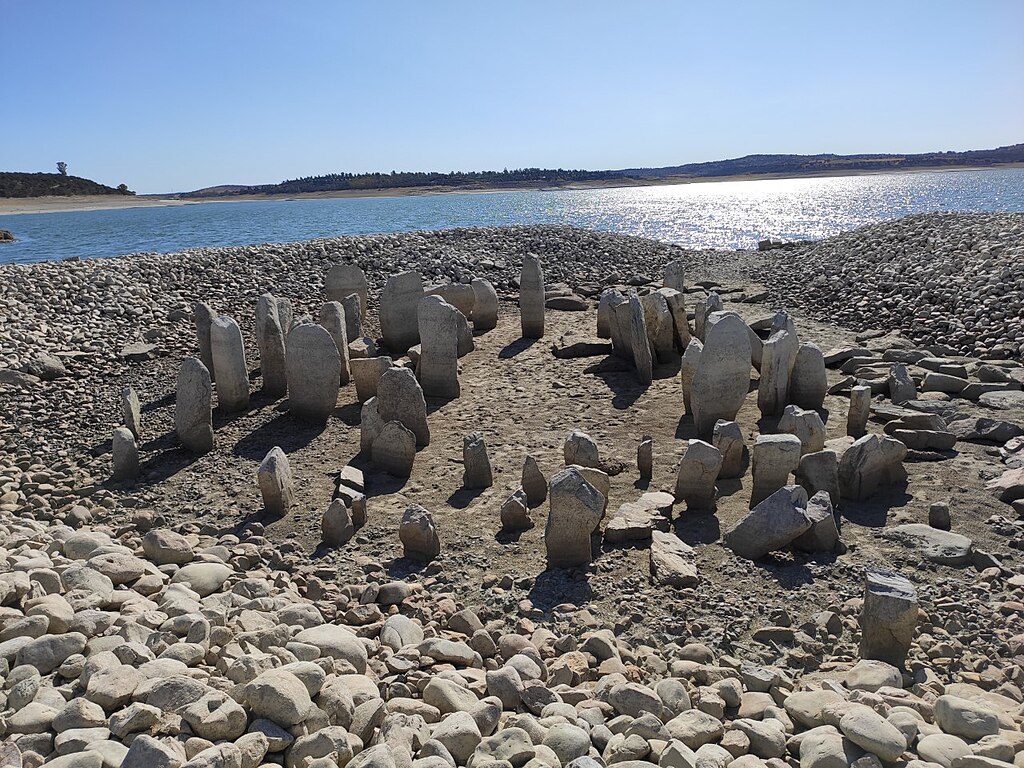
Hidden beneath the Valdecañas Reservoir in western Spain lies one of Europe’s oldest monuments—the Dolmen of Guadalperal, also called the “Spanish Stonehenge.” This stone circle, made up of more than 100 granite slabs arranged in a 26-meter ring, is estimated to be between 4,000 and 7,000 years old. Archaeologists believe it once served as a temple, a burial site, and possibly even a trading hub along the Tagus River.
The site was excavated in the 1920s by German archaeologist Hugo Obermaier, but his findings were not published until the 1960s. Just a few years later, in 1963, the Spanish government created the Valdecañas Reservoir to supply water and electricity, which left the dolmen submerged. For decades, only the tallest stones occasionally broke through the surface during summer droughts.
That changed in 2019 and again in 2022, when severe droughts caused the water level to drop enough for the entire structure to emerge. NASA’s Landsat 8 satellite captured striking images of the exposed monument in 2019, and in 2022 archaeologists returned to document what one called “a rare opportunity to be able to access it.”
The exposure also raised urgent concerns. After decades underwater, the stones are cracking, eroding, and in some cases collapsing. Tourists visiting in 2019 made the problem worse by touching and leaning on the megaliths. Local residents launched a petition, signed by tens of thousands of people, calling for the monument to be moved to safer ground to prevent further damage.
Drought Reveals Europe’s Hidden Relics
Spain’s Stonehenge is not the only site uncovered by falling water levels. Across Europe, rivers and reservoirs have exposed reminders of the past—each with its own story of disruption and survival.
Galicia’s Ghost Village
In early 2022, Spain’s Alto Lindoso reservoir on the border with Portugal dropped to about 15 percent of its capacity. The falling water uncovered the abandoned village of Aceredo. Visitors walked streets lined with door frames, a fountain, and remnants of daily life, briefly visible before being submerged again.
Rome’s Tiber River
Italy faced its worst drought in seventy years, lowering the Tiber River enough to expose the piers of a first-century bridge linked to Emperor Nero near the Vatican. Normally invisible beneath the surface, two piers remained in view for much of the summer. As historian Anthony Majanlahti explained, “Because the water level of the river is so low now due to widespread drought across Italy, we’re able to see a lot more of the piers of the bridge that we usually could.”
Po River, Northern Italy
The same drought lowered the Po River, Italy’s longest waterway, exposing a 450-kilogram World War II bomb near Borgo Virgilio. The Italian army evacuated about 3,000 residents before carrying out a controlled explosion. “The bomb was found by fishermen on the bank of the River Po due to a decrease in water levels caused by drought,” said Colonel Marco Nasi.
Hunger Stones on Central European Rivers
In Central Europe, centuries-old “hunger stones” reappeared along the Elbe River. These markers, carved during past droughts, warned future generations about the hardship of low water. One stone near Děčín carries a stark message: “When you see me, cry.”
The Science Behind Disappearing Waters
When reservoirs and rivers shrink, it’s more than a visual spectacle. The changes point to specific weather patterns, climate trends, and shifts in water systems that scientists have been monitoring for years.
Heat as the Trigger
The event that brought Spain’s dolmen back into full view in 2019 followed a well-known pattern: hot, dry air moving north. According to NASA, “the 2019 heatwave got its start in late June, when warm air masses from the Sahara first hit Spain and then spread to Central Europe.” Persistent high-pressure systems locked the heat in place, driving evaporation and lowering water levels.
From Weather to Climate
That same year, the World Meteorological Organization noted: “An unusually early and intense heatwave has set new temperature records in Europe, posing a major threat to people’s health, agriculture and the environment.” The WMO also pointed out that heatwaves like this are consistent with the projections of more frequent and intense events in a warming world.
Why Rivers and Reservoirs Drop
Drought is often the result of a chain reaction. Lower rainfall and snow reduce water supplies, while hotter summers increase evaporation and demand. The European Commission’s Joint Research Centre observed this clearly in 2022: “The severe drought… has been further expanding and worsening,” with repeated heatwaves pushing river discharges across the continent to historic lows.

The Scale of Change
Independent assessments confirm the trend. The State of the Climate in Europe 2022 report highlighted widespread drought, below-average rainfall, and confirmed Europe as “the fastest-warming” WMO region. That summer was also the warmest on record for many countries.
What Satellites Show Us
NASA’s GRACE and GRACE-FO satellites, which measure the weight of water stored on land, reveal how widespread these shifts are. As NASA hydrologist Matt Rodell explained, “Global warming is going to cause more intense droughts and wet periods, which affects people, the economy, and agriculture around the world.”
Europe’s drying rivers are not isolated incidents. They are the result of overlapping forces: weather events like Saharan heatwaves, long-term climate change increasing the odds of extreme heat, and water systems pushed beyond balance. Together, these factors are reshaping landscapes, exposing hidden relics, and underscoring the urgency of climate adaptation.
Protecting Fragile Discoveries
When ancient sites reappear, they often face more danger than protection. At the Dolmen of Guadalperal, NASA reported that the granite stones are porous and already cracking, eroding, and in some cases collapsing after decades underwater. The situation worsened when tourists visited during drought periods, touching and leaning against the stones and accelerating their decline. In other parts of Europe, drought has revealed different risks—such as a 450-kilogram World War II bomb uncovered in Italy’s Po River, which forced the evacuation of thousands of residents before the army could safely detonate it.
Global organizations have warned that these events are becoming more common. UNESCO has identified climate change as one of the greatest threats to World Heritage sites. ICOMOS and ICCROM emphasize that the first priority in such situations should be rapid documentation and careful recovery, ensuring that well-meaning emergency measures do not cause further damage.

Current preservation strategies focus on detailed recording through drone photogrammetry, laser scanning, and close-range imaging. In cases where structures risk collapse, temporary stabilization such as bracing may be applied until full conservation plans are developed. Authorities are also encouraged to enforce access controls to prevent contact with fragile remains and to protect visitors from hazards like unstable debris or unexploded ordnance.
Spain’s decision in 2022 to declare the Dolmen of Guadalperal a Bien de Interés Cultural reflects how legal frameworks can strengthen protections and unlock resources for preservation. Even so, fluctuating water levels mean that many of these sites may vanish again before documentation is complete. The urgency is clear: act quickly, proceed cautiously, and align preservation with international best practices to safeguard what drought unexpectedly reveals.
Drought as a Reminder of Health and Survival
The resurfacing of ancient relics is not just about history—it highlights how human survival has always been tied to the environment. Centuries ago, people carved “hunger stones” into riverbeds during severe droughts. These markers were warnings of famine, carved at a time when failed harvests meant hunger, disease, and loss of life. They are some of the earliest records showing how environmental stress directly shaped human health.
The same connection exists today. Modern droughts reduce the availability of clean water, which is essential not just for drinking but also for hygiene and disease prevention. When water supplies fall, sanitation suffers, increasing the risk of outbreaks. At the same time, heatwaves put strain on the body, raising the risk of dehydration, kidney problems, and cardiovascular events. The World Health Organization has warned that extreme heat and water scarcity are among the most immediate health threats linked to climate change, affecting millions worldwide each year.

Food systems are also vulnerable. When reservoirs dry up and rainfall is limited, crop yields decline. Reduced harvests mean higher food prices and, in some areas, outright shortages. This leads to malnutrition, especially in children and older adults who are more sensitive to changes in food supply. These pressures do not only affect physical health—they also contribute to anxiety, depression, and other mental health challenges in communities facing long-term uncertainty.
What these resurfacing sites remind us is that health and environment cannot be separated. Ancient villagers who carved warnings into stone understood that survival depended on respecting natural cycles. Today, the lesson is the same. Protecting rivers, conserving water, and reducing greenhouse gas emissions are not abstract environmental goals—they are direct investments in public health. Wellness extends beyond the individual. It is about maintaining the stability of the ecosystems that allow communities to thrive.
Practical Tips for Staying Healthy During Drought and Extreme Heat
When water becomes scarce and temperatures rise, health risks increase. These simple but effective steps can help protect your wellbeing and support your community:
- Stay hydrated consistently. Drink water throughout the day, even if you don’t feel thirsty. Avoid relying on sugary or caffeinated drinks, which can worsen dehydration.
- Recognize early signs of heat stress. Watch for dizziness, nausea, rapid heartbeat, or unusual fatigue. These are signals to cool down, rest, and rehydrate before symptoms escalate.
- Adapt your daily routine. Limit outdoor activities during peak heat hours, usually between 10 a.m. and 4 p.m. If you must go out, wear light clothing, a hat, and sunscreen.
- Use water wisely. Conserve water at home by fixing leaks, turning off taps while brushing, and using collected rainwater when possible. Small steps protect both health and community resources.
- Support local food choices. Buying seasonal and locally grown produce reduces the pressure on water-stressed agricultural systems and helps maintain food security in your area.
- Stay informed. Follow health and weather advisories from local authorities. Alerts about water quality, heatwaves, or drought conditions can help you take timely action.
- Check on vulnerable groups. Older adults, children, and people with chronic health conditions are more at risk during drought and extreme heat. A simple check-in can make a big difference.
By treating water as a shared resource and making small but intentional lifestyle adjustments, you can reduce risks for yourself and support the wellbeing of your wider community.
Caring for the Past, Protecting Our Future
The droughts that have revealed ancient stones, ghost villages, and warning markers remind us that human history has always been linked to the stability of the environment. What resurfaces is not only archaeological evidence but also a warning about how fragile health and survival can be when natural systems are disrupted.

The same conditions that uncover relics also put communities at risk today—through water shortages, food insecurity, and rising heat-related illness. These discoveries highlight an essential truth: preserving cultural memory and protecting human health depend on the same choices. Responsible water use, sustainable energy, and climate-conscious policies are not separate from wellness; they are the foundation of it.
As these ancient sites appear and disappear with the water levels, they call for more than curiosity. They call for action. Protecting the Earth’s resources is inseparable from protecting ourselves and the generations that will follow.
Featured Image from Pleonr, CC BY-SA 4.0, via Wikimedia Commons


