
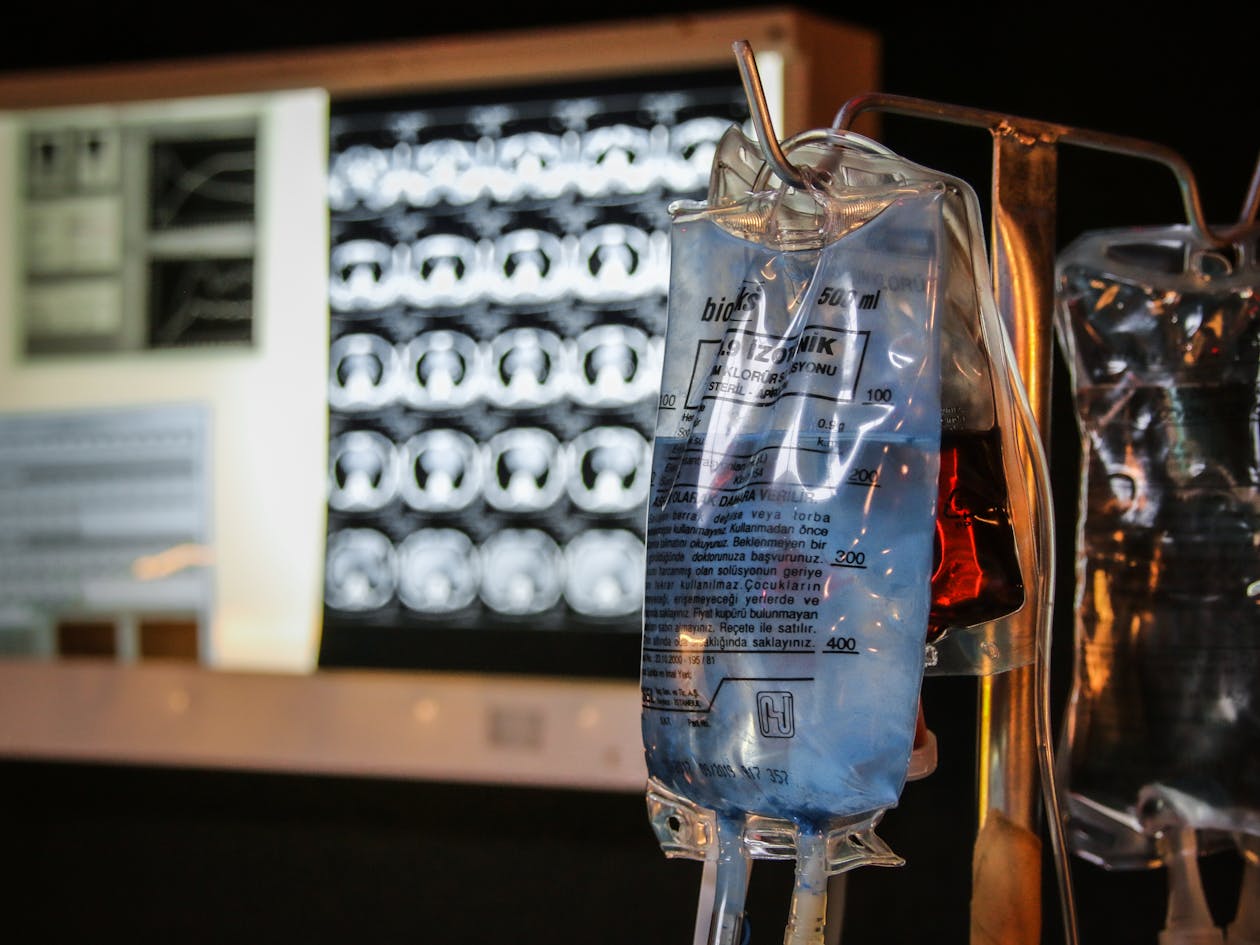
Every day, hospitals connect thousands of patients to clear plastic bags filled with life-saving fluids. Saline drips into veins. Medications flow through tubes. Bodies rehydrate, recover, heal.
But something else might be flowing too. Chinese researchers discovered that medical infusion bags shed thousands of microscopic plastic particles into the fluids they contain. Each bag releases roughly 7,500 particles per liter. Each particle travels directly into the bloodstream. No digestive system to filter them. No lungs to catch them. Just straight access to your circulatory system.
Scientists knew about particles in IV bags back in the 1970s. Yet for five decades, medical researchers paid almost no attention to what those particles were made of or where they ended up inside the human body.
What Scientists Found After Filtering Medical Saline

A research team from the State Key Laboratory of Infectious Disease in China examined two brands of polypropylene IV saline bags. Polypropylene makes up the bags because of its transparency, chemical resistance, and sealing properties.
Scientists emptied 250 mL bags into beakers at the standard hospital infusion rate of 40 to 60 drops per minute. After filtering the liquid through 0.2-micrometer polycarbonate membranes, they analyzed what remained using surface-enhanced Raman spectroscopy and scanning electron microscopy.
Both brands contained polypropylene particles. Lots of them.
Particles ranged from 1 to 62 micrometers in size. About 90% measured between 1 and 20 micrometers. Roughly 60% fell between 1 and 10 micrometers. Shapes varied too: filaments, blocks, and granules broke off the bag surfaces and mixed into the saline.
Brand 1 averaged 7,900 particles per liter. Brand 2 averaged 7,020 particles per liter. Scientists settled on 7,500 as a working average.
Bags shed these particles through degradation. UV light and heat speed up the process. Temperature increases from 23°C to 40°C reduce polypropylene stiffness by 20%. UV radiation triggers photo-oxidation, making plastics brittle. Both conditions cause more particles to break off into the liquid.
How Many Particles Enter Patients During Treatment
A single 250 mL bag delivers about 1,875 particles into a patient’s bloodstream. But medical treatments rarely stop at one bag.
Patients with severe dehydration lose over 7% of their body weight. For someone weighing 65 kg, replacing that fluid requires 4.2 to 5.6 liters. Between 31,500 and 42,000 particles enter their blood.
Hospital patients need 13 to 16 bottles of saline daily to maintain fluid balance. That means 24,375 to 30,000 particles per day.
Abdominal surgery patients receive about 7 liters of fluid on surgery day alone. Up to 52,500 particles flow into their bloodstream in 24 hours.
Women in labor receive around 240 mL per hour during an average 4.1-hour delivery. Around 7,380 particles enter their blood while giving birth.
Emergency shock treatment demands rapid infusion of at least 500 mL in 15 minutes. Patients get 3,750 particles during those critical moments.
Athletes who receive IV hydration for sweat rates exceeding 1.5 liters per hour take in 11,250 particles every hour.
Where Microplastics Land After Entering Your Bloodstream

Particles measuring 1.27 micrometers collect mainly in the liver, with some reaching the spleen and lungs. Particles sized at 15.8 micrometers lodge mostly in the lungs, fewer in the liver, and none in the spleen. Larger particles between 40 and 160 micrometers also deposit in the lungs, with smaller amounts in the liver and kidneys.
Lung capillaries measure 2 to 15 micrometers in diameter. Most IV bag particles fall right in that range. Median particle sizes from the Chinese study were 9.2 micrometers for brand 1 and 7.7 micrometers for brand 2.
Human studies confirm microplastic presence in organs. Researchers examined 11 patients and found microplastics in the livers of six people with end-stage cirrhosis. Particles ranged from 3.0 to 29.5 micrometers with a median of 9.8 micrometers. Healthy patients showed no liver microplastics.
Blood studies reveal more. One analysis detected polyethylene in carotid artery plaque removed from 58.4% of 304 patients. Patients with polymers in their plaque faced a 4.5 times higher risk for fatal events over 34 months of follow-up.
Another study examined 26 blood clots. Sixteen contained particles between 2.1 and 26.0 micrometers. About 69% measured smaller than 10 micrometers.
Human placentas allow polypropylene particles sized 5 to 10 micrometers to pass through. Infused microplastics could reach developing babies.
Physical Damage These Particles Can Cause
Researchers documented a stark case in medical literature. A 26-year-old woman received total parenteral nutrition through IV. She developed a fever up to 38.9°C and shortness of breath. Her oxygen saturation dropped to 88 to 91% in room air.
Doctors performed a lung biopsy. Results showed blood clots in artery branches, blood vessel damage, and granulomas (immune cells wrapped in fibrous tissue). Particulate matter ranging from 0.5 to 650 micrometers caused the problems. After stopping the IV nutrition, she recovered.
Particles trigger biological responses. Inflammation occurs when particles lodge in tissue. Cell death can follow. Granulomas form as the immune system tries to wall off foreign material. Blood clots develop when particles activate coagulation cascades.
Respiratory obstruction happens when particles accumulate in the lung capillaries. Organ dysfunction can occur during cardiac surgery when particles interfere with blood flow. Tissue damage and fibrosis may develop over time.
Studies on critically ill children found that infused particles are associated with serious complications, including organ dysfunction.
Chemical Risks Beyond Physical Blockages

Polypropylene particles don’t stay intact forever. Polymers break down into monomers. Plasticizers and other chemicals added during manufacturing leach out.
Some of these chemicals are toxic. Others trigger localized immune responses. Genotoxicity concerns exist, though evidence remains limited, and scientists need more research to establish clear connections.
Both the United States Pharmacopoeia and European Pharmacopoeia classify particulate matter in intravenous solutions as hazardous contamination. Yet current standards don’t prevent all particles from reaching patients.
Research authors stated: “Our findings highlight an aspect of plastic pollution that affects humans most directly, as MPs are being injected into the bloodstream. This pathway was identified years before the landmark report on the effects of plastic pollution on marine life; yet, it has received much less attention.”
Better Filters Could Stop Particles Before Infusion
Current 0.2 micrometer filters miss particles larger than that threshold. Most IV bag microplastics measure between 1 and 62 micrometers. Filters catch none of them.
Submicrometer filtration systems could work. Adding a filtering step right before fluid enters the body would catch particles before they reach the bloodstream.
Closed-system designs reduce contamination from external sources. Manufacturing with materials resistant to microplastic shedding would cut particle generation at the source.
Quality control needs tightening across the entire medical device and pharmaceutical supply chain. Variations exist between brands, batches, and manufacturing facilities. Polypropylene quality differs. Storage duration matters. Temperature and UV exposure during transport and storage affect degradation rates.
What Medical Professionals Need to Know Now

Scientists conducting the research wrote: “Potentially effective measures include the use of highly efficient micrometer- or submicrometer-level filtration systems during intravenous infusion and enhanced monitoring across the medical device and pharmaceutical supply chain to meet stringent safety standards.”
Healthcare providers can start by recognizing high-risk patient populations. People receiving multiple infusions over days or weeks accumulate more particles. Surgical patients, trauma victims, and chronically ill individuals need consideration.
Treatment planning should account for particle load. When possible, oral rehydration reduces IV exposure. Minimizing unnecessary infusions cuts particle entry.
Watch for respiratory symptoms in patients with heavy IV use. Unexplained shortness of breath, oxygen saturation drops, or lung complications might be linked to particle accumulation.
Document unusual complications. Better reporting helps researchers understand the full scope of microplastic effects.
Research Gaps Scientists Still Need to Fill

Direct toxicology studies on human health remain scarce. Scientists need controlled trials examining long-term accumulation effects. How do particles affect organ function over months or years?
Brand and batch variations require systematic study. Manufacturing differences could mean some products release far more particles than others. Standardized detection methods across studies would allow better comparisons.
Alternative materials deserve investigation. Glass bottles avoid plastic shedding but bring other challenges. New polymers might resist degradation better than polypropylene.
Scientists concluded their paper by noting: “Future research should focus on more direct toxicological studies to comprehensively assess the potential toxicity of MPs and their associated health risks. These findings will provide a scientific basis for formulating appropriate policies and measures to mitigate the potential threats posed by MPs to human health.”
Medical treatments save lives every day. IV fluids remain essential tools. But knowing what enters the bloodstream alongside those fluids matters. Particles that were invisible for 50 years now demand attention, measurement, and solutions.
