
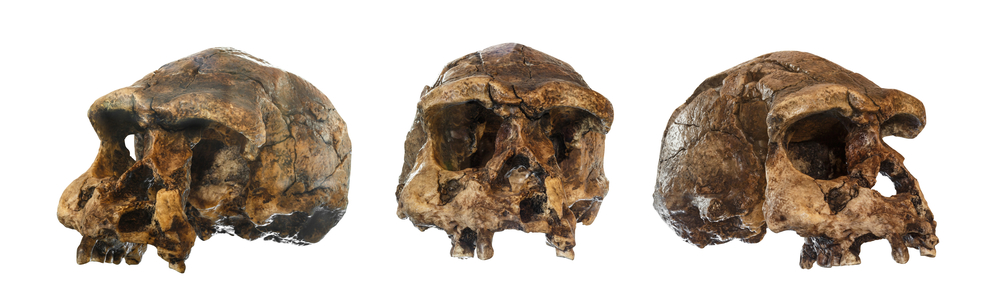
Something sat in storage for 34 years. Scientists thought they knew what it was. A crushed skull from China, badly deformed, classified, and catalogued. Just another Homo erectus fossil, interesting but not groundbreaking.
Except they were wrong. New analysis reveals that the skull might belong to a completely different species. Not just any species, either, but one that could force textbooks to rewrite the entire story of where humans came from and when we first appeared on Earth.
Numbers tell the story. Previous estimates placed the split between modern humans and Neanderthals around 500,000 to 700,000 years ago. New data from this fossil pushes that divergence back to 1.32 million years ago. Our origin story just got twice as old.
Even more radical is the question that scientists are now asking whether humans first evolved in Africa at all.
Crushed Fossil Required Digital Reconstruction to Read Its Secrets
Workers discovered Yunxian 2 on a terrace of the Hanjiang River in Hubei Province, China, in 1990. Badly crushed, fragmented, and displaced, the skull presented enormous interpretation challenges. Age and broad features suggested Homo erectus, a primitive human species thought to contain direct ancestors of modern humans.
Classification made sense at the time. Large brain case, jutting lower jaw, thick brow ridge. Characteristics matched erectus specimens found elsewhere. Scientists filed the fossil away under that label and moved on.
Problems emerged when researchers examined the skull more carefully decades later. Distortion made proper analysis nearly impossible. Small fractures covered the surface. Large fragments had shifted out of position. Matrix material fills cracks and crevices. Nobody could determine the skull’s true shape without removing a million years of compression and damage.
Previous reconstruction attempts used landmark-based realignment and mirroring techniques. Limited by available technology, those efforts produced only rough approximations. Real answers required better tools.
Modern Technology Revealed What Scientists Couldn’t See Before

Researchers applied cutting-edge digital reconstruction methods developed in recent years. High-resolution CT imaging captured the skull’s internal and external structure in minute detail. Advanced surface scanning mapped every contour and feature.
Computer algorithms separated fossil bone from the surrounding matrix digitally. Software identified fracture patterns and displacement vectors. Scientists repositioned fragments virtually, testing different arrangements until pieces fit together properly.
Distortion consisted mainly of fragmentation and displacement rather than plastic deformation. Plastic deformation involves twisting, bending, or flattening when subjected to continuous force. Yunxian 2 had broken and shifted but hadn’t fundamentally warped. Fragments could be returned to their original positions digitally.
Reconstruction revealed anatomical details invisible in the crushed fossil. Brain case shape emerged. Facial structure became clear. Measurements became possible. Scientists could finally see what the skull actually looked like a million years ago.
Reconstructed Skull Shows Mix of Primitive and Advanced Features
Yunxian 2 emerged as large and long, with a broad, flat braincase. Brain capacity measured approximately 1,143 cubic centimeters, similar to other ancient human fossils like Dali, Petralona, and Ceprano.
Primitive traits appeared throughout. Thick supraorbital torus (brow ridge) dominated the face. Broad basicranium and palate stretched wide. Vault profile appeared long and low from the side. The frontal bone receded backward. Parietal bones showed rather flat contours.
Yet several features departed from typical Homo erectus morphology. Skull lacked the strongly angled occipital bone with prominent transverse ridge found in erectus. Missing too was the protruding occipital bun with central depression typical of Neanderthals.
Face projected forward but less than erectus specimens. Nasal bones jutted anteriorly. Cheekbones appeared large and high. The upper face and nasal opening measured wide. Zygomaxillary region (where cheekbone meets upper jaw) faced forward rather than angling sideways, matching Asian fossils like Harbin and Dali more than erectus.
The frontal lobe remained low and narrow, barely more expanded than the erectus specimens. Posterior parts of parietal and occipital lobes showed lateral and posterior expansion similar to Kabwe, Petralona, and Jinniushan fossils.
Mosaic morphology defied simple classification. Skull combined erectus-like primitiveness with derived features seen in later humans.
Why Scientists Think Skull Belongs to Homo Longi Instead

Geometric morphometric analysis compared 533 landmarks and semi-landmarks across 26 complete hominin fossils and 153 recent human specimens. Statistical clustering placed Yunxian 2 in a distinctive position alongside Dali, Jinniushan, and Harbin fossils rather than with erectus specimens.
Overall, brain case shape and tooth structure matched Homo longi characteristics better than erectus. Longi, meaning “dragon man,” describes a species recently proposed to incorporate Asian fossils previously lumped into vague categories like “archaic Homo sapiens.”
Nine derived characteristics (synapomorphies) define the longi clade: larger cranial capacity, lower and longer frontal squama, narrower interorbital breadth, deeper glabellar inflexion, and others. Yunxian 2 displays these features clearly.
Phylogenetic analyses using parsimony methods and Bayesian tip-dating techniques grouped Yunxian 2 with other Asian Middle Pleistocene hominins, including Dali, Jinniushan, Xujiayao, and Hualongdong. All belong to the monophyletic longi clade.
Yunxian represents the oldest member of this group, though not the most basal fossil in the clade. Its age places it near the theoretical origin point of the longi lineage.
Homo Longi Connects to Mysterious Denisovans Who Lived Alongside Humans
Denisova Cave in Russia’s Altai Mountains yielded fragmentary fossils identified through DNA as representing a clade distinct from both Homo sapiens and Neanderthals. Only tiny bone fragments exist. Scientists know Denisovans mainly through genetic material.
Mitochondrial DNA analysis placed Denisovans with Sima de los Huesos fossils from Spain, outside the divergence between modern humans and Neanderthals. Nuclear genome sequences suggested Denisovans were the sister group to Neanderthals. Different inheritance patterns in mitochondrial versus autosomal DNA produced conflicting results.
Phylogenetic analysis based on limited morphological characters scored for Denisovans suggests they most likely belong to the longi clade. Few preserved specimens prevent definitive conclusions, but available evidence points toward longi membership.
Derived features shared between Denisovans and other longi clade fossils include reduced metacone on upper third molar, strengthened Carabelli’s cusp on second molar, reduced second molar width, and increased second molar hypocone size. Denisovan phalanx shows dimensions and shape within modern human range, matching the gracile phalanx without ungual tuberosity expansion found in Jinniushan, another longi clade member.
Dating Pushes Human Evolution Split Back 400,000 Years

Bayesian tip-dating analysis revealed much greater time depths for Homo diversification and sapiens origins than previously estimated. Longi clade origin dates to approximately 1.2 million years ago, slightly older than the Yunxian fossils. The Sapiens clade occurred around 1.02 million years ago, close to Yunxian’s age.
Divergence between the longi and sapiens clades happened roughly 1.32 million years ago. Monophyletic Neanderthal clade, widely considered sister to sapiens, diverged from both longi and sapiens clades around 1.38 million years ago.
Yunxian’s geological age of 940,000 to 1.1 million years places it close to the theoretical origin time of both longi and sapiens clades. Narrow temporal gap between Yunxian and deeper longi nodes suggests rapid early diversification, similar to patterns in sapiens and Neanderthal clades.
Discovery Doubles Accepted Timeline for Modern Human Origins
Professor Chris Stringer, anthropologist and research leader in human evolution at London’s Natural History Museum, assessed the implications. He stated: “This changes a lot of thinking because it suggests that by 1m years ago our ancestors had already split into distinct groups, pointing to a much earlier and more complex human evolutionary split than previously believed. It more or less doubles the time of origin of Homo sapiens.”
Previous evolutionary models compressed human diversification into the last half-million years. New timeline stretches that process across more than a million years. Ancestors had already separated into distinct lineages far earlier than scientists imagined.
Rapid early diversification characterized multiple human clades. Rather than gradual branching over hundreds of thousands of years, lineages split quickly and then developed separately. The pattern suggests population pressures or environmental changes triggered swift divergence.
Yunxian preserves transitional features close to clades’ origins. Its mosaic morphology retains primitive traits from erectus, Kabwe, and Petralona while developing derived features shared with both longi and sapiens. Skull captures a moment near the branching point before the groups fully diverged.
Fossil Could Mean Humans First Emerged Outside Africa

Reclassifying Yunxian as longi rather than erectus carries geographic implications. If the sapiens clade originated around 1.02 million years ago and the Asian longi clade represents the sister group, the common ancestor potentially lived outside Africa.
Stringer noted the possibility that early Homo sapiens lived in western Asia rather than Africa. The geographic distribution of early human fossils shows deeper evolutionary roots in Asia than “Out of Africa” models predicted.
Suggestion remains tentative. More evidence needs examination before overturning decades of African origin consensus. But Yunxian opens that possibility for serious consideration.
Stringer characterized Yunxian’s importance plainly: “This fossil is the closest we’ve got to the ancestor of all those groups.”
Analysis Identifies Just Five Major Human Branches in Last 800,000 Years
Computational analysis of a wider fossil selection simplified the human family tree considerably. Large-brained humans evolved along five major branches: Asian erectus, heidelbergensis, sapiens, Neanderthals, and Homo longi (including Denisovans).
Previous classifications created confusing arrays of species names and categories. Middle Pleistocene fossils from between 1 million and 300,000 years ago generated particular confusion, dubbed the “muddle in the middle” by paleontologists.
Stringer explained the breakthrough: “We feel that this study is a landmark step towards resolving the ‘muddle in the middle’ [the confusing array of human fossils from between 1m and 300,000 years ago] that has preoccupied palaeoanthropologists for decades.”
Five-branch model provides a clearer evolutionary framework. Rather than dozens of poorly defined species and subspecies, human evolution followed several major lineages that can be tracked through the fossil record.
Findings Contradict Some Recent Genetic Studies

New conclusions run counter to analyses based on genetic comparisons of living humans and ancient DNA. Molecular clock estimates produced different divergence timelines. Morphological evidence from skull shapes clashes with genetic evidence from DNA sequences.
Different methods generate conflicting results. Genetic studies examine mutation rates and molecular differences to estimate separation times. Morphological studies analyze physical features and anatomical characteristics. Both approaches have strengths and weaknesses.
Controversy seems inevitable. The scientific community will debate these findings vigorously. Some researchers will defend genetic timelines. Others will favor morphological evidence.
Scientists Want More Fossils and DNA Evidence Before Confirming Theory
Dr. Frido Welker, associate professor in human evolution at the University of Copenhagen, offered a measured response. Not involved in the research, Welker provided an outside perspective: “It’s exciting to have a digital reconstruction of this important cranium available. If confirmed by additional fossils and genetic evidence, the divergence dating would be surprising indeed.”
Additional fossils would strengthen or weaken classification claims. More Homo longi specimens would establish pattern reliability. Discovering similar features in other Asian fossils would support grouping.
Genetic evidence could prove or disprove the morphology hypothesis definitively. Extracting DNA from Yunxian itself would settle debates immediately. Ancient DNA analysis could confirm the relationship to Denisovans and establish a precise phylogenetic position.
Welker suggested molecular data from the specimen would provide insights confirming or disproving the authors’ conclusions. Current classification rests entirely on physical features. DNA evidence would add independent verification.
What Reconstruction Technology Means for Other Fossils
Hundreds of fossil skulls sit in museums worldwide, crushed and distorted by geological forces. Many remain poorly understood because damage prevents accurate analysis. Digital reconstruction methods developed for Yunxian could unlock secrets trapped in those deformed specimens.
Technology transforms paleontology. What scientists couldn’t see 30 years ago becomes visible today. Fossils dismissed as too damaged for study might yield breakthrough discoveries under modern analysis.
Yunxian spent three decades misclassified. How many other specimens await proper identification? Future reconstructions could revise evolutionary trees repeatedly as technology improves and old fossils reveal new information.
Human origin story keeps getting rewritten. Each fossil, each analysis, each technical advancement adds pieces to an enormously complicated puzzle. Yunxian suggests that the puzzle is bigger and more complex than anyone imagined.
