
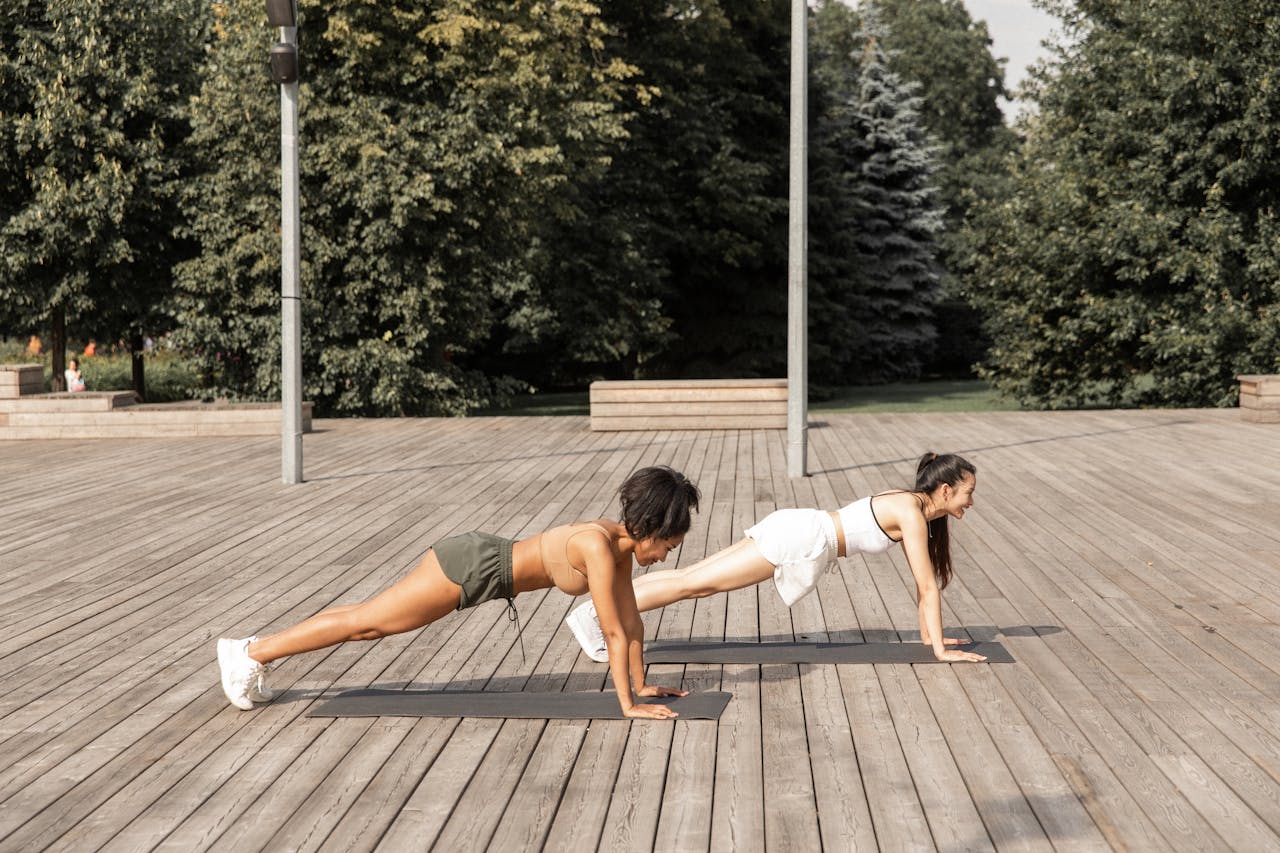
Planks are everywhere in fitness advice. They are simple, require no equipment, and are often promoted as a reliable way to build core strength. A recent viral article shared age based plank time benchmarks, suggesting one to two minutes in your 20s and 30s, with shorter holds recommended as people get older.
At face value, that guidance sounds reasonable. Strength and endurance do tend to change with age. But focusing only on how long someone can hold a plank misses the more important questions. Research shows that plank effectiveness depends far more on muscle activation, breathing, and form than on chasing longer times.

Looking at what the science actually measures gives a clearer picture of how planks work, how long most people benefit from holding them, and how to use them in a way that supports strength and joint health rather than turning them into an endurance contest.
What a Plank Trains (Beyond “Abs”)
A plank is best understood as a full trunk stabilization task rather than an abdominal exercise. Its primary role is to train the body to resist movement at the spine. During a plank, muscles on the front, sides, and back of the trunk contract together to keep the spine in a neutral position against gravity. This coordinated tension is what allows the torso to remain stable while the arms and legs support body weight.
A review of trunk stabilization exercises published in Healthcare shows that plank variations recruit a wide range of trunk muscles at the same time rather than targeting a single area in isolation. The study explains that this simultaneous activation supports the trunk’s role as a stabilizing unit, with muscles working together to limit unwanted movement at the spine while maintaining alignment.

This type of coordinated muscle activity is especially relevant for everyday function. The trunk must remain stable to allow efficient force transfer during tasks such as standing for long periods, lifting objects, or maintaining posture while sitting. By training the body to maintain spinal position under load, planks reinforce the stabilizing role of the core rather than emphasizing visible muscle contraction alone. This is why planks are commonly included in both athletic conditioning and clinical rehabilitation programs that focus on movement control and injury prevention.
Why Holding Longer Isn’t Always Better
Planks are often treated as a test of willpower, but the body does not benefit from holding the position once fatigue alters how the trunk is controlled. As muscles tire, the nervous system becomes less able to maintain precise coordination between the muscles that stabilize the spine. Subtle changes in posture then occur, even if they are not obvious to the person holding the plank. These changes shift the load away from the muscles that are meant to provide stability and toward passive structures such as spinal joints and connective tissue.
From a training and injury prevention perspective, this matters because the goal of a plank is spinal control, not endurance for its own sake. When alignment can no longer be maintained, the exercise no longer reinforces the stabilizing patterns it is intended to train. Instead, it becomes a prolonged static hold with diminishing returns and a higher likelihood of unnecessary strain, particularly in the lower back.

Clinical research on core stability supports this approach. A review on trunk control and low back function published in the Journal of Clinical Medicine emphasizes that endurance based core exercises are most effective when they are performed with consistent alignment and controlled muscle activation rather than maximal time under tension. The authors note that maintaining quality movement patterns is central to reducing mechanical stress on the spine and supporting long term spinal health.
In practical terms, this means that a shorter plank performed with steady posture and controlled breathing can provide a stronger training stimulus than a much longer hold where posture gradually deteriorates. Holding longer is not inherently harmful, but it is only beneficial if control is maintained throughout the entire duration.
What Research Shows About Plank Training Results
Plank research is most useful when it looks at what changes after a structured program rather than a one off maximum hold. In the Selvakumar study, recreational athletes followed a six week plan using either a conventional plank or a body saw plank variation, then were reassessed for core endurance and dynamic stability. Both groups improved on these outcomes after training, and the differences between the two approaches were not statistically significant. That finding matters because it suggests results are driven more by consistent exposure and progressive effort than by picking a single best plank style.

This also supports a practical training principle that applies beyond planks. When a movement is performed regularly with a clear plan, the body adapts in measurable ways that translate to performance markers such as balance and stability. In this context, the body saw plank did not clearly outperform the standard plank, which implies that many people can start with simpler options and still make progress, as long as the training is consistent and appropriately challenging.
The same study also highlights why it is risky to draw sweeping conclusions from a single trial. The participants were recreational athletes, the intervention lasted six weeks, and the outcomes focused on endurance and dynamic stability rather than sport performance or injury rates. So the safest takeaway is narrow but useful. A planned plank routine can improve measurable stability related outcomes in an active population, and variations may not be necessary to see benefits early on.
So How Long Should You Hold a Plank?
Research does not point to a single ideal plank duration. Instead, it supports using time as a tool to reinforce control rather than as a performance goal. The purpose of holding a plank is to maintain a stable trunk under load, and the useful duration is the amount of time that position can be held without loss of alignment or coordination. Once control begins to fade, extending the hold adds little training value.
This is why most evidence based recommendations fall within relatively modest time ranges. These ranges allow the stabilizing muscles of the trunk to work continuously without drifting into compensatory patterns. They also make it easier to repeat sets with consistent quality, which is how adaptations are built over time.

Based on research findings and clinical practice guidelines, commonly used working ranges include:
- Beginners: 20 to 30 seconds per set
- Intermediate: 30 to 60 seconds per set
- Advanced: Around 60 seconds per set with increased difficulty rather than additional time
Age based benchmarks often cited in popular media loosely reflect these same ranges, but age itself is not the deciding factor. What matters is whether the position can be held with steady spinal alignment and controlled muscle engagement. Someone older with good movement control may tolerate longer holds than a younger person whose form breaks down quickly.
In practice, plank duration works best when treated as a ceiling rather than a target to constantly push. Staying within a range that allows repeatable, high quality holds supports the stabilizing function planks are meant to train and aligns with how improvements in strength and control actually occur.
Practical Progression and When to Modify
A structured plank routine works best when progression is deliberate rather than aggressive. The goal is to expose the trunk to repeated bouts of controlled tension that can be maintained across multiple sets. Starting with a manageable volume allows the nervous system and supporting muscles to adapt without encouraging compensatory movement patterns.
A commonly used evidence aligned structure includes:
- Sets and duration: Two to three sets held for 20 to 30 seconds
- Rest periods: About 30 to 60 seconds between sets
- Progression: Increase duration only when alignment and control remain consistent
- Upper limit: Around 60 seconds per set
- Advancement: Add variations or increased difficulty instead of extending time
This approach mirrors how trunk stabilization is trained in both athletic conditioning and rehabilitation settings, where repeatable quality matters more than single maximal efforts.
While planks are generally safe, they are not appropriate for everyone in their standard form. Individuals with active low back pain, recent abdominal or spinal surgery, or shoulder or wrist symptoms that worsen during planks should use caution and seek professional guidance. In these cases, modified planks or alternative stabilization exercises can provide similar benefits with lower joint stress.
The Real Measure of a Good Plank
The strongest takeaway from the research is that planks work when they are treated as a skill, not a test. Their value comes from training the body to maintain control at the spine under load, using steady muscle coordination and consistent positioning. Time alone does not define effectiveness. What matters is whether the position reinforces the stabilizing function the exercise is designed to train.

For most people, holding a plank within a controlled range and repeating it with good form delivers the benefits that research consistently supports. Once a clean hold can be maintained for about 30 to 60 seconds, further progress is better achieved by refining control or adjusting difficulty rather than extending the clock. In that sense, the plank is less about how long you last and more about how well you hold the position.
