
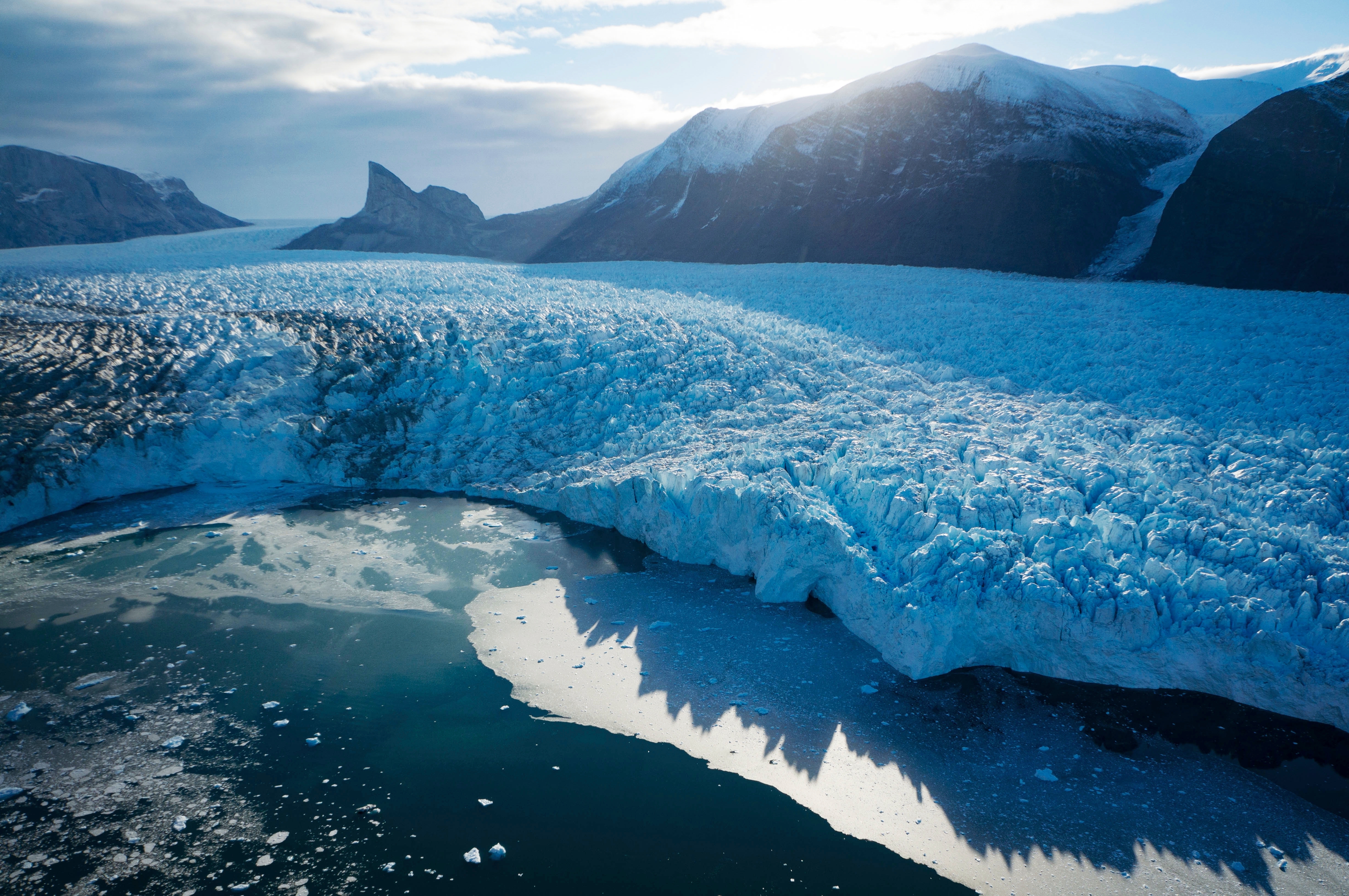
Most people think of Greenland as a barren, frozen expanse that simply exists at the top of the world. Yet this quiet island has suddenly become the focus of intense global attention from politicians and scientists alike.
Beneath kilometers of ice lies a geological archive dating back nearly to the birth of the planet and a vast store of minerals essential for a green future. Understanding what lies under the surface reveals why this remote territory is rapidly becoming one of the most critical locations on Earth.
An Ancient Archive of Earth’s History

On most maps, Greenland looks massive, rivaling the size of Africa. In reality, it is much smaller—roughly the size of the Democratic Republic of Congo. Yet, the island’s value lies not in its physical footprint, but in its age. It acts as a planetary archive, holding rocks that date back nearly 4 billion years.
Geologists often compare the island’s structure to a Cadbury Creme Egg. It features a hard, rocky shell made of craggy mountains and cliffs that encases a massive center of white ice. This distinct composition is the result of three intense geological processes: mountain building, rifting, and volcanic activity.
Millions of years ago, Greenland was wedged tightly between North America and Europe. Around 60 million years ago, a massive rift tore these continents apart to create the North Atlantic Ocean. As the island drifted westward, it traveled over a volcanic hotspot that injected the land with molten lava. Because of this chaotic journey, Greenland preserves a stunning variety of geological records, from native iron to ancient basement rocks, allowing scientists to study the Earth’s infancy through its rugged terrain.
An Ice-Capped Fortune

Greenland sits on what might be one of the richest untapped stockpiles of natural resources on the planet. Deep within its crust—and often buried under miles of ice—lie vast deposits of “rare earth elements” (REEs) like dysprosium and neodymium. These materials are the backbone of the green energy revolution, indispensable for manufacturing electric vehicle motors, wind turbine magnets, and high-tech batteries.
Geologists estimate that the island holds enough of these critical elements to satisfy a quarter of the world’s future demand, potentially totaling nearly 40 million tonnes. For industries desperate to secure supply chains outside of current major producers like China, Greenland represents a massive opportunity.
The potential extends beyond green tech. The US Geological Survey estimates that northeast Greenland contains approximately 31 billion barrels of oil and gas equivalents—a volume comparable to the entire proven crude oil reserves of the United States.
However, knowing the resources are there is different from reaching them. Since less than 20% of the island is ice-free, the vast majority of this wealth remains locked beneath glaciers up to two kilometers thick. Advanced survey techniques, such as ground-penetrating radar, are finally allowing scientists to peer through the ice, but for now, much of Greenland’s fortune remains a frozen promise.
Why the World’s Scientists Are in Greenland

For scientists, Greenland is far more than a frozen expanse; it is the ultimate living laboratory. While the world watches the ice sheet—which would raise global sea levels by an estimated 7.4 meters if it melted entirely—researchers are currently uncovering much more than just climate data.
The island has transformed into a hub for cutting-edge technology and innovation. In 2022, the government deployed the Tarojoq, a $37 million research vessel designed to navigate the treacherous waters near glacial edges. This ship’s agility allows scientists to observe exactly how fresh meltwater interacts with the ocean ecosystem, a critical piece of the climate puzzle that was previously difficult to access.
Innovation is also happening on dry land. In the capital city of Nuuk, researchers are now using the island’s first AI-powered supercomputer to identify and track marine species. Tasks that once took weeks of manual video review are now completed rapidly by algorithms. Whether it is studying the unique genetics of the Inuit population or forecasting fish stocks, Greenland is proving that its value lies as much in its scientific discoveries as in its natural resources.
The High Stakes of Greenland Mining

Finding a mineral deposit is only the first step. Extracting it in Greenland presents a logistical nightmare. The island has almost no established infrastructure outside of its main towns. There are no roads or railways connecting settlements, meaning all heavy equipment and personnel must be moved by air or sea. This reality forces mining companies to build everything from scratch, turning what might be a profitable mine elsewhere into a massive financial gamble.
Processing these resources adds another layer of complexity. Rare earth elements are rarely found in pure form. They are often locked inside rocks mixed with radioactive materials like uranium. This creates a significant environmental and legal hurdle. In 2021, the government passed legislation limiting uranium content in mining projects, effectively freezing the development of a major rare earth mine in Southern Greenland.
History warns us of the risks involved. Past mining operations left behind “waste rock” that was once thought to be harmless but actually leached heavy metals into the surrounding ecosystem. This pollution contaminated local waters, affecting fish and shellfish that communities rely on for food. Because of the Arctic’s low temperatures, environmental recovery is painfully slow. Traces of contamination can still be detected fifty years later.
Locals are acutely aware of these stakes. While not strictly opposed to mining, Greenlanders are demanding a seat at the table. They want to ensure that any new projects are not just extraction sites for foreign powers but collaborative efforts that respect the land and benefit the people who call it home.
Beyond the Ice: 3 Surprising Insights

For those looking to understand the island beyond the headlines, here are three lesser-known details that paint a clearer picture of Greenland’s reality.
The “Ice” That Never Melts: While the island is famous for its glaciers, it is also the home of cryolite, a rare mineral historically known as “the ice that never melts.” It looks remarkably like frozen water but has a high melting point. This mineral was not just a geological curiosity; it was a strategic asset. During World War II, mines in southwest Greenland supplied the Allied forces with cryolite, which was essential for producing the aluminum used in military aircraft.
A “Technicolor” Human Presence: The mental image of Greenland is often a wash of white and grey, but the human footprint is vibrant. The few towns scattered along the coast are famous for their “technicolour” homes—brightly painted structures that stand in defiance of the stark landscape. This architectural style makes the settlements visually distinct and instantly recognizable against the craggy mountains and fjord-cut cliffs.
The Scale of the “Green” Zone: It is easy to dismiss the island’s habitable zone when you hear that over 80% of the land is covered in ice. However, statistics can be misleading. The remaining “ice-free” area is nearly double the size of the United Kingdom. This massive stretch of land is where the biodiversity thrives, where the history is written, and where the potential for future development lies.
Greenland’s Great Dilemma

Greenland sits at the center of a difficult modern dilemma. To build a sustainable future, the world desperately needs the raw materials buried beneath its ice. The lithium and rare earth elements found here are essential for the batteries and wind turbines required to lower global carbon emissions. However, obtaining them requires industrializing one of the few remaining untouched landscapes on Earth.
This creates a sharp conflict. We risk damaging the local environment in our rush to save the global climate. The decision is further complicated by geopolitics. As major powers compete for access to these strategic resources, the island faces immense pressure to open its doors to rapid development.
The path forward requires a delicate balance. It cannot simply be about aggressive extraction. The focus must be on sustainable partnerships that respect the stability of the ice sheet and the sovereignty of the people living there. If the world treats Greenland solely as a warehouse for raw materials, we may solve one crisis only to create another. The future of the green energy transition depends on getting this specific decision right.
